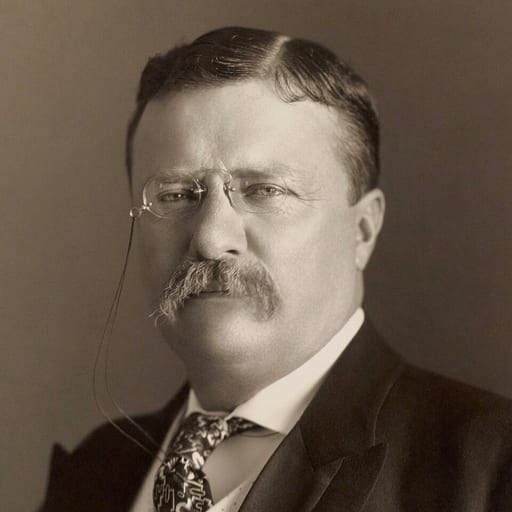
Hall of Masters

Theodore Roosevelt

시어도어 루스벨트

26th US president; author of The Strenuous Life

1,147 records in all

  • Principles 361
  • Episodes 266
  • Quotes 520
Ask with this master's words

3 free questions a day, no sign-up.

Photo: Pach Brothers; restored by Adam Cuerden  Public domain  Original  cropped

Episodes

40 basic records of 266

Episodes are real events from public sources, summarised by us.

  • The Army's Lack of Training

    During the Spanish War, the army suffered because it had not been reorganized or exercised in large bodies. Major-generals were put in command of divisions despite never having led more than three companies together in the field before.

    LessonDo not promote people to large-scale leadership roles if they haven't practiced managing smaller units effectively.
  • Washington's Resignation of Power

    After the Revolution, Washington was the idol of the country and could have easily taken control as a ruler with the army's support. Instead, he chose to resign his commission at Annapolis, prioritizing democratic duty over personal rule.

    LessonA great leader knows when to step back and prioritize the long-term health of the organization over their own authority.

  • Building the Executive Branch

    Washington took a theoretical 'paper constitution' and turned it into a functioning government with revenue, credit, and a judiciary. He transformed a bankrupt confederation into a vigorous national power during his eight years as president.

    LessonExecution is about turning abstract plans into organized, operational systems with tangible assets.

  • The Battle of Trenton

    Despite all his subordinate generals failing to show up or cross the river, Washington proceeded alone with his main force. He crossed the icy Delaware on Christmas Eve and surprised the Hessian garrison at dawn.

    LessonSuccess often depends on the leader's refusal to hesitate even when the supporting infrastructure collapses.

  • The Flanking March to Princeton

    Trapped behind a river by Cornwallis, Washington left his campfires burning to deceive the enemy into thinking he was still there. He then took a secret roundabout road at night to attack the British rear at Princeton.

    LessonDeception and unconventional movement can turn a defensive trap into an offensive opportunity.

  • 1814Risk

    The Defense of General Armstrong

    Captain Reid was anchored in a neutral port when a superior British force appeared. Suspecting they would ignore international law, he immediately prepared his crew with boarding-nettings and loaded guns.

    LessonNever assume a 'safe' environment will protect you from a determined competitor.

  • Restoring the Line

    After inspiring the troops, Sheridan spent hours methodically organizing the divisions and ensuring every officer was in position. He waited until the entire line was restored before launching a counter-attack.

    LessonInspiration gets people to stop running, but organization wins the battle.

  • The Hammering of the Tennessee

    During the Battle of Mobile Bay, the Union fleet faced the ironclad Tennessee, which their shots could not penetrate. Instead of giving up, the monitor Chickasaw stayed within fifty yards and maintained a steady rapping of shots that eventually jarred the frame and disabled the ship.

    LessonConsistency and positioning can defeat a technically superior competitor.

  • The Big Stick Philosophy

    Roosevelt advocated for a national policy of combining quiet diplomacy with the readiness to use force. He argued that boasting without power is contemptible, while power without civility leads to unnecessary trouble.

    LessonA founder should build a superior product or capability while maintaining a humble and professional demeanor in negotiations.

  • The Call for Americanization

    Roosevelt addressed the Knights of Columbus to advocate for the total integration of immigrants into American life. He argued against treating newcomers as mere labor and called for a unified national identity based on shared duties and a high standard of living.

    LessonA leader must ensure that every member of the organization feels a sense of belonging and justice to secure their loyalty and prevent internal friction.

  • 1919Brand

    The Final Message on Americanism

    In his final days, Roosevelt sent a letter to the American Defense Society to define what it meant to be a citizen. He argued against a 'polyglot boarding-house' identity and pushed for a single national loyalty.

    LessonA strong organization requires a clear, unified identity that overrides individual backgrounds.

  • Elizabeth's Strategic Retreat

    Queen Elizabeth faced strong opposition from the people regarding her policy on monopolies. Recognizing the resolve of the influential classes, she immediately yielded to their demands to maintain her rule.

    LessonA leader should be pragmatic enough to abandon a policy when it faces unified opposition from key stakeholders.

  • Spain's Costly Uniformity

    Spain sought complete religious uniformity through the Inquisition, crushing all dissent with torture and murder. While they achieved uniformity, it cost them their greatness and led to national desolation.

    LessonForcing absolute conformity within an organization can destroy the very qualities that make it great and noble.

  • The Industrial Experiment

    Roosevelt observed that the rapid industrial development of the late 19th century had fundamentally changed the social and political fabric of the nation. He recognized that while this brought wealth, it also introduced unprecedented anxiety and complex administrative challenges.

    LessonRapid growth brings new categories of risk that require a different mindset than the one used to build the foundation.

  • The Failure of Visionary Reformers

    Roosevelt observed educated men wasting energy on a scheme to graft the English parliamentary system onto the U.S. Constitution. They ignored the practical impossibility of the task because they lacked experience in how the government actually functioned.

    LessonSolving a problem requires a deep, practical understanding of the existing system before proposing a solution.

  • The Salary Restoration Fight

    A congressman used a technicality to cut a secretary's salary by $400. Senator Lodge fought back in the full Senate by exposing the folly of the provision and showing he was ready for a resolute fight, causing the opposition to collapse.

    LessonShowing a clear intent to fight resolutely can cause an opposition built on weak arguments to collapse immediately.

  • 1896Team

    The McKinley-Hobart Partnership

    In the 1896 election, the Republican party nominated William McKinley and Garret Hobart, who were perfectly aligned on gold-based currency and protective tariffs. This unity provided a stable platform compared to the fractured opposition.

    LessonA leadership team that speaks with one voice on core issues builds stronger confidence in the organization.

  • Closing the Educational Gap

    Roosevelt observed a gap between primary schools and high-level industrial courses that led students away from practical trades. He advocated for the federal government to support states in establishing agricultural and technical high schools to bridge this divide.

    LessonIdentify gaps in your team's skill pipeline and invest in practical training to ensure long-term operational success.

You are seeing 172 basic records. Membership answers from all 1,147 of this master's records.

See membership

More masters in this field

See the whole field

Leaders in history and crisis

These records are our compilation of public statements and sources. We are not affiliated with or endorsed by Theodore Roosevelt or any related company. If something should come down, tell us. Takedown request form