Hall of Masters

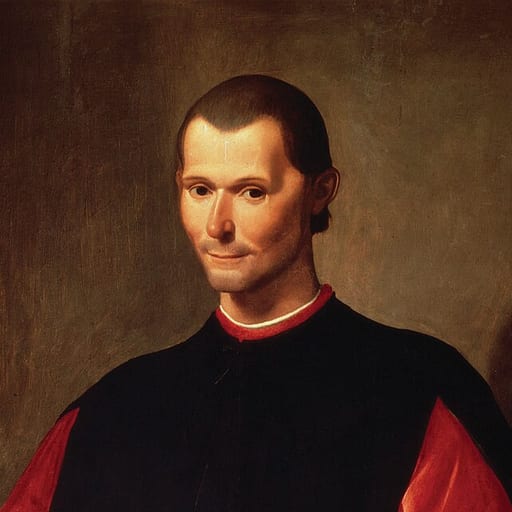
Niccolò Machiavelli

니콜로 마키아벨리

Florentine diplomat, author of The Prince

1,049 records in all

  • Principles 323
  • Episodes 263
  • Quotes 463
Ask with this master's words

3 free questions a day, no sign-up.

Photo: Santi di Tito  Public domain  Original  cropped

Episodes

39 basic records of 263

Episodes are real events from public sources, summarised by us.

  • The Translation of the Discourses

    Ninian Hill Thomson translated Machiavelli's work from Italian to English to preserve the original flavor. He was encouraged by Professor Pasquale Villari to undertake this significant intellectual task.

    LessonHaving a mentor or expert encouragement can be the catalyst for taking on a complex and valuable project.
  • The Limitation of Florence

    Florence was founded under the auspices of Rome, either by soldiers or nearby mountain dwellers. Because it did not start as an independent entity, its early progress was limited by what the sovereign state permitted.

    LessonStarting as a dependent or subsidiary can cap your potential growth based on the interests of the parent organization.

  • The Failure of Solon's Athens

    Solon established a purely democratic government in Athens, but it lacked checks from monarchic or aristocratic elements. As a result, the government was so short-lived that Solon himself saw the rise of a new despotism.

    LessonA system based on a single ideal without balancing forces is fragile and prone to rapid collapse.

  • Savonarola's Influence in Florence

    The people of Florence, who considered themselves sophisticated, were convinced by Friar Savonarola that he spoke with God. He gained their faith through his lifestyle and doctrines without performing any miracles.

    LessonEven sophisticated audiences can be moved by a compelling narrative and a consistent, principled character.

  • The Decline of Roman Meritocracy

    Initially, Romans only sought office if they were worthy, but as the city became secure and powerful, influence and flattery replaced merit. This led to the exclusion of good men from leadership roles as the system failed to adapt to the people's corruption.

    LessonSuccess can breed complacency that destroys the very meritocracy that built the success.

  • The Fall of Appius Claudius

    Appius gained power by pretending to favor the common people but quickly turned arrogant and cruel once in office. He abandoned his popular support to side with the nobles, but he could not satisfy their greed and was eventually overthrown after a public scandal.

    LessonBetraying your primary supporters before securing a new base is a fatal strategic error.

  • The Fall of Piero Soderini

    Piero Soderini gained power in Florence by securing the people's affection. His enemies failed to neutralize him because they didn't adopt his popular methods, eventually resorting to a dangerous conflict that hurt the state.

    LessonThe safest way to beat a competitor is to provide the same benefits they offer before they can monopolize the market's loyalty.

  • The Mistake of Fabius Maximus

    Fabius Maximus advocated for a cautious strategy against Hannibal, but the Roman people found it 'base' and preferred the 'spirited' but reckless Varro. This preference for a bold-looking strategy led to the disastrous defeat at Cannae.

    LessonDo not let the desire to look bold or decisive push you into a high-risk strategy that lacks a solid foundation.

  • The Swiss Victory at Novara

    The Swiss army, lacking guns and cavalry, advanced against a French army fortified with artillery. They routed the French without being stopped by the heavy fire, proving that disciplined infantry can overcome technological advantages.

    LessonA lean, highly disciplined team can often disrupt a competitor who relies too heavily on expensive infrastructure.

  • The Decline of Venice and Florence

    Venice and Florence expanded their territories by acquiring Lombardy and Tuscany, but they became weaker because they spent more on these wars than they gained. They focused on acquiring land without knowing how to properly integrate or strengthen themselves through it.

    LessonUnprofitable expansion drains resources and leaves a company more vulnerable than it was when it was smaller.

  • The Fall of Machiavelli

    After years of building a national militia, the Republic fell and Machiavelli lost his official position. He was later arrested, tortured, and exiled to his farm in poverty.

    LessonEven the most dedicated professional can face sudden career collapse due to shifts in political or market power.

  • The Meeting in the Orchard

    Fabricio Colonna visited Florence and was invited by Cosimo Rucellai to a private garden to discuss military strategy. They sought a shaded place to avoid the heat and engage in deep, uninterrupted learning.

    LessonCreating the right environment for high-level discussion is essential for learning from experts.

  • Roman Legion Selection Process

    Roman Consuls selected their legions by rotating the order of choice among different tribes to ensure an equal distribution of talent. They combined experienced soldiers with new recruits to maintain a high standard of performance across all units.

    LessonA fair and systematic selection process ensures that talent is distributed evenly across different departments or teams.

  • The Artillery Neutralization Strategy

    Machiavelli describes a tactical maneuver where light troops rush the enemy's artillery after the first shot. By engaging in close combat immediately, they prevent the enemy from reloading and firing a second time.

    LessonSpeed and proximity can render a competitor's most expensive and powerful tools completely ineffective.

  • Writing from Experience

    마키아벨리는 외교관으로서 겪은 고난과 위험을 통해 얻은 지식을 바탕으로 군주론을 썼어요. 그는 이 책을 위대한 인물들의 행동에 대한 지식으로 채웠으며, 이를 로렌초 데 메디치에게 헌정했어요.

    LessonReal-world experience and the study of successful predecessors are the most valuable assets for a leader.

  • Ferdinand of Spain's Great Feats

    King Ferdinand undertook grand military campaigns and religious conquests to build his reputation. These actions kept his subjects occupied and increased his esteem, preventing internal rebellion.

    LessonExecuting ambitious projects can build a powerful brand and keep a team focused on collective goals.

  • Posthumous Publication and Global Influence

    Machiavelli's work 'The Prince' was published years after his death and spread rapidly due to the printing press. It influenced a wide range of leaders, from Henry VIII in England to Charles V of the Holy Roman Empire, despite being controversial.

    LessonGreat ideas can achieve massive scale and longevity if they leverage the most effective distribution channels of their time.

  • The Danger of Calumnies

    마키아벨리는 공식적인 고발 시스템은 필요하지만, 증명할 수 없는 은밀한 비방은 조직에 해롭다고 경고했어요. 이러한 비방은 불신을 조장하고 조직 내 파벌 싸움을 일으키기 때문이에요.

    Lesson투명한 피드백 채널을 구축하여 근거 없는 소문이 조직 문화를 해치지 않도록 방지해야 해요.

You are seeing 156 basic records. Membership answers from all 1,049 of this master's records.

See membership

More masters in this field

See the whole field

Strategy and mental models

These records are our compilation of public statements and sources. We are not affiliated with or endorsed by Niccolò Machiavelli or any related company. If something should come down, tell us. Takedown request form