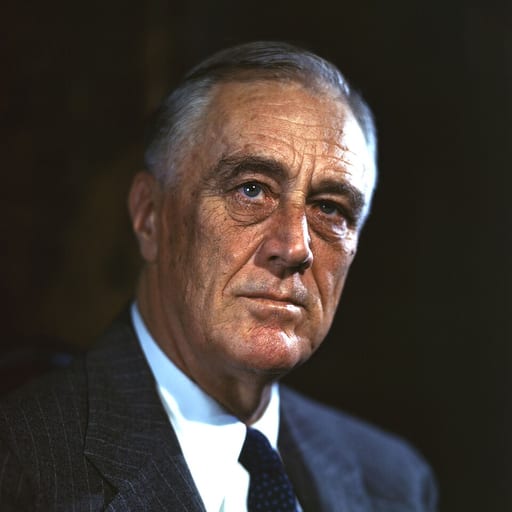
Hall of Masters

Franklin D. Roosevelt

프랭클린 D. 루스벨트

US president who led through the Great Depression and World War II

945 records in all

  • Principles 282
  • Episodes 224
  • Quotes 439
Ask with this master's words

3 free questions a day, no sign-up.

Photo: Leon Perskie  CC BY 2.0  Original  cropped

Episodes

34 basic records of 224

Episodes are real events from public sources, summarised by us.

  • Ending the Business of Relief

    Roosevelt decided to transition away from direct cash relief because it sapped the vitality of the people. He proposed a new plan to put three and a half million employable people to work on useful public projects.

    LessonWhen a strategy harms the long-term spirit of the organization, a leader must be willing to end it and pivot to a more sustainable model.
  • Modernizing Executive Management

    Roosevelt identified that the task of executive management had grown so complex that the existing administrative machinery needed a comprehensive overhauling. He planned to address Congress specifically on modernizing the executive branch to improve efficiency.

    LessonAs an organization grows, the administrative infrastructure must be periodically overhauled to handle new magnitudes of scale.

  • The Budget Balance Challenge

    Critics asked Roosevelt to balance the budget immediately by cutting functions, but could not name specific expenditures to eliminate. Roosevelt insisted on maintaining work relief for the needy while gradually reducing the deficit.

    LessonWhen faced with vague demands for cost-cutting, insist on specific details to avoid damaging essential operations.

  • The 1938 Business Recession

    During a period of economic perplexity, Roosevelt addressed the nation to contrast the current recession with the total despair of 1933. He argued that the fundamental economic conditions were sounder than before despite the temporary setback.

    LessonMaintaining a long-term perspective during a downturn helps prevent panic and allows for a clearer assessment of fundamental strengths.

  • The Shift to Wartime Production

    Roosevelt faced the massive task of converting a peacetime economy into a wartime arsenal. He acknowledged that while some goals were met, others like airplane production lagged due to the need to build new infrastructure first.

    LessonScaling up requires a difficult initial phase of building tools and systems before output can flow steadily.

  • The Lend-Lease Concept

    Recognizing that allies could no longer pay cash for weapons, Roosevelt proposed providing supplies to be repaid in kind later. This allowed the U.S. to support the defense of democracy without immediate financial barriers.

    LessonFlexible payment terms can sustain vital partnerships when a partner faces a temporary cash flow crisis.

  • 1941Risk

    The Pearl Harbor Attack

    Japan launched a surprise attack on an American outpost in the Pacific on a peaceful Sunday morning. This event forced the United States to shift its industrial and military strength toward active war.

    LessonExternal shocks can instantly change a business's entire strategic focus and resource allocation.

  • The Battle of Midway

    The United States secured a vital victory at Midway Island, which was strategically essential for maintaining communication lines across the Pacific. While other actions were defensive, this victory allowed the U.S. to transition from a delaying strategy to an offensive one.

    LessonSecuring key infrastructure and communication lines is the prerequisite for moving from defense to growth.

  • Operation Torch in North Africa

    After months of secret planning, a massive amphibious expedition was launched to French North Africa to relieve pressure on the Russian front. The operation successfully opened a new front and removed the threat of an Axis attack through West Africa.

    LessonStrategic diversion can force a competitor to split their resources, weakening their primary front.

  • The Atlantic Charter Principles

    Roosevelt and Churchill agreed on a set of principles for the post-war world, which faced criticism from isolationists for being too idealistic. Despite the difficulty of applying these rules to every messy situation, Roosevelt insisted they were essential targets for influence.

    LessonFounders should establish core principles early on, even if they cannot be perfectly implemented in every day-to-day crisis.

  • Recalling Military for Production

    Due to an extreme shortage of civilian labor and an urgent need for equipment, the government had to pull soldiers and sailors back from duty to work in war production. This highlighted the massive resource gap between available talent and the scale of the mission.

    LessonWhen facing urgent growth or production needs, you may have to reallocate your most skilled people to foundational operational roles.

  • The Weight of Responsibility

    On the night of his landslide election victory, Roosevelt expressed deep concern to his son about having the strength to handle the presidency. He turned to prayer for guidance and strength to do the job correctly.

    LessonEven the most successful leaders feel the heavy burden of responsibility and seek external strength during major transitions.

  • Mobilizing for Global Conflict

    After the attack on Pearl Harbor, Roosevelt supervised the total mobilization of the American economy for the war effort. He coordinated with Allied leaders to plan for the post-war world and the United Nations.

    LessonLarge-scale success requires coordinating complex resources and building international alliances.

  • Defeat in the Senate Primary

    Roosevelt ran for a U.S. Senate seat in New York but lost the Democratic primary because he lacked President Wilson's support and faced a strong opponent from Tammany Hall. After this defeat, he strategically chose to become allies with the Tammany Hall boss he had previously opposed.

    LessonWhen a powerful gatekeeper blocks your path, it is often wiser to form a strategic alliance than to continue a losing battle.

  • Reluctant Return to Leadership

    Roosevelt was hesitant to run for Governor of New York because he wanted to focus on his recovery and feared a Republican victory. He only agreed after party leaders convinced him that he was the only candidate capable of winning, and he ultimately won by a narrow margin.

    LessonSometimes the best time to take a risk is when others identify you as the only person capable of solving a specific problem.

  • Centralized Decision Making

    Roosevelt maintained control by making all major decisions himself, often bypassing collective agencies like the Cabinet. He managed his team by fostering competition among aides to spark creativity and ensure he remained the final authority.

    LessonWhile delegation is important, maintaining a central role in key decisions ensures the vision remains consistent during rapid growth or crisis.

  • Resolving Agency Deadlocks

    Vice President Wallace and Jesse H. Jones led different agencies that clashed over funding and responsibility for rubber supplies. Roosevelt ended the dispute by dissolving both agencies to stop the internal friction.

    LessonWhen internal politics and overlapping responsibilities hinder progress, a clean break or restructuring is often necessary.

  • Financing the War Effort

    To fund massive government spending, Roosevelt instituted high tax rates and the first federal withholding tax. Despite a doubling of the GDP, the national debt increased significantly to sustain the production of military equipment.

    LessonScaling rapidly requires aggressive and sometimes unpopular financial measures to sustain the necessary infrastructure.

  • Creation of the TVA

    루스벨트 대통령은 대공황 시기 인프라 부족과 빈곤에 시달리던 테네시 계곡 지역을 현대화하기 위해 뉴딜 정책의 일환으로 TVA를 창설했어요. 이 기관은 전력 공급뿐만 아니라 홍수 조절, 비료 제조, 지역 경제 개발을 아우르는 복합적인 역할을 맡았어요.

    LessonA single organization can drive regional economic transformation by integrating multiple infrastructure services under one strategic vision.

  • The Blanket Agreement Launch

    Instead of waiting for individual industry codes to be perfected, Roosevelt sent a blanket agreement to every employer in the country. This move was designed to start the economic recovery immediately rather than waiting six months for complex negotiations.

    LessonSpeed to market with a 'good enough' universal solution often beats waiting for a perfect, customized one.

You are seeing 142 basic records. Membership answers from all 945 of this master's records.

See membership

More masters in this field

See the whole field

Leaders in history and crisis

These records are our compilation of public statements and sources. We are not affiliated with or endorsed by Franklin D. Roosevelt or any related company. If something should come down, tell us. Takedown request form