Hall of Masters

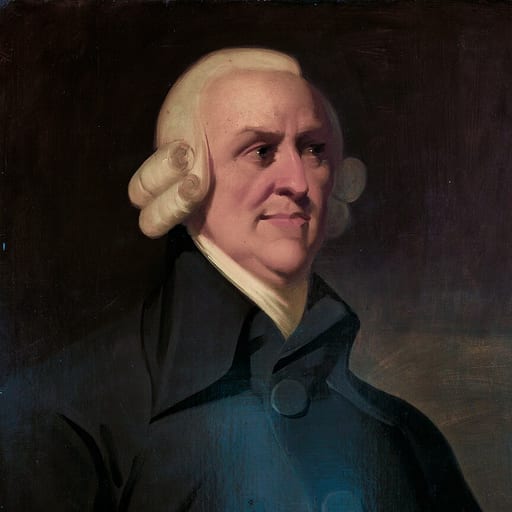
Adam Smith

애덤 스미스

Scottish economist and moral philosopher; The Wealth of Nations

743 records in all

  • Principles 261
  • Episodes 185
  • Quotes 297
Ask with this master's words

3 free questions a day, no sign-up.

Photo: Unknown author  Public domain  Original  cropped

Episodes

28 basic records of 185

Episodes are real events from public sources, summarised by us.

  • Writing to Pass the Time

    While tutoring in Toulouse, Smith found the environment somewhat boring. To occupy his time, he began writing a book that would eventually contribute to his economic theories.

    LessonA period of isolation or boredom can be the perfect catalyst for starting your most important work.

  • The Success of Plain Common Sense

    Joseph Schumpeter noted that Smith avoided overly technical or ingenious methods in his writing. By focusing on common sense and homely observations, he made complex economic ideas accessible and persuasive to a wide audience.

    LessonTo influence a large market, prioritize clarity and common sense over technical complexity.

  • Destruction of Manuscripts

    Shortly before his death, Smith ordered nearly all of his unpublished manuscripts to be destroyed. He had been planning major treatises on law and the arts, but only fragments survived in posthumous publications.

    LessonFocus on completing your most important work while you can, as unfinished projects may never reach the world.

  • Developing a Lecturing Style

    As a professor in Glasgow, Smith delivered lectures without a script, relying on extemporary elocution. Although he started hesitantly, his passion and fluency grew as he illustrated his points, eventually making his subjects fashionable.

    LessonAuthentic enthusiasm and a structured logical approach can overcome a lack of natural grace in presentation.

  • 1649Brand

    The Execution of Charles I

    Despite the suffering of many during the civil wars, the execution of King Charles I caused far greater public indignation. People felt a unique sympathy for the fall of a monarch that they did not feel for common citizens.

    LessonHigh-status individuals or brands evoke much stronger emotional reactions from the public than ordinary ones.

  • The Fall of the King of Macedon

    After being defeated by Paulus Aemilius, the King of Macedon was led in a Roman triumph. Despite having a secure and comfortable life guaranteed by the Romans, he was devastated because he lost the admiration and attention of the public.

    LessonFor those used to high status, the loss of public influence and the 'gaze of the world' is more painful than the loss of physical comfort.

  • The Corruption of International Diplomacy

    Smith observes that in international relations, nations often ignore justice because there is no immediate impartial spectator to hold them accountable. Ambassadors who deceive foreign ministers are often praised by their own citizens for gaining an advantage.

    LessonWithout external objective standards, groups tend to reward unethical behavior that benefits the collective.

  • The Watch Collector's Obsession

    A person owns a watch that loses two minutes a day and despises it. He spends fifty guineas on a new one that is accurate to a minute a fortnight, even though he is no more punctual than before.

    LessonPeople buy high-end products for the perfection of the craft, not necessarily for improved personal performance.

  • 1751Career

    Transition to Professor at Glasgow

    Adam Smith was admitted to the Logic chair at Glasgow College. He later took over the Moral Philosophy class, where his lectures began to influence the economic thinking of the region.

    LessonStarting in a specialized role can provide the platform needed to eventually influence broader strategic directions.

  • Discrimination Against Scotch Students

    스미스를 포함한 스코틀랜드 출신 학생들은 옥스퍼드 밸리올 칼리지에서 부당한 대우와 차별을 받았어요. 한 명의 잘못을 전체의 책임으로 돌리는 분위기 때문에 학생들은 대학 측에 지속적으로 고충을 토로했어요.

    LessonUnfair institutional environments can stifle talent and force individuals to seek alternative support systems.

  • 1751Hiring

    The Dilemma of Hiring a Genius

    Smith wanted to hire his friend David Hume for the Logic chair but worried about public backlash due to Hume's controversial reputation. Ultimately, despite Hume's brilliance, the public's opinion and political influence led to someone else being hired.

    LessonA candidate's brilliance must be weighed against the potential brand risk they pose to the organization.

  • Protecting James Watt from Guilds

    The Glasgow trade guilds tried to stop James Watt from opening a workshop because he hadn't served a local apprenticeship. Adam Smith and his colleagues used the University's independent authority to grant Watt a workshop within their grounds, bypassing the city's restrictive laws.

    LessonWhen rigid regulations stifle talent, use your institutional autonomy to provide a safe space for innovation.

  • Opposing the Glasgow Theatre

    아담 스미스는 글래스고에 첫 상설 극장을 세우려는 상인들의 계획에 반대하는 위원회에 참여했어요. 그는 대학의 특권을 조사하고 시 당국과 협력하여 극장 설립을 막으려 노력했는데, 이는 당시 공연들이 도덕적 안전장치가 부족하다고 판단했기 때문이에요.

    LessonA leader may support a concept in principle but oppose its specific implementation if it lacks necessary safeguards for the public good.

  • Learning from Merchants

    아담 스미스는 그의 저서 국부론을 위한 자료를 수집할 때 Andrew Cochrane과 같은 실무 상인들의 정보에 크게 의존했음을 인정했어요. 이러한 교류는 그가 경제 이론을 정립하는 데 실질적인 토대가 되었어요.

    LessonPractical insights from experienced operators are essential for building sound business theories.

  • Defeating a Hostile Bank Run

    스코틀랜드 은행이 Cochrane의 은행을 파산시키기 위해 대량의 지폐를 한꺼번에 인출하려 시도했어요. Cochrane은 시간을 벌기 위해 소액 동전으로 천천히 지급하는 기발한 전략으로 위기를 넘겼어요.

    LessonCreative tactics can sometimes save a business from aggressive attempts by competitors to force a liquidity crisis.

  • Lobbying for Raw Material Access

    Cochrane은 스코틀랜드 제조업자들의 비용을 낮추기 위해 미국산 철에 대한 수입 관세 철폐를 추진했어요. 그는 이것이 국가 전체의 이익이 되고 수출을 늘릴 것이라고 주장하며 의회에 영향력을 행사했어요.

    LessonReducing the cost of raw materials through policy or negotiation directly increases the competitiveness of the final product.

  • Founding the Edinburgh Review

    Adam Smith and his colleagues started a new literary magazine to promote Scottish intellectual work, which they felt was being ignored by English periodicals. They aimed to incite a pursuit of learning by showing the gradual advance of science in their country.

    LessonIdentify a gap where your community's value is being ignored and create a platform to showcase it.

  • The Challenge of Language Barriers

    스미스는 프랑스 여행을 시작할 때 프랑스어를 거의 하지 못했어요. 이 때문에 파리에 머무는 동안 현지 지식인들과 교류하기보다는 주로 영국인 친구들과 시간을 보냈어요.

    Lesson전문 지식이 뛰어나더라도 언어적 소통 능력이 부족하면 새로운 시장에서의 네트워킹이 제한될 수 있어요.

  • Learning from the French Theater

    Adam Smith was a steady playgoer in Paris and admired how French dramatists followed general rules of genius. He used these theatrical observations to develop his later theories on the philosophy of imitative arts.

    LessonObserving high-quality performance in unrelated fields can provide rich metaphors and insights for your own work.

  • Association with Dr. Quesnay

    Smith attended meetings at Dr. Quesnay's apartments, where he was viewed as a simple and judicious man. Although he didn't agree with all their views, he respected Quesnay so much that he intended to dedicate 'The Wealth of Nations' to him.

    LessonBuild relationships with peers who share your goals, even if you disagree on the specific methods or theories.

You are seeing 112 basic records. Membership answers from all 743 of this master's records.

See membership

More masters in this field

See the whole field

Money and wealth thinking

These records are our compilation of public statements and sources. We are not affiliated with or endorsed by Adam Smith or any related company. If something should come down, tell us. Takedown request form