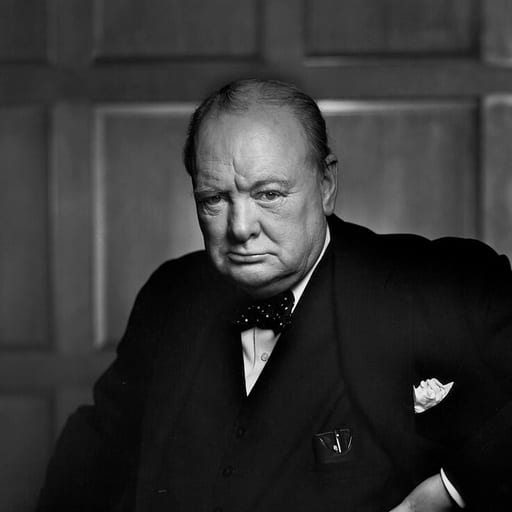
Hall of Masters

Winston Churchill

윈스턴 처칠

British prime minister during World War II; writer and Nobel laureate

1,054 records in all

  • Principles 352
  • Episodes 280
  • Quotes 422
Ask with this master's words

3 free questions a day, no sign-up.

Photo: Yousuf Karsh / Library and Archives Canada  Public domain  Original  cropped

Episodes

42 basic records of 280

Episodes are real events from public sources, summarised by us.

  • The Sand River Crossing

    British forces needed to cross the Sand River while facing Boer positions. General French crossed early to secure a ford, while Ian Hamilton seized a drift at night to forestall the enemy.

    LessonActing quickly to occupy key territory before the competition can arrive is a decisive advantage.
  • The Artillery Order Mistake

    A sergeant-major mistakenly recalled the wrong battery from Broadwood's cavalry during a critical engagement. This forced Broadwood to abandon his advance, but the error ultimately prevented him from being isolated without support.

    LessonOperational errors can sometimes lead to a safer, albeit unplanned, strategic outcome.

  • The Battle of Johannesburg

    During the advance on Johannesburg, two British brigades began to drift apart, creating a dangerous gap. Ian Hamilton turned this mistake into an advantage by thrusting a battery of guns into the interval to weaken the enemy's flank.

    LessonUnexpected operational gaps can be turned into strategic vantage points if a leader acts decisively.

  • The Invasion of Abyssinia

    Despite religious prohibitions and bad omens, the Khalifa decided to invade Abyssinia to secure his borders. Abu Anga led the campaign, carefully navigating mountain passes and winning a decisive battle at Debra Sin through superior weaponry and timing.

    LessonSuccess in high-risk ventures requires a combination of strategic boldness from the top and meticulous execution on the ground.

  • The Nairobi Site Error

    Nairobi was originally chosen as a railway depot because it was convenient for construction, despite being low, swampy, and unhealthy. By the time Churchill visited, better ground was found nearby, but the town was already too established to move.

    LessonConvenience in the short term can lead to permanent structural disadvantages if long-term health and scalability are ignored.

  • 1907Risk

    The Rhinoceros Encounter

    While hunting an oryx, Churchill's party unexpectedly encountered three rhinoceroses. They decided to focus on killing one first to avoid being overwhelmed by multiple charging beasts at once.

    LessonIn high-risk situations, focus all resources on neutralizing one threat at a time rather than splitting your attention.

  • The Push to Embo

    Churchill was supposed to return to camp after seeing Mount Kenya, but the landscape inspired him to push 28 miles further to Embo. He abandoned his supplies and lunch to reach the advanced post before nightfall.

    LessonSometimes a leader must seize the momentum of a vision, even if it means abandoning short-term comforts.

  • The Invisible City of Kampala

    Churchill arrived at Kampala, a city of sixty thousand people that was completely hidden under banana plantations. He realized that the true scale of a place or operation might not be visible from a distance if it is integrated into the environment.

    LessonTrue scale and substance are often hidden beneath the surface or environment.

  • Freeing the James Martin

    A transport boat got stuck on a rock, and the local workers were too afraid of crocodiles to enter the water. The chief, James Kago, took decisive action by physically throwing the men into the river to push the vessel free.

    LessonIn moments of paralysis, a leader must sometimes use forceful intervention to overcome fear and get the operation moving again.

  • The Warning Against Complacency

    Churchill observed the British government and public ignoring Germany's rapid rearmament while enjoying a peaceful summer. He criticized the House of Commons for being unfocused and merely cheering ministers instead of taking defensive action.

    LessonA leader must remain vigilant and sound the alarm even when the majority is lulled into a false sense of security.

  • 1938Risk

    The Warning of the Dark Stairway

    Churchill observed Britain's decline in power over five years as Germany rearmed. He warned that the nation was descending a stairway where the carpet ends and the stones eventually break underfoot.

    LessonIgnoring a growing threat leads to a gradual loss of leverage until you are forced to fight from a position of weakness.

  • Facilitating American Correspondents

    During a week of intense air battles, there were delays in allowing American newspaper correspondents to send their reports. Critics urged the government to trust these first-class journalists with background information to counter German propaganda effectively.

    LessonEmpower your advocates with timely information so they can tell your story accurately and quickly.

  • The Debate on Peace Aims

    During a House of Commons session, members debated the necessity of declaring clear post-war aims to encourage both the British public and people in occupied Europe. They argued that a constructive plan for the future was essential to sustain morale during the long wait for victory.

    LessonA clear vision of the 'after' is a powerful tool for motivating a team through a difficult 'now'.

  • The state of the Home Front

    Churchill argued that for the military to succeed, the Home Front needed to be united through equal sacrifice and fair pay. He believed that avoiding class or political divisions was the only way to survive the war.

    LessonA leader must ensure internal fairness to maintain the collective strength needed for external competition.

You are seeing 158 basic records. Membership answers from all 1,054 of this master's records.

See membership

More masters in this field

See the whole field

Leaders in history and crisis

These records are our compilation of public statements and sources. We are not affiliated with or endorsed by Winston Churchill or any related company. If something should come down, tell us. Takedown request form