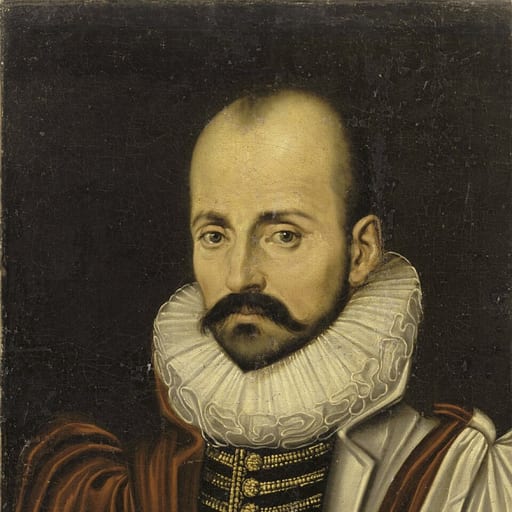
Hall of Masters

Michel de Montaigne

미셸 드 몽테뉴

French writer who invented the essay

1,105 records in all

  • Principles 358
  • Episodes 243
  • Quotes 504
Ask with this master's words

3 free questions a day, no sign-up.

Photo: Unknown author  Public domain  Original  cropped

Episodes

36 basic records of 243

Episodes are real events from public sources, summarised by us.

  • The Hasty Correspondent

    Montaigne preferred to write his own letters quickly, even with messy handwriting and blots, rather than dictating to someone who couldn't keep up with his thoughts. He trained high-ranking recipients to accept his informal, unpolished style.

    LessonDirect and fast communication is often more effective than polished work that loses the author's voice.

  • King Edward's Refusal to Intervene

    During the Battle of Crecy, the Prince of Wales was struggling in the vanguard, and his lords sent for help. King Edward refused to send reinforcements, wanting his son to have the full credit and honor of the victory himself.

    LessonA leader should step back and allow their team to take full ownership of a victory, even when the risk is high.

  • The King's Lack of Privacy

    King Hiero complained that his royalty felt like a prison because he could never travel freely or eat without a crowd of spectators. He envied the simple freedom of private citizens who could enjoy life without being watched.

    LessonScaling a business or personal brand too high can lead to a loss of personal freedom and simple pleasures.

  • Galba's Strategic Sleep

    Galba invited Maecenas to supper and noticed Maecenas and his wife exchanging glances. To facilitate their interaction and avoid a confrontation, Galba pretended to fall into a deep sleep, even rebuking a servant who tried to steal a plate by saying he was only asleep for Maecenas.

    LessonA leader must sometimes choose which conflicts are worth acknowledging and which are better ignored for a larger goal.

  • 1570Hiring

    The underutilization of La Boetie

    Montaigne observed that his friend La Boetie, despite being highly capable, spent his life in minor roles due to a lack of ambition and a dull public age. He felt the public suffered a detriment because such a great talent was not given higher office.

    LessonFailing to match high-capacity talent with high-impact roles is a waste of organizational resources.

  • Gathering intelligence in Bordeaux

    While serving in a leadership capacity in Bordeaux, Montaigne actively monitored city gates and met with people of all political shades to track enemy movements. He reported rumors of naval advances and troop concentrations to the Governor to ensure the town's safety.

    LessonEffective leaders stay informed by listening to diverse sources, even those with opposing viewpoints.

  • The Near Despair of d'Anguien

    At the Battle of Serisolles, Monsieur d'Anguien twice tried to kill himself because his side of the field was losing. By doing so, he almost missed out on the great victory his army eventually achieved.

    LessonJudging the outcome of a complex situation too early can lead to fatal mistakes that rob you of victory.

  • The Secret of Fulvius

    Fulvius accidentally leaked an important secret entrusted to him by Emperor Augustus. Realizing his breach of trust had ruined his standing, he and his wife chose to die rather than live with the disgrace of his loose tongue.

    LessonThe inability to guard sensitive information is a fatal flaw that can destroy a career and personal relationships instantly.

  • Montaigne's Retirement to Writing

    Montaigne retired to his house to live in privacy and let his mind rest. However, his idle mind became like a runaway horse, creating chaotic fantasies, which led him to start writing to bring order to his thoughts.

    LessonUnstructured time can lead to mental chaos; use creative output to discipline your focus.

  • The Advantage of a Poor Memory

    Montaigne struggled with a notoriously bad memory, which led others to question his intelligence and friendship. He realized this defect actually protected him from ambition and forced him to develop his own judgment instead of parroting others.

    LessonPersonal weaknesses can be leveraged to build unique strengths like independent thinking.

  • The Lacedaemonian Stratagem

    During the battle of Plataea, the Lacedaemonian infantry could not break the Persian line. They decided to retire and disperse, tricking the enemy into breaking their own formation to pursue them, which led to a Greek victory.

    LessonSometimes breaking a rigid stance is the only way to force an opponent into a vulnerable position.

  • Evaluating Italian Prosperity

    During his travels, Montaigne was most impressed by the material prosperity and efficient cultivation of the Italian plains. He prioritized observing the well-being of the workers and the economic health of the region over art or religion.

    LessonReal-world evidence of material success and operational efficiency is often more instructive than cultural prestige.

You are seeing 166 basic records. Membership answers from all 1,105 of this master's records.

See membership

More masters in this field

See the whole field

Philosophy and wisdom traditions

These records are our compilation of public statements and sources. We are not affiliated with or endorsed by Michel de Montaigne or any related company. If something should come down, tell us. Takedown request form