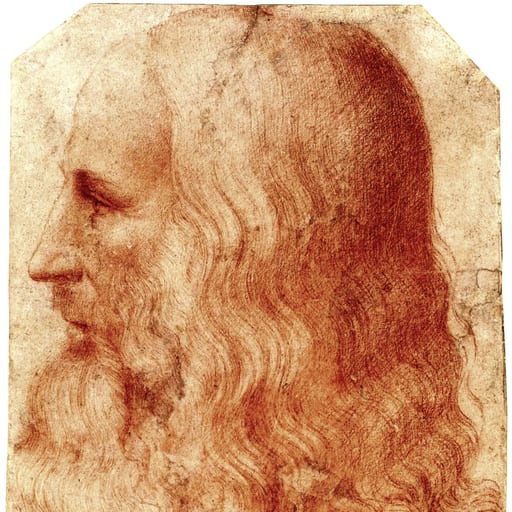
Hall of Masters

Leonardo da Vinci

레오나르도 다 빈치

Renaissance painter, engineer and notebook keeper

873 records in all

  • Principles 297
  • Episodes 206
  • Quotes 370
Ask with this master's words

3 free questions a day, no sign-up.

Photo: Attributed to Francesco Melzi  Public domain  Original  cropped

Episodes

31 basic records of 206

Episodes are real events from public sources, summarised by us.

  • Apprenticeship at Verrocchio's Workshop

    Leonardo joined the workshop of Andrea del Verrocchio around age 14. He spent seven years learning a vast range of skills including drafting, chemistry, metallurgy, and mechanics, which laid the foundation for his polymathic career.

    LessonBroad technical training in a high-standard environment provides the tools for future innovation.
  • The Pitch to Sforza

    Leonardo moved to Milan and wrote a letter to Duke Ludovico Sforza. He focused on his abilities in engineering and weapon design, only briefly mentioning his painting skills to align with the Duke's military interests.

    LessonTailor your pitch to the specific needs and interests of the person you want to work for.

  • 1490Hiring

    Managing a Problematic Assistant

    살라이라는 조수가 레오나르도의 가문에 들어왔으나, 불과 1년 만에 도둑질과 거짓말 등 여러 비행을 저질렀어요. 그럼에도 불구하고 레오나르도는 그를 매우 관대하게 대하며 30년 동안 곁에 두었어요.

    LessonEven the greatest masters sometimes struggle with hiring and may choose loyalty or personal affection over pure professional merit.

  • The Struggle with Deadlines and Completion

    1480년대에 레오나르도는 세 건의 중요한 의뢰를 받았지만, 그중 두 점은 끝내 완성하지 못했어요. 나머지 한 점도 완성하기까지 너무 오랜 시간이 걸려 대금 지급과 완료에 관한 지루한 협상을 거쳐야 했어요.

    LessonHigh-quality innovation often conflicts with strict deadlines, leading to difficult business negotiations over unfinished deliverables.

  • Testing Ancient Designs

    Modern engineers built Leonardo's designs, such as a parachute and a giant crossbow, for a documentary. While some designs worked successfully, others did not perform as well when subjected to real-world testing.

    LessonEven the most brilliant conceptual designs must be tested against reality to prove their actual viability.

  • The Milan Canal Project

    A canal project between Martesana and Milan had been stalled since 1457 due to extreme geographical difficulties. Leonardo took over the role of engineer, leveling hills and filling valleys to complete the 200-mile waterway.

    LessonA founder's unique vision and technical courage can revive valuable projects that others abandoned as impossible.

  • The Unfinished Legacy of Manuscripts

    Leonardo collected a vast amount of intelligence on motion, water, and anatomy but never arranged them into a final form. He postponed the task of digesting this 'immense chaos' for so long that he passed away before it could be published.

    LessonGreat ideas lose their value if they are not organized and brought to the world during your lifetime.

  • Analyzing the Mechanics of Power

    Leonardo analyzed why one figure could throw a weapon farther than another by studying body mechanics. He concluded that twisting the body in the opposite direction before a strike creates the necessary impulse for a powerful motion.

    LessonSuccess in execution often depends on the intensity and correctness of the preparatory phase.

  • The Wall Observation Method

    Leonardo developed a technique for generating new ideas by staring at stained walls and veined marble. He found that these random patterns helped his mind invent landscapes, battles, and strange faces.

    LessonWhen stuck, look at abstract or chaotic environments to trigger lateral thinking and new compositions.

  • The Snow Observation

    Leonardo observed how falling snow changes appearance based on its background. He noticed it looks darker against the sky but brilliant white against a dark window frame.

    LessonThe value of a feature is determined by its environment, not just its inherent qualities.

  • Defining the Mathematical Point

    Leonardo debated the nature of points and lines, distinguishing between a mathematical point which has no size and a natural point which is continuous. He used these definitions to build a logical framework for his painting techniques.

    LessonDefining your basic units and terms clearly is the first step to solving complex problems.

  • The Sforza Statue Competition

    Ludovico il Moro announced a competition for an equestrian statue of his father. Leonardo likely competed against other artists like Pollajuolo, eventually winning the commission after reminding the Duke of the project.

    LessonWinning a contract often requires both creative excellence and proactive follow-up with the client.

  • The Large Scale Casting Strategy

    Leonardo planned for massive projects by breaking them down into manageable units. He advised that for a hundred thousand pound cast, one should use multiple furnaces limited to 2000 or 3000 pounds each.

    LessonBreak down massive operations into smaller, controlled units to ensure reliability and prevent total failure.

  • The Lifting of the Battistero

    Leonardo proposed a bold plan to lift the entire church of San Giovanni in Florence to add a new basement. He used persuasive reasoning and mechanical designs for jacks and wheels to convince the city's governors that the impossible task was feasible.

    LessonA visionary leader can make the impossible seem achievable by breaking it down into logical, mechanical steps.

  • Managing a Difficult Pupil

    In 1490, a ten-year-old boy named Jacomo joined Leonardo's studio but proved to be thievish and dishonest. Despite the boy stealing money and lying, Leonardo continued to provide for his basic needs and meticulously recorded every expense.

    LessonEven when dealing with difficult subordinates, maintaining clear records and fulfilling basic responsibilities is essential for professional conduct.

You are seeing 132 basic records. Membership answers from all 873 of this master's records.

See membership

More masters in this field

See the whole field

Craft, arts and performance

These records are our compilation of public statements and sources. We are not affiliated with or endorsed by Leonardo da Vinci or any related company. If something should come down, tell us. Takedown request form