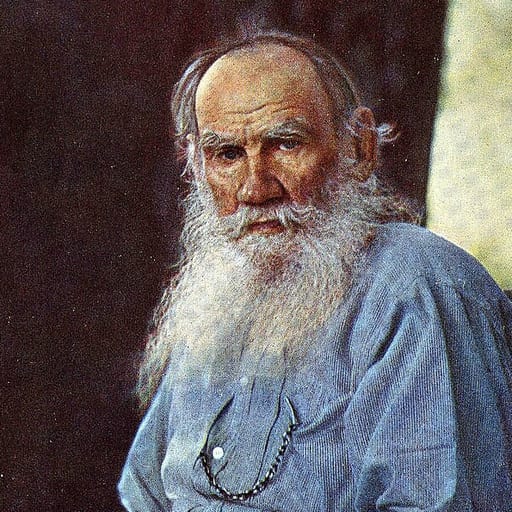
Hall of Masters

Leo Tolstoy

레프 톨스토이

Russian novelist and moral thinker; author of War and Peace

880 records in all

  • Principles 311
  • Episodes 268
  • Quotes 301
Ask with this master's words

3 free questions a day, no sign-up.

Photo: Sergei Prokudin-Gorskii  Public domain  Original  cropped

Episodes

40 basic records of 268

Episodes are real events from public sources, summarised by us.

  • The Missed Mazurka

    Ivan Vasilievich loses the chance to dance the important mazurka with his beloved because he leaves the ball to get a pair of gloves. An engineer named Anisimov asks her first while Ivan is away at the hairdresser's.

    LessonBeing present and prepared is more important than minor aesthetic details when a key opportunity arises.
  • The Prince's Financial Settlement

    Prince Michael Ivanovich discovered his estranged daughter living in poverty with a child. Despite his anger and wounded pride, he traveled to her town to arrange a financial settlement so she could be independent of others.

    LessonEven in moments of personal failure or conflict, ensure that basic responsibilities are met to prevent further disaster.

  • Michael's Reconciliation with Lisa

    Michael Ivanovich tracked down his estranged daughter Lisa, who was living in poverty after having a child out of wedlock. Initially filled with rage and concern for his reputation, he was overcome with pity upon seeing her frail condition and begged for her forgiveness.

    LessonTrue leadership and resolution come from recognizing one's own guilt and showing mercy rather than enforcing rigid judgment.

  • The Forgotten Auction Letter

    Volgin was enjoying his stay so much that he forgot to write a crucial letter for an art auction. He had to rush to write it and a check for 180 roubles while the carriage and staff waited outside.

    LessonDistractions in a comfortable environment can lead to costly oversights in professional responsibilities.

  • The Publication of Beliefs

    톨스토이는 자신의 진실한 신념을 담은 '나의 신앙은 어디에 있는가'라는 책을 썼어요. 그는 이 책에서 교회의 교리가 그리스도의 가르침, 특히 악에 대한 비폭력 저항이라는 핵심 원칙을 어떻게 왜곡하고 있는지 지적했어요.

    LessonEven established institutions can lose sight of their founding principles, requiring a return to core values.

  • The Invention of Aesthetics

    Tolstoy observed that the wealthy classes of the 18th century invented the science of aesthetics to justify their preference for art that provided pleasure. They misinterpreted ancient Greek concepts to claim that beauty and goodness were identical, creating a theory that suited their lifestyle.

    LessonBe wary of frameworks that are created solely to justify existing comforts rather than seeking objective truth.

  • The King's Three Questions

    Tolstoy wrote a story about a king who sought to avoid failure by finding the right time, the right people, and the most important task. He concluded that the answer is always to focus on the present moment and the person currently in front of him.

    LessonSuccess comes from being fully present and serving the immediate needs of your current stakeholders.

  • The shift to manual labor

    After achieving massive literary success, Tolstoy decided to retire to the country. He adopted a life of frugality and manual labor, personally cultivating his estates based on his interpretation of simple living.

    LessonA founder may find renewed purpose and clarity by returning to hands-on, fundamental work after reaching a peak in their career.

  • 1844Career

    Dropping Out of Formal Education

    Tolstoy began studying law and oriental languages at Kazan University but was described by teachers as unable and unwilling to learn. He left the university in the middle of his studies to return to his family estate and pursue his own interests.

    LessonTraditional education systems may not suit every high-performer; sometimes leaving is necessary to find one's true path.

  • Early Autobiographical Success

    톨스토이는 지주 아들의 성장 과정을 다룬 자전적 소설들을 썼어요. 나중에 그는 이 작품들을 감상적이라며 거부했지만, 이 글들은 그의 실제 삶을 많이 드러내 주었어요.

    Lesson자신의 과거와 성장을 솔직하게 기록하는 것은 보편적인 공감을 얻는 콘텐츠의 기초가 돼요.

  • 1906Risk

    Risking for Forbidden Ideas

    Despite his personal rejection of violence, Tolstoy took risks to help circulate prohibited anarchist literature in Russia. He even corrected the proofs for Kropotkin's 'Words of a Rebel' which was published illegally.

    LessonSupporting intellectual freedom often requires taking personal risks to ensure diverse perspectives are heard.

  • Negotiating with Stalin

    Dissatisfied with government funding for Tolstoy's centennial, Alexandra met with Stalin in June 1928. While Stalin refused the direct cash request, an agreement was reached with the State Publishing House to produce a 92-volume collection.

    LessonWhen a direct request for capital is denied, look for alternative resource-based agreements to achieve the goal.

  • The Promise of Alexander

    Tolstoy met a young worker named Alexander and persuaded him to give up drinking by sharing a success story of a mutual acquaintance. Despite Tolstoy's initial doubt when the lad didn't show up at noon, Alexander arrived in the evening, exhausted from work, just to collect the educational booklets he was promised.

    LessonTrue commitment is shown through action and effort, even when it is inconvenient after a long day of labor.

  • Spiritual Crisis and Illness

    1908년 7월, 톨스토이는 아내와의 갈등으로 심각한 영적 위기를 겪었고 이는 곧 육체적인 병으로 이어졌어요. 그는 죽음의 문턱까지 갔음에도 불구하고 자신의 신념과 현실 사이의 모순 때문에 괴로워했어요.

    Lesson리더의 내면적 갈등은 건강에 직접적인 영향을 미칠 수 있으므로, 신념과 행동의 일치를 찾는 것이 중요해요.

  • The Hell of Domestic Contradiction

    톨스토이는 자신의 부유한 지주 생활이 주변의 가난과 대비되는 것에 괴로워하며 숲속 오두막으로 떠나길 갈망했어요. 하지만 가족을 고통스럽게 할 수 없다는 약함 때문에 떠나지 못하고 이를 자신의 죄라고 여겼어요.

    Lesson리더는 자신의 가치관과 현실의 괴리에서 오는 고통을 성장을 위한 훈련으로 승화시켜야 해요.

  • The Formal Will

    Fearing his family would monopolize his works after his death, Tolstoy consulted experts and created a formal will. He left his posthumous works to a trusted friend and his daughter to ensure they became public property and that profits would help peasants buy back land.

    LessonFormal legal structures are often the only way to protect a mission from being compromised by successors.

  • Strength Growing with Difficulty

    As Tolstoy's life became increasingly difficult due to family tensions and public criticism, he noted a paradoxical increase in his strength to endure. He found more joy in the consciousness of this growing inner strength than pain from the burdens themselves.

    LessonResilience is a muscle that develops in direct proportion to the weight of the challenges one faces.

  • Commitment to Conscience

    톨스토이는 미래에 어떤 일이 일어날지 예측할 수 없는 상황에서도 오직 양심과 신 앞에 떳떳하게 행동하겠다는 원칙을 세웠어요. 그는 결과에 연연하지 않고 매일매일 자신에게 주어진 고통을 견디며 나아가고자 노력했어요.

    Lesson불확실한 미래에 대처하는 가장 확실한 방법은 현재의 원칙과 양심에 충실한 것이에요.

  • The Breaking Point of a Relationship

    톨스토이는 아내 소피아가 그의 원칙에 반하여 둘째 딸에게 유모를 고용했을 때 부부 관계가 악화되기 시작했다고 느꼈어요. 그는 유모가 자신의 아이를 두고 남의 아이를 돌봐야 하는 상황을 정의롭지 못하다고 생각했어요.

    LessonCore values and principles can create deep friction in long-term partnerships if they are not aligned.

  • Sacrificing Independence for Peace

    톨스토이는 창작 활동을 위해 여행을 떠나거나 다양한 사람들을 집으로 초대하고 싶어 했지만, 아내의 요구로 인해 집에 머물러야 했어요. 그는 가정의 평화를 유지하기 위해 자신의 개인적인 욕구와 자유를 억제하며 살았어요.

    LessonSometimes maintaining a functional environment requires the conscious sacrifice of personal preferences.

You are seeing 132 basic records. Membership answers from all 880 of this master's records.

See membership

More masters in this field

See the whole field

Philosophy and wisdom traditions

These records are our compilation of public statements and sources. We are not affiliated with or endorsed by Leo Tolstoy or any related company. If something should come down, tell us. Takedown request form