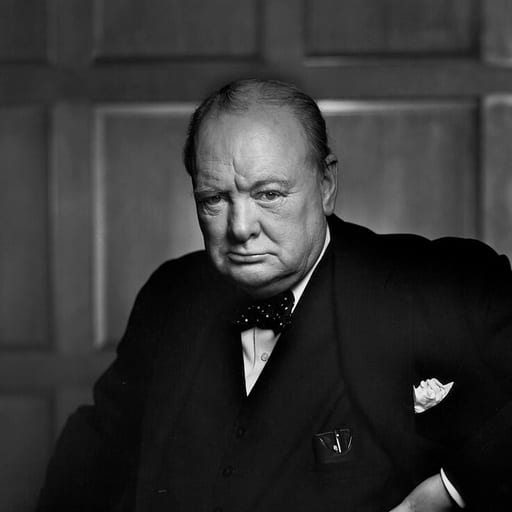
Winston Churchill
윈스턴 처칠
British prime minister during World War II; writer and Nobel laureate
1,054 records in all
- Principles 352
- Episodes 280
- Quotes 422
3 free questions a day, no sign-up.
Photo: Yousuf Karsh / Library and Archives Canada Public domain Original cropped
Quotes
63 basic records of 422
Quotes are word for word from the source.
Accepting reality
I abandoned the idea of flight and fell asleep.
Our noteAfter realizing the sentries were too vigilant, Churchill decided to rest instead of attempting a hopeless escape.
Impact of misinformation
A month's feeding on such literary garbage weakens the constitution of the mind.
Our noteChurchill describes how constant exposure to enemy propaganda and lies demoralized the prisoners.
Moral strength and proximity
The moral strength of an army which welcomes the closest personal encounter must exceed that of an army which depends for its victories only on being able to kill its foes at a distance.
Our noteHe discusses why the willingness to engage in close combat provides a psychological advantage.
Deliberate execution
There was to be absolutely no hurry of any kind whatever. Let the enemy entrench and fortify. If necessary, we were prepared to sap up to his positions. Let him discover where the attack impended. Even then all his resistance should be overborne.
Our noteDescribing the British army's strategy of extreme deliberation over speed.
Merit over seniority
We have put what we think is the best fighting man in command regardless of seniority. We shall support him as he may request. We can do no more.
Our noteGeneral Warren explaining why he promoted Thorneycroft during the battle.
Focus on future
Of this I am quite sure, that if we open a quarrel between the past and the present, we shall find that we have lost the future.
Our noteChurchill was discouraging Parliament from wasting time blaming past leaders for military failures during the crisis.
Preserving core assets
This decision was painful, but it was also right, because the fortunes of the battle in France could not have been decisively affected even if we had thrown in our entire fighter force.
Our noteChurchill justifies the decision to hold back air reserves during the fall of France.
Persistence through uncertainty
During that war we repeatedly asked ourselves the question: 'How are we going to win?' And no one was able ever to answer it with much precision, until at the end, quite suddenly, quite unexpectedly, our terrible foe collapsed before us
Our noteReflecting on the unpredictable nature of victory in World War I.
Adapting to errors
Explanations arrived too late to make it worth while to revert to the original plan, and, perhaps, seeing that French was unable to make Ventersburg siding, it was just as well that Broadwood did not try alone.
Our noteChurchill notes how a communication error led to a change in plans that might have been a blessing in disguise.
Work Equals Results
I planted those myself when I came: they grow quickly, don't they? Only a question of water, and that is only a question of work.
Our noteThe settler showed Churchill the trees he grew by working to secure a water supply.
Stoic patience
The only thing to do is to wait patiently till the next disaster.
Our noteThe author describes the grim mindset required to survive repeated bad news in captivity.
Fragile foundations
Never was there such a house of cards as the Egyptian dominion in the Soudan. The marvel is that it stood so long, not that it fell so soon.
Our noteChurchill analyzes why a corrupt and poorly defended organization eventually collapses.
Boldness in crisis
the Mahdi and Abdullah, with that courage which in several great emergencies drew them to the boldest courses, determined to put a brave face on the matter and blockade Khartoum itself.
Our noteThe Sudanese leaders decided on a high-risk strategy when they saw the British hesitation.
Momentum and risk
The Mahdi depended on success for existence. The tremendous forces of fanaticism are exerted only in a forward direction. Retreat meant ruin.
Our noteExplaining why the Mahdi chose a desperate assault on Khartoum.
Character and genius
he was a man of stainless honour and enduring courage, who in varied capacities displayed a fertile and abundant genius.
Our noteChurchill's final assessment of General Gordon's character and leadership.
Planning and execution
The whole operation was well and carefully planned, and its success in execution was complete.
Our noteChurchill reflects on the successful military operation at Firket.
Respecting the competition
Now, as on other occasions throughout the war, the Dervishes by their military behaviour excited the admiration of their enemies.
Our noteChurchill acknowledges the bravery and discipline of the opposing forces despite being enemies.
Decisive timing
The Sirdar had a few days in which to make up his mind whether he would keep his gunboats on the upper or lower reach.
Our noteChurchill describes Kitchener's decision regarding the placement of gunboats as the Nile river level fell.
Risk and relief
The Sirdar, delighted that no evil consequences had followed his daring move, and finding that he was neither attacked nor harassed in any way, journeyed to Kassala
Our noteChurchill notes the relief felt after a risky military advance proved successful without immediate retaliation.
Inevitable conclusion
Next week only twenty miles will intervene, and then the creep of the serpent will cease, and, without argument or parley, one way or the other the end will come.
Our noteChurchill reflects on the approaching final confrontation that requires no further words.
Unyielding commitment
We shall go on to the end. We shall fight in France, we shall fight on the seas and oceans, we shall fight with growing confidence and growing strength in the air, we shall defend our island, whatever the cost may be.
Our noteHe declares the absolute resolve to continue the struggle across all domains regardless of the cost.
Pioneering new markets
It is the Indian trader who, penetrating and maintaining himself in all sorts of places to which no white man would go or in which no white man could earn a living, has more than any one else developed the early beginnings of trade
Our noteHe acknowledges the role of Indian entrepreneurs in developing trade in difficult environments.
Avoid extreme reactions
These second thoughts err, no doubt, as much on the side of extravagant depression as the first impression was over-sanguine.
Our noteChurchill reflects on the emotional swings between initial optimism and later disappointment in new ventures.
Technology over labor
Iron roads, not jogging porters; tireless engines, not weary men; cheap power, not cheap labour; steam and skill, not sweat and fumbling: there lies the only way to tame the jungle
Our noteChurchill argues for using machinery instead of manual labor to achieve industrial efficiency.
Cultural Progress
It is not easy to convey the air of honest fun and good humour which pervaded these curious performances, or to measure the intellectual progress which the attitude of the Baganda towards them implied.
Our noteChurchill reflects on the sophisticated humor and evolving mindset of the local people during a traditional performance.
Inclusive hiring
There must be room in our army system for nearly everyone who is not grossly idle or grossly stupid.
Our noteChurchill argues for finding suitable roles for various types of officers.
Embracing opposition
I have always felt that a politician is to be judged by the animosities which he excites among his opponents. I have always set myself not merely to relish but to deserve thoroughly their censure.
Our noteHe was speaking at a dinner about how to measure a leader's impact.
Purpose of life
What is the use of living, if it be not to strive for noble causes and to make this muddled world a better place for those who will live in it after we are gone?
Our noteHe was expressing his faith in human progress and the duty to improve the world.
Systems as means
the fiscal system of a country and the system of Government which prevails in a country are only means to an end, and that end must be to create conditions favourable to the social and moral welfare of the masses of the citizens.
Our noteDefining the ultimate goal of government and economic policy.
Constructive action
We have left the wilderness of phrases and formulas, the cut and dried party issues, and we have broken violently into a world of constructive action.
Our noteDescribing the shift from political rhetoric to social organization.
You are seeing 158 basic records. Membership answers from all 1,054 of this master's records.
See membershipMore masters in this field
See the whole fieldLeaders in history and crisis
These records are our compilation of public statements and sources. We are not affiliated with or endorsed by Winston Churchill or any related company. If something should come down, tell us. Takedown request form