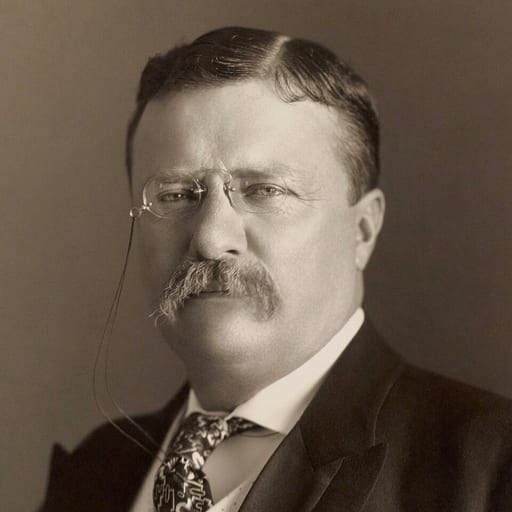
Theodore Roosevelt
시어도어 루스벨트
26th US president; author of The Strenuous Life
1,147 records in all
- Principles 361
- Episodes 266
- Quotes 520
3 free questions a day, no sign-up.
Photo: Pach Brothers; restored by Adam Cuerden Public domain Original cropped
Quotes
78 basic records of 520
Quotes are word for word from the source.
Inefficient Strategy
What was actually done, however, combined cruelty with ultimate inefficiency; it caused great immediate suffering, while perpetuating exactly the conditions against which it was supposed to provide.
Our noteRoosevelt criticizes Cromwell's Irish policy for being both cruel and strategically counterproductive.
Single Identity Focus
We have no room for any people who do not act and vote simply as Americans, and as nothing else.
Our noteRoosevelt discusses the necessity of immigrants fully adopting American identity for national cohesion.
Total Commitment
if he wishes ever to amount to anything he must throw himself heart and soul, and without reservation, into the new life to which he has come.
Our noteHe explains that success in a new environment requires complete immersion and letting go of the past.
Managing expectations
He must not be frightened by the many unpleasant features of the contest, and he must not expect to have it all his own way, or to accomplish too much.
Our noteAdvice for those entering the messy reality of public life or business competition.
Limits of books
No man ever really learned from books how to manage a governmental system.
Our noteRoosevelt argues that management and leadership are practical arts learned through doing.
Focus on duty
No man can do good service in the Legislature as long as he is worrying over the effect of his actions upon his own future.
Our noteRoosevelt discusses the mindset required for public servants to act with integrity despite political risks.
Managing difficult stakeholders
A gentleman interested in a proposed law to protect primaries took to telegraphing daily questions as to its progress--a habit of which I broke him by sending in response telegrams of several hundred words each
Our noteRoosevelt describes how he handled a persistent and annoying correspondent by making the interaction costly.
Knowledge breeds support
The men of intelligence and ability who once familiarize themselves with the workings of the system, as they are bound to do if they are on the committee, are sure to become its supporters.
Our noteRoosevelt notes that understanding the inner workings of a good system naturally leads to supporting it.
Official Authority
A man of the character of Mr. Hobart is sure to make his weight felt in an administration, but the power of thus exercising influence should be made official rather than personal.
Our noteRoosevelt discusses the importance of formalizing the Vice-President's role in the administration.
Shared Purpose
The two represent the same forces, and they stand for a party with a coherent organization and a definite purpose, to the carrying out of which they are equally pledged.
Our noteRoosevelt describes the ideal partnership between McKinley and Hobart.
Environment for excellence
the best work has always been produced by men who lived in castes or social circles where the standard of essential comfort was high; that is, where men were well clothed, well fed, well housed
Our noteRoosevelt discusses how a baseline of comfort and resources enables high-quality creative and intellectual work.
Leveling the field
We insist that the race shall be run on fairer terms than before because we remove all handicaps.
Our noteHe explains that removing unfair advantages makes the final victory a true test of merit.
Essential Worker Attributes
The worker must possess not only resolution, firmness of purpose, broad charity, and great-hearted sympathy, but he must also possess common-sense sanity, and a wholesome aversion alike to the merely sentimental and the merely spectacular.
Our noteRoosevelt describes the necessary traits for effective social and philanthropic work.
Mutual Uplift
The best way to raise any one is to join with him in an effort whereby both you and he are raised by each helping the other.
Our noteRoosevelt explains the principle of mutual obligation in social improvement.
Responsibility in content
The excuse advanced for vicious writing, that the public demands it and that demand must be supplied, can no more be admitted than if it were advanced by purveyors of food who sell poisonous adulterations.
Our noteHe criticizes journalists who justify harmful content by citing market demand.
Character over class
The man who, if born to wealth and power, exploits and ruins his less fortunate brethren is at heart the same as the greedy and violent demagogue who excites those who have not property to plunder those who have.
Our noteRoosevelt explains that bad character is the same regardless of a person's social status.
Justice over peace
We sincerely and earnestly believe in peace; but if peace and justice conflict, we scorn the man who would not stand for justice though the whole world came in arms against him.
Our noteRoosevelt argues that moral principles must take precedence over mere comfort or lack of conflict.
Principled Support
I will do everything I can do to help business conditions, except anything that is wrong.
Our noteRoosevelt clarifies his stance on supporting the economy while maintaining legal and ethical standards.
You are seeing 172 basic records. Membership answers from all 1,147 of this master's records.
See membershipMore masters in this field
See the whole fieldLeaders in history and crisis
These records are our compilation of public statements and sources. We are not affiliated with or endorsed by Theodore Roosevelt or any related company. If something should come down, tell us. Takedown request form