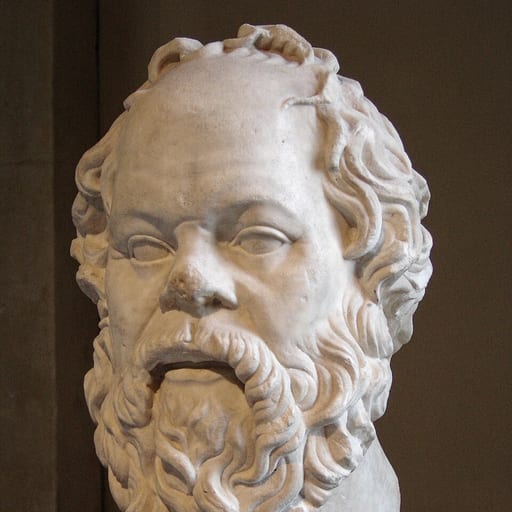
Socrates
소크라테스
Athenian philosopher known through Plato's dialogues
566 records in all
- Principles 191
- Episodes 116
- Quotes 259
3 free questions a day, no sign-up.
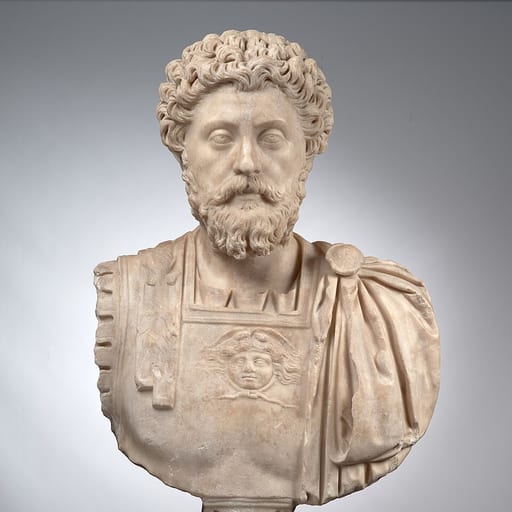
Photo: Copy of Lysippos (?) Public domain Original cropped
Quotes
39 basic records of 259
Quotes are word for word from the source.
True value exchange
The exchange of one fear or pleasure or pain for another fear or pleasure or pain, which are measured like coins, the greater with the less, is not the exchange of virtue.
Our noteSocrates explains that true virtue is not just trading one selfish desire for another.
The root of misanthropy
Misanthropy arises from too great confidence of inexperience; you trust a man and think him altogether true and good and faithful, and then in a little while he turns out to be false and knavish
Our noteSocrates explains why people become cynical after being disappointed by others.
The human middle ground
few are the good and few the evil, and that the great majority are in the interval between them.
Our noteSocrates discusses the rarity of extreme character traits in people.
Striving for mental health
let us rather say that there is as yet no health in us, and that we must quit ourselves like men and do our best to gain health
Our noteSocrates encourages his friends to keep seeking truth despite confusing arguments.
First principles thinking
I first assumed some principle which I judged to be the strongest, and then I affirmed as true whatever seemed to agree with this, whether relating to the cause or to anything else
Our noteSocrates explains his method of reasoning and seeking truth through foundational principles.
Virtue through practice
The being of all virtues, and chiefly of temperance, depends on the practice of them.
Our noteSocrates emphasizes that character is built through repeated action.
Teaching by questioning
You lead me through the field of my own knowledge, and then by pointing out analogies to what I know, persuade me that I really know some things which hitherto, as I believed, I had no knowledge of.
Our noteSocrates reflects on the power of the Socratic method of questioning.
Purpose of consumption
Bad men live that they may eat and drink, whereas good men eat and drink that they may live.
Our noteSocrates distinguishes between living for pleasure and living for a higher purpose.
Simplicity and satisfaction
The man who eats with the greatest appetite has the least need of delicacies.
Our noteSocrates was discussing the relationship between appetite and the need for luxury.
Reducing desires
Those who want fewest things are nearest to the Gods.
Our noteSocrates explained that having fewer wants leads to a higher state of being.
Questioning all people
The respectful attention shown to him by Socrates, whose love of conversation, no less than the mission imposed upon him by the Oracle, leads him to ask questions of all men, young and old alike, should also be noted.
Our noteSocrates approaches everyone regardless of age to fulfill his mission of seeking wisdom through dialogue.
Professional altruism
Then, I continued, no physician, in so far as he is a physician, considers his own good in what he prescribes, but the good of his patient
Our noteSocrates emphasizes that a professional's duty is to the client's welfare.
The weight of life
Is the attempt to determine the way of man's life so small a matter in your eyes--to determine how life may be passed by each one of us to the greatest advantage?
Our noteSocrates challenges Thrasymachus for trying to leave before discussing the most important question of how to live.
Value of deep dialogue
Indeed I do; nor can I imagine any theme about which a man of sense would oftener wish to converse.
Our noteSocrates responds to the importance of discussing the nature of justice.
Specialization of labor
to him and to every other worker was assigned one work for which he was by nature fitted, and at that he was to continue working all his life long and at no other
Our noteSocrates explains why a person should focus on a single craft to achieve excellence.
Quality ensures stability
everything which is good, whether made by art or nature, or both, is least liable to suffer change from without?
Our noteSocrates discusses how high-quality things are more durable and less affected by outside forces.
Elements of temperance
Are not the chief elements of temperance, speaking generally, obedience to commanders and self-control in sensual pleasures?
Our noteSocrates defines the core traits of a disciplined and temperate person.
Following the logic
I really do not know as yet, but whither the argument may blow, thither we go.
Our noteSocrates expresses his willingness to follow the truth of a discussion wherever it leads.
Habits as nature
Did you never observe how imitations, beginning in early youth and continuing far into life, at length grow into habits and become a second nature, affecting body, voice, and mind?
Our noteSocrates explains how the things we repeat and emulate eventually shape our character.
Specialization in business
in our State, and in our State only, we shall find a shoemaker to be a shoemaker and not a pilot also, and a husbandman to be a husbandman and not a dicast also
Our noteSocrates argues that each person should focus on a single craft to ensure excellence and order.
Mind Over Matter
not that the good body by any bodily excellence improves the soul, but, on the contrary, that the good soul, by her own excellence, improves the body
Our noteSocrates discusses the relationship between mental discipline and physical health.
Utility of effort
if a man was not able to live in the ordinary way he had no business to cure him; for such a cure would have been of no use
Our noteSocrates discusses the limits of medical intervention and resource allocation.
Trusting good people
I think, he said, that there is no need to impose laws about them on good men; what regulations are necessary they will find out soon enough for themselves.
Our noteSocrates discusses why detailed legislation is unnecessary for virtuous citizens who can govern their own conduct.
Risk of uncertainty
to carry on an argument when you are yourself only a hesitating enquirer, which is my condition, is a dangerous and slippery thing
Our noteSocrates expresses his concern about leading others astray when he himself is still searching for the truth.
Reason over appearance
But when experience showed that to let all things be uncovered was far better than to cover them up, and the ludicrous effect to the outward eye vanished before the better principle which reason asserted
Our noteSocrates explains how practical utility eventually overcomes the initial social stigma of new customs.
Equality of talent
Men and women alike possess the qualities which make a guardian; they differ only in their comparative strength or weakness.
Our noteSocrates argues that gender does not determine one's capacity to lead or protect the state.
Selective breeding
the best of either sex should be united with the best as often, and the inferior with the inferior, as seldom as possible
Our noteSocrates applies the principles of animal breeding to maintain the high quality of the guardian class.
Shared ownership mindset
And is not that the best-ordered State in which the greatest number of persons apply the terms 'mine' and 'not mine' in the same way to the same thing?
Our noteHe explains how shared interests and language lead to a more stable and unified organization.
Distraction of plunder
Does not the practice of despoiling an enemy afford an excuse for not facing the battle? Cowards skulk about the dead, pretending that they are fulfilling a duty, and many an army before now has been lost from this love of plunder.
Our noteSocrates warns against losing focus on the main objective due to short-term material gains.
Criteria for leadership
Whichever of the two are best able to guard the laws and institutions of our State--let them be our guardians.
Our noteSocrates discusses who is best suited to lead and protect a community or organization.
You are seeing 85 basic records. Membership answers from all 566 of this master's records.
See membershipMore masters in this field
See the whole fieldPhilosophy and wisdom traditions
These records are our compilation of public statements and sources. We are not affiliated with or endorsed by Socrates or any related company. If something should come down, tell us. Takedown request form