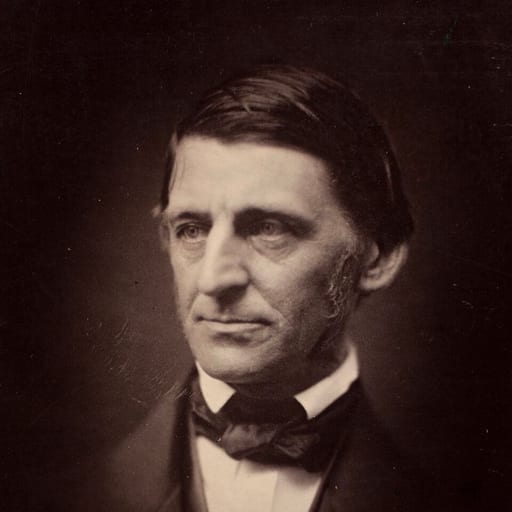
Hall of Masters

Ralph Waldo Emerson

랠프 월도 에머슨

Essayist and lecturer; author of Self-Reliance

1,253 records in all

  • Principles 399
  • Episodes 233
  • Quotes 621
Ask with this master's words

3 free questions a day, no sign-up.

Photo: Josiah Johnson Hawes  Public domain  Original  cropped

Episodes

35 basic records of 233

Episodes are real events from public sources, summarised by us.

  • The Misery of the Brownists

    The English Brownists traveled to New Plymouth to establish a plantation. Due to their ignorance of the new environment, they suffered through a year of extreme misery but endured it with immense patience.

    LessonEarly ventures often face extreme hardship due to a lack of local knowledge, requiring resilience to survive the first year.
  • Carlyle's Literary Conquest

    Emerson observed that while the world was rapidly modernizing with railroads and global trade, literature had not yet reflected this expansion. Thomas Carlyle was the first to successfully 'conquer' these modern details in his writing style, using facts as symbols in a way no one had before.

    LessonBeing the first to translate a complex new reality into a usable format or product provides a lasting competitive advantage.

  • The evolution of partnership

    Emerson describes how relationships begin with external stimuli and passion but must evolve into a mutual discovery of strengths and weaknesses. This process allows partners to represent the broader human experience to one another.

    LessonLong-term collaboration requires moving beyond initial excitement to a deep understanding of a partner's character.

  • Scipio's Defiance

    Scipio was charged with embezzlement but refused to justify himself before the tribunes. Instead of presenting his accounts, he tore the records to pieces to show his disdain for the accusation.

    LessonA person of integrity does not always need to lower themselves to answer petty or malicious accusations.

  • The Lesson of the Gallery

    Emerson observed that viewing fine sculpture and painting trained his eyes to see the beauty in everyday people on the street. He realized that art serves as a 'gymnastics of the eye' rather than an end in itself.

    LessonTraining and tools are useful only if they eventually help you see and act better in the real world.

  • The Shepherd's Emblem

    Emerson reflects on a poor shepherd who dies in a snowstorm just feet away from his own home. He uses this as a metaphor for how humans often perish while being very close to the truth they seek.

    LessonSuccess often lies just beyond a mental barrier that we fail to cross despite being inches away.

  • The Universal Author

    Emerson observed that all great literature feels as if it were written by one all-seeing person. He noted that Shakespeare's plays and Pope's translations remain as modern and relevant as if they were written today.

    LessonTimeless work focuses on universal human truths rather than fleeting trends.

  • Self-Published Success

    After delivering his famous address The American Scholar, Emerson published the talk at his own expense. He printed 500 copies, and the entire edition sold out within a single month.

    LessonTaking the financial risk to self-publish can validate your market demand and keep more of the upside.

  • Commitment to Abolitionism

    Though he had long-standing moral concerns, Emerson did not become an ardent abolitionist until 1844. He eventually realized that the movement was essential for the practical discussion of ethics in society.

    LessonA leader's convictions may evolve slowly, but true commitment often comes from recognizing the broader ethical implications of a cause.

  • The Concord Hymn Performance

    Emerson wrote the 'Concord Hymn' for an Independence Day celebration, which was both read and sung by a local choir. This event demonstrated his ability to create content that resonated with local community values and historical identity.

    LessonCreating works that celebrate shared history can solidify a leader's position as a cultural authority.

  • The Synthesis of Plato and Socrates

    Plato used the character and wit of his teacher Socrates as the central figure in his writings. This allowed Plato to communicate his intellectual treasures through a relatable, human lens that combined street-level humor with saintly wisdom.

    LessonCombining high-level theory with a grounded, relatable personality makes complex ideas more accessible and immortal.

  • Plato's Intellectual Mapping

    Emerson observes that while earlier thinkers mapped small districts of knowledge, Plato was the first to draw the entire sphere of the mind. He integrated all past wisdom into a symmetrical and detailed system that mirrored nature itself.

    LessonA founder should strive for a holistic vision of their industry rather than just focusing on a small niche.

  • Mirabeau's Bold Plagiarism

    Mirabeau took a concluding speech written by Dumont and used it as his own the very next day, even after being told others had seen it. He felt his personality and presence gave the words their true weight and authority.

    LessonThe value of an idea often depends on the strength and authority of the person who executes it.

  • The Fall of Napoleon

    Napoleon built a vast empire through intellect and force but lacked moral principle and honesty. By 1814, his extreme egotism had exhausted Europe and his own people, leading to his total desertion and the collapse of his gains.

    LessonLeadership based solely on self-interest and fear eventually paralyzes followers and leads to systemic failure.

  • The Lord Mayor's Defense of the Thames

    When King James I threatened to punish London by moving his royal court elsewhere, the Lord Mayor remained unfazed. He replied that as long as the King left them the Thames river, the city's commercial power would remain intact.

    LessonThe fundamental infrastructure of your business is often more valuable than the prestige of your current leadership or associations.

  • The Saxon Cultural Victory

    Despite being formally conquered by the Normans, the Saxons maintained their longevity and eventually forced the victors to adopt their language and laws. They used their strong personality and work ethic to secure civil liberties over time.

    LessonResilience and a superior work ethic can eventually subvert and overcome even the most dominant established powers.

  • The Rejection of Labor Protections

    When Sir S. Romilly proposed a bill to limit how far parish children could be sent for apprenticeships, it was opposed by Peel and Wortley. They argued that protecting family affections among the lower orders was unnecessary and that stopping the binding of children to manufacturers would injuriously raise the price of labor.

    LessonHistorical business growth often prioritized low labor costs and industrial utility over social welfare.

You are seeing 188 basic records. Membership answers from all 1,253 of this master's records.

See membership

More masters in this field

See the whole field

Philosophy and wisdom traditions

These records are our compilation of public statements and sources. We are not affiliated with or endorsed by Ralph Waldo Emerson or any related company. If something should come down, tell us. Takedown request form