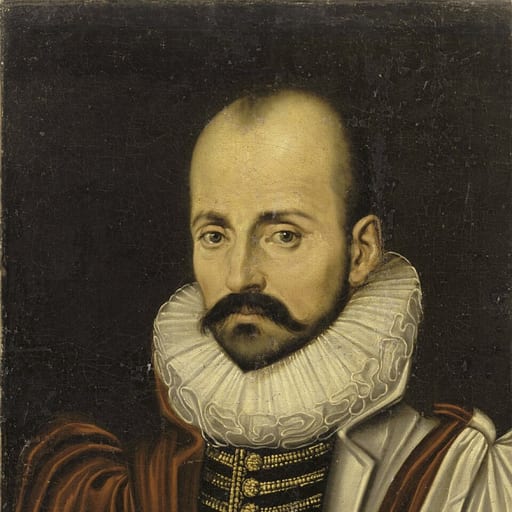
Michel de Montaigne
미셸 드 몽테뉴
French writer who invented the essay
1,105 records in all
- Principles 358
- Episodes 243
- Quotes 504
3 free questions a day, no sign-up.
Photo: Unknown author Public domain Original cropped
Quotes
76 basic records of 504
Quotes are word for word from the source.
Duty of reporting
I should rather conceive it had been the servant's duty faithfully to have represented to him the whole thing as it passed, to the end that the liberty of selecting, disposing, judging, and concluding might have remained in him
Our noteMontaigne criticizes ambassadors who hide information from their leaders, arguing that leaders need full facts to decide.
Discipline in execution
To obey more upon the account of understanding than of subjection, is to corrupt the office of command
Our noteHe discusses the importance of following orders even when the subordinate thinks they know a better way.
Testing your principles
To death do I refer the assay of the fruit of all my studies: we shall then see whether my discourses came only from my mouth or from my heart.
Our noteHe reflects on how death serves as the ultimate test of one's philosophy and learning.
Avoid forced performance
Married people, having all their time before them, ought never to compel or so much as to offer at the feat, if they do not find themselves quite ready
Our noteMontaigne discusses the psychological pressure of performance in marriage and the wisdom of waiting for the right moment.
Power of belief
Why do the physicians possess, before hand, their patients' credulity with so many false promises of cure, if not to the end, that the effect of imagination may supply the imposture of their decoctions?
Our noteHe explores how a patient's belief in a cure can be as effective as the medicine itself.
Ownership of work
I never yet saw that father, but let his son be never so decrepit or deformed, would not, notwithstanding, own him
Our noteMontaigne explains why he claims his own writings despite their flaws.
Selective reading
I never seriously settled myself to the reading any book of solid learning but Plutarch and Seneca
Our noteMontaigne discusses his specific influences and reading habits.
Submit to truth
let him be lessoned to acquiesce and submit to truth so soon as ever he shall discover it, whether in his opponent's argument, or upon better consideration of his own
Our noteMontaigne discusses the importance of intellectual honesty over winning an argument.
Healthy mind and body
The soul that lodges philosophy, ought to be of such a constitution of health, as to render the body in like manner healthful too
Our noteHe argues that true learning should improve one's physical and mental presence.
Substance over mimicry
The imitation of words, by its own facility, immediately disperses itself through a whole people; but the imitation of inventing and fitly applying those words is of a slower progress.
Our noteHe notes that while anyone can copy jargon, true mastery of thought and application is rare.
The delusion of hope
Few men come to die in the opinion that it is their latest hour; and there is nothing wherein the flattery of hope more deludes us
Our noteMontaigne discusses how people often deny the reality of their own mortality until the very end.
Theoretical vs actual courage
it is no such great matter for a man in health and in a temperate state of mind to resolve to kill himself
Our noteMontaigne argues that planning for a crisis is easier than facing it in reality.
The danger of satiety
satiety begets disgust; 'tis a blunt, dull, stupid, tired, and slothful passion
Our noteHe warns against the lack of drive that comes from having too much of something.
Deceptive appearances
Strangers see nothing but events and outward appearances; everybody can set a good face on the matter, when they have trembling and terror within
Our noteHe notes that external observers cannot see the true internal state of a person.
Self-awareness as value
I do not value myself upon any other account than because I know my own value.
Our noteHe explains that his only real merit is knowing his own limitations.
Physical presence in leadership
I am of something lower than the middle stature, a defect that not only borders upon deformity, but carries withal a great deal of inconvenience along with it, especially for those who are in office and command
Our noteMontaigne discusses how physical stature affects the perceived authority of a leader.
Accepting personal limitations
My hands are so clumsy that I cannot even write so as to read it myself, so that I had rather do what I have scribbled over again, than take upon me the trouble to make it out.
Our noteHe admits to his lack of manual dexterity and poor handwriting.
Avoiding unnecessary stress
I steal away from occasions of vexing myself, and turn from the knowledge of things that go amiss
Our noteHe explains his strategy for maintaining peace of mind by ignoring minor household failures.
Neglecting personal business
We occupy our thoughts about the general, and about universal causes and conducts, which will very well carry on themselves without our care; and leave our own business at random
Our noteHe critiques the tendency to focus on abstract theories while ignoring practical, immediate responsibilities.
Avoiding avarice
What a mean and ridiculous thing it is for a man to study his money, to delight in handling and telling it over and over again!
Our noteHe criticizes the obsession with counting and hoarding wealth.
Independence and rights
I am clearly of opinion that a man should live by right and by authority, and not either by recompense or favour.
Our noteMontaigne expresses his desire for legal independence rather than relying on the mercy of powerful people.
The cost of gratitude
I think nothing so dear as what has been given me, and this because my will lies at pawn under the title of gratitude
Our noteHe explains why he prefers paid services over favors that create emotional debt.
Learning from diversity
I do not know, as I have often said a better school wherein to model life than by incessantly exposing to it the diversity of so many other lives, fancies, and usances
Our noteHe describes travel as the ultimate educational tool for understanding human nature.
Value of communication
There can be no pleasure to me without communication: there is not so much as a sprightly thought comes into my mind, that it does not grieve me to have produced alone
Our noteMontaigne explains why he finds no joy in ideas that cannot be shared with a worthy companion.
Self reform
Do but reform yourself; for that is wholly in your own power! whereas you have no other right but patience towards fortune
Our noteMontaigne emphasizes focusing on internal change rather than trying to control external luck.
Responsibility of the audience
Tis the indiligent reader who loses my subject, and not I; there will always be found some word or other in a corner that is to the purpose, though it lie very close.
Our noteMontaigne defends his rambling style by placing the burden of attention on the reader.
Mental independence
Reserve a backshop, wholly our own and entirely free
Our noteHe advises maintaining a private mental space independent of social or professional obligations.
Blind belief
Nothing is so firmly believed, as what we least know
Our noteHe observes that people often hold the strongest convictions about things they understand the least.
Active learning
Books have not so much served me for instruction as exercise
Our noteHe views reading as a mental workout rather than just a way to collect facts.
Evaluating source credibility
it is much more reasonable to believe the Roman historians in such things than Greeks and foreigners.
Our noteMontaigne argues for prioritizing primary or local sources over foreign accounts.
You are seeing 166 basic records. Membership answers from all 1,105 of this master's records.
See membershipMore masters in this field
See the whole fieldPhilosophy and wisdom traditions
These records are our compilation of public statements and sources. We are not affiliated with or endorsed by Michel de Montaigne or any related company. If something should come down, tell us. Takedown request form