Tolstoy's View on Art and the Peasantry
톨스토이는 예술과 시가 인간의 본성에 해로운 영향을 미칠 수 있다고 믿었어요. 그는 글을 배운 사람보다 농민이 더 정상적인 존재라고 생각했어요.
LessonFounders should consider whether their products simplify or complicate the natural human experience.
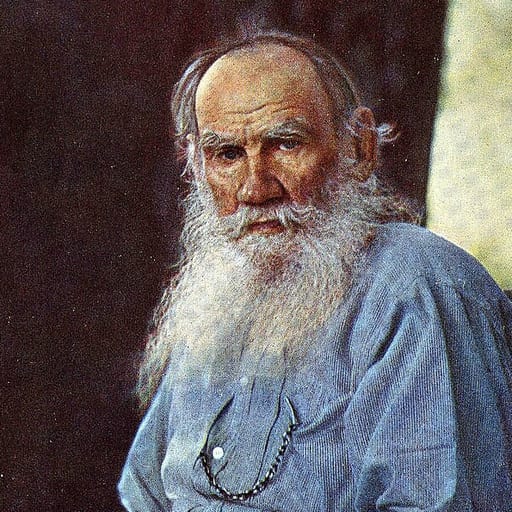
레프 톨스토이
Russian novelist and moral thinker; author of War and Peace
880 records in all
3 free questions a day, no sign-up.
Photo: Sergei Prokudin-Gorskii Public domain Original cropped
40 basic records of 268
Episodes are real events from public sources, summarised by us.
톨스토이는 예술과 시가 인간의 본성에 해로운 영향을 미칠 수 있다고 믿었어요. 그는 글을 배운 사람보다 농민이 더 정상적인 존재라고 생각했어요.
LessonFounders should consider whether their products simplify or complicate the natural human experience.
During his flight from home, Tolstoy fell ill and was taken to a trackman's hut at Astopovo station. He died there surrounded by family, failing to achieve the lonely, anonymous death he had desired as a final act of renunciation.
LessonEven the most carefully planned exits or pivots can be thwarted by the unpredictable reality of human frailty.
Tolstoy met a peasant on the road who was reading news leaflets about the war. The man expressed deep sorrow over the destruction of lives and property, questioning the need for the conflict.
LessonReal-world feedback from the ground provides a clearer picture of reality than official propaganda.
A simple seaman wrote to Tolstoy asking if God truly loves war and if there is any truth left on earth. The sailor offered to pay for books that could help him understand the morality of his commanders' orders.
LessonPeople at the bottom of a hierarchy often feel the ethical weight of decisions made at the top.
Tolstoy visited a poor mother and daughter to rescue the girl from a life of prostitution. He realized the mother was doing what she thought was best for her daughter's survival within their social reality, and his own social circle held similar views on women's roles.
LessonTo change a result, you must first address the systemic incentives and cultural views that produce it.
Tolstoy secured promises for three thousand rubles from wealthy acquaintances to fund his relief work. However, when it came time to collect, not a single person followed through on their pledge, leaving him with almost no funds.
LessonIn business and philanthropy, a promise of capital is worthless until the money is transferred.
Tolstoy planned to help the poor in Moscow by organizing a census and distributing money. A simple man challenged him, suggesting that instead of organized charity, the wealthy should simply take the poor into their homes to live and work together.
LessonDirect, personal involvement is often more effective and honest than bureaucratic solutions.
Tolstoy describes a scenario where a farmer starts mending his own plough and then begins helping neighbors for money or labor. This organic need creates a specialized role that is naturally justified by the community's demand.
LessonA business should start from a real, local need rather than an abstract idea of what a business should be.
Tolstoy realized that his privileged life as a famous writer was based on a parasitic relationship with the working class. He decided to stop deceiving himself and face the truth of his social position, even though it contradicted his entire upbringing.
LessonA founder must be willing to dismantle their own ego and status to find a more authentic and useful path.
Tolstoy expressed deep distrust in government officials and formal petitions, believing leaders were often fanatics or cowards afraid of losing their positions. He correctly predicted that a petition to the Czar would never be read or acted upon.
LessonDo not rely on formal bureaucracy or the promises of middle managers who are more concerned with their own safety than with justice.
Despite facing financial difficulties and a lack of public understanding, the author successfully founded the National Farm School near Doylestown. The school helped hundreds of young men escape crowded city ghettos to pursue healthy lives as farmers.
LessonPersistence in a social enterprise is often fueled by a sense of duty to a higher cause or a personal pledge.
The author sent multiple reports and letters to Tolstoy about the school's progress, but never received a reply. It was later concluded that the Russian government had blacklisted the author and intercepted all mail to Tolstoy.
LessonExternal political or systemic risks can disrupt essential communication channels between partners or mentors.
Tolstoy fled his family and home at an extreme old age to seek a wilderness for his final days. While many suspected failing mentality, his recent writings showed his mind remained sharp and focused on social misery.
LessonA leader's commitment to their principles can be so absolute that they are willing to abandon all personal comfort to remain true to their message.
The Russian government suppressed Tolstoy's writings that detailed peasant misery and government oppression. Officials prioritized their own promotion and strict adherence to headquarters' instructions over the welfare of the starving people.
LessonInstitutional inertia and personal ambition often block necessary reforms and the communication of truth.
Driven to despair by the government's cruelty and his own family's indifference, Tolstoy resolved to retire to a wilderness. He felt that his fifty years of labor for the poor had failed to make a meaningful impression on society.
LessonWhen a mission feels futile and misaligned with one's environment, a radical change of setting may seem like the only solution.
Tolstoy's private papers were searched and his school was closed by the authorities. This personal wrong grew into a broader hostility toward the state and church, fueling his role as a spokesman for the oppressed.
LessonPersonal setbacks and unfair treatment can be the catalyst for a founder's larger mission and public voice.
Disturbed by a public execution in France, Tolstoy moved to Switzerland. The natural beauty and supportive friends there helped him recover from mental strain and rediscover a joy for living.
LessonChanging your environment and seeking nature can be a powerful tool for recovery after a traumatic or draining period.
The lame tailor was offered a spot in a group of five rich peasants who profited by overcharging others for land. He refused to exploit the tenants and proposed giving allotments to everyone on equal terms based on the actual cost.
LessonIntegrity in pricing and distribution builds long-term community trust and a loyal following.
After hearing about Stepan's conversion and the life of Maria Semenovna, Lisa Eropkin decided to abandon her shallow social life. She resolved to give all her possessions to the poor to ensure her suitor loved her for herself and not her wealth.
LessonA clear mission or moral pivot can strip away false incentives and test the sincerity of partners.
Vassily orchestrated a transfer to a specific cell to execute a complex escape plan involving floorboards, a mortuary, and handmade ropes. He used a simple plank to loosen window gratings and scale walls, eventually reaching safety.
LessonMeticulous planning and the creative use of available tools are essential for overcoming high barriers.
You are seeing 132 basic records. Membership answers from all 880 of this master's records.
See membershipPhilosophy and wisdom traditions
These records are our compilation of public statements and sources. We are not affiliated with or endorsed by Leo Tolstoy or any related company. If something should come down, tell us. Takedown request form