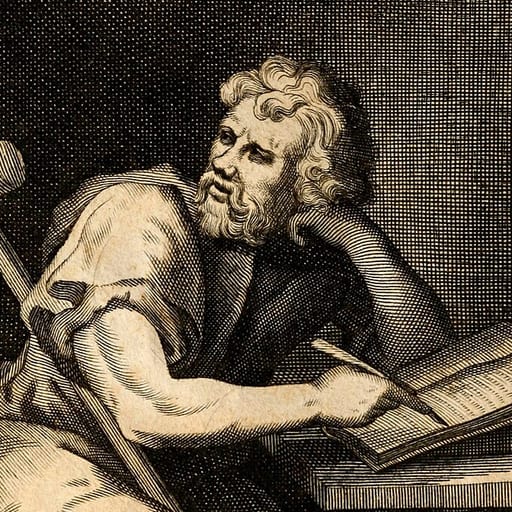
Epictetus
에픽테토스
Stoic philosopher born a slave; the Discourses and the Enchiridion
932 records in all
- Principles 303
- Episodes 208
- Quotes 421
3 free questions a day, no sign-up.
Photo: William Sonmans / Michael Burghers Public domain Original cropped
Quotes
63 basic records of 421
Quotes are word for word from the source.
Source of happiness
In truth we thank the Gods for that wherein we place our happiness.
Our noteHe observes that people celebrate external status rather than internal moral progress.
True human connection
But a man who meets a man is one who learns the other's mind, and lets him see his in turn.
Our noteEpictetus criticizes superficial meetings and advocates for a deep exchange of principles.
Besting your rivals
Asked how a man should best grieve his enemy, Epictetus replied, "By setting himself to live the noblest life himself.
Our noteEpictetus explains that personal excellence is the most effective response to those who oppose you.
Practice over theory
But when I have found my interpreter, what remains is to put in practice his instructions. This itself is the only thing to be proud of.
Our noteEpictetus explains that understanding a text is worthless without applying its lessons to one's life.
Discipline in speech
Keep neither a blunt knife nor an ill-disciplined looseness of tongue.
Our noteA brief warning about the dangers of undisciplined communication.
Listen more talk less
Nature hath given men one tongue but two ears, that we may hear from others twice as much as we speak.
Our noteEpictetus explains why humans have two ears and only one mouth.
probability as guide
Probability, argued they, was the guide of life
Our noteThe author explains how Skeptics navigated daily life despite doubting the reality of their perceptions.
Questioning bare opinion
Behold, the beginning of philosophy is the observation of how men contradict each other, and the search whence cometh this contradiction, and the censure and mistrust of bare opinion.
Our noteHe describes the analytical process of moving beyond subjective feelings to find truth.
True independence
if you hold that only to be your own which is so, and the alien for what it is, alien, then none shall ever compel you
Our noteHe explains how recognizing boundaries leads to personal freedom.
Testing perceptions
Straightway, then, practice saying to every harsh appearance--_Thou art an Appearance and not at all the thing thou appearest to be
Our noteHe advises questioning our immediate reactions to difficult situations.
Active study
Is it enough that we merely wish to become good and wise, or must we not also learn something?
Our noteHe emphasizes that wisdom requires intentional study, not just good intentions.
Lead by example
Thou wouldst do them good--then do not chatter to them, but show them in thyself what manner of men philosophy can make.
Our noteHe advises that true leadership and influence come from personal conduct rather than mere words or lecturing.
Use of circumstances
Things are indifferent, but the uses of them are not indifferent.
Our noteEpictetus explains that while external events are neutral, our reaction to them defines our character.
Power of assent
But that ratification of them, which we name assent, whereby the appearances are comprehended and judged, these are voluntary, and are done by human choice.
Our noteHe distinguishes between automatic reactions and the conscious choice to accept them as true.
Learning from workers
But learn how those live that are in health--slaves, and laborers, and true philosophers
Our noteEpictetus suggests observing those who perform manual labor to understand resilience.
Internal locus of control
Trusting in what? Not in fame, nor wealth, but in his own valor--that is, his opinions of the things that are and are not in our power.
Our noteHe uses Odysseus as an example of someone who relies on internal strength rather than status.
Service and profit
He hath so formed the nature of the reasoning creature that he may never win aught of his own good without he furnish something of service to the common good.
Our noteEpictetus discusses how individual interest and the common good are naturally linked.
Source of Suffering
For there is no loss and no suffering save only in those things which we possess.
Our noteEpictetus discusses how attachment to external possessions leads to emotional distress when they are lost.
Natural human affection
But he knows well that if a little child be born, it is no longer in our power not to love it and be anxious for it.
Our noteEpictetus argues that humans are naturally social and cannot help but care for their offspring.
Individual vs Whole
Look at thyself as a solitary creature, and it is according to Nature to live to old age, to grow rich, to keep good health.
Our noteHe contrasts the desires of a solitary individual with the duties of a person as part of a community.
Respecting autonomy
For he remembered very well that no man can command the ruling faculty of another.
Our noteExplaining why Socrates did not engage in useless contentions with others.
Self Worth
Why, then, art thou ignorant of thy high ancestry? Why knowest thou not whence thou camest?
Our noteHe reminds the reader of their divine origin to encourage higher standards of personal conduct.
Self Stewardship
Now He hath given thee to thyself, and saith, _I had none more worthy of trust than thee; keep this man such as he was made by nature
Our noteThe philosopher views self-care and integrity as a sacred trust given by the creator.
Skill Through Action
Every skill and faculty is maintained and increased by the corresponding acts; as, the faculty of walking by walking, of running by running. If you will read aloud well, then do it constantly; if you will write, then write.
Our noteThe principle of deliberate practice and habit formation.
True inner beauty
For thou art not flesh and hair, but a Will: if thou keep this beautiful, then wilt thou be beautiful.
Our noteEpictetus explains that human excellence lies in the character and will, not in physical appearance.
Objective observation
Doth a man bathe himself quickly? Then, say not, _Wrongly_, but _Quickly_. Doth he drink much wine? Then say not, _Wrongly_, but _Much
Our noteHe encourages observing facts without jumping to moral judgments before understanding the person's reasons.
Lead by example
For example, do not discourse at a feast upon how one ought to eat, but eat as one ought.
Our noteHe uses the simple act of eating to illustrate that behavior is the best teacher.
Internal accountability
The position and token of the vulgar: he looks never to himself for benefit or hurt, but always to outward things.
Our noteHe contrasts the common tendency to blame circumstances with the philosopher's focus on self.
Practice Over Theory
The first and most necessary point in philosophy is the use of the precepts, for example, not to lie. The second is the proof of these
Our noteHe argues that applying moral rules is far more important than merely being able to explain or prove them.
Inner resourcefulness
the Cynic tries the extreme of abnegation in order to demonstrate practically that man has resources within himself which make him equal to any fate
Our noteThe author explains the purpose behind the Cynic's lifestyle of extreme self-denial.
You are seeing 139 basic records. Membership answers from all 932 of this master's records.
See membershipMore masters in this field
See the whole fieldPhilosophy and wisdom traditions
These records are our compilation of public statements and sources. We are not affiliated with or endorsed by Epictetus or any related company. If something should come down, tell us. Takedown request form