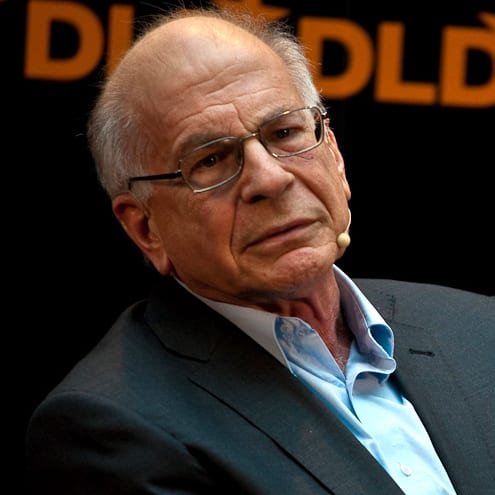
Daniel Kahneman
대니얼 카너먼
Nobel laureate psychologist, author of Thinking, Fast and Slow
122 records in all
- Principles 33
- Episodes 43
- Quotes 46
3 free questions a day, no sign-up.
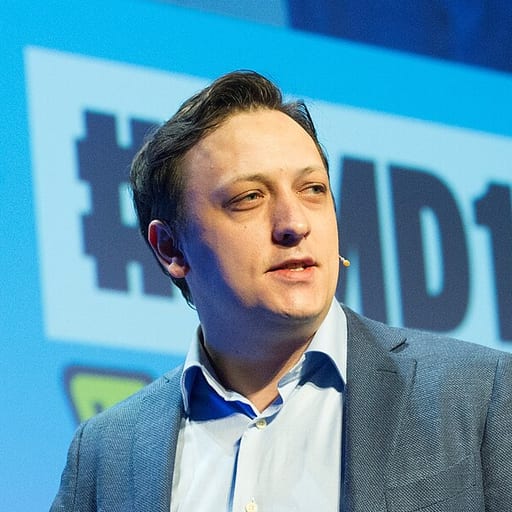
Photo: nrkbeta CC BY-SA 2.0 Original cropped
Quotes
10 basic records of 46
Quotes are word for word from the source.
Sources of error
There is an interesting fact - that noise and bias are independent sources of error, so that reducing either of them improves overall accuracy.
Our noteDiscussing how noise and bias contribute differently to decision-making errors.
Reducing hiring error
Google, for example, when it hires people, they have a minimum of four individuals making independent assessments of each candidate. And that reduces the standard deviation of error at least by a factor of two.
Our noteExplaining how multiple independent assessments can mitigate noise in hiring.
Noise versus bias
Noise is clearly a statistical way of looking at things, and bias is inherently causal - so the interplay of those forms of thinking.
Our noteHe was explaining the core themes of his then-upcoming book on noise in human judgment.
Conditions for Intuition
You're going to have Gary Klein-type intuition, expert intuition, if you have a regular world. That's condition number one. There are regularities that you can pick up.
Our noteKahneman discusses the specific environments where expert intuition can actually be trusted.
Impact of Early Success
Those kinds of experiences - that you can do things that seemed impossible or unlikely - that is certainly very liberating and encouraging and induces creativity.
Our noteKahneman reflects on how his early military achievements shaped his creative confidence.
Definition of intelligence
Intelligence is not only the ability to reason; it is also the ability to find relevant material in memory and to deploy attention when needed.
Our noteDiscussing the components of cognitive control and attention.
Nature of risk-taking
There is no evidence that risk takers in the economic domain have an unusual appetite for gambles on high stakes; they are merely less aware of risks than more timid people are.
Our noteDiscussing the engine of capitalism and the psychology of risk.
Decision framing bias
Unless there is an obvious reason to do otherwise, most of us passively accept decision problems as they are framed and therefore rarely have an opportunity to discover the extent to which our preferences are frame-bound rather than reality-bound.
Our noteAnalyzing how the framing of problems affects human preferences.
Illusion of confidence
Confidence is a feeling, one determined mostly by the coherence of the story and by the ease with which it comes to mind, even when the evidence for the story is sparse and unreliable.
Our noteExplaining why high confidence does not equal high probability of being right.
Trusting experts
We can believe an expert who admits uncertainty but cannot take expressions of high confidence at face value. As I first learned on the obstacle field, people come up with coherent stories and confident predictions even when they know little or nothing.
Our noteDistinguishing between justified expertise and sincere overconfidence.
You are seeing 21 basic records. Membership answers from all 122 of this master's records.
See membershipMore masters in this field
See the whole fieldStrategy and mental models
These records are our compilation of public statements and sources. We are not affiliated with or endorsed by Daniel Kahneman or any related company. If something should come down, tell us. Takedown request form