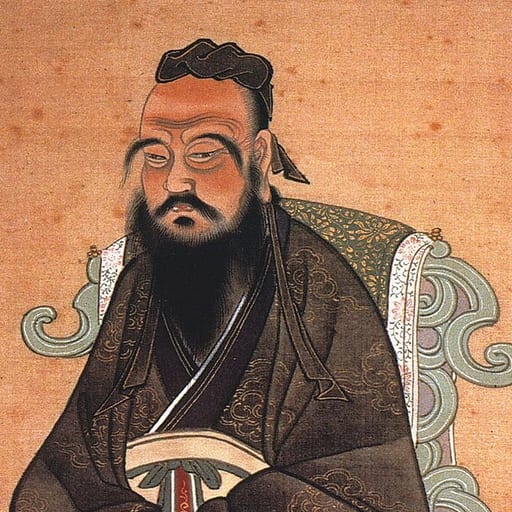
Confucius
공자
Chinese teacher and philosopher; the Analects
870 records in all
- Principles 266
- Episodes 277
- Quotes 327
3 free questions a day, no sign-up.
Photo: Unknown artist, about 1770 Public domain Original cropped
Quotes
49 basic records of 327
Quotes are word for word from the source.
Wealth and poverty
"It is no light thing," said he, "to endure poverty uncomplainingly; and a difficult thing to bear wealth without becoming arrogant."
Our noteConfucius discusses the difficulty of maintaining character regardless of one's financial status.
Effective communication
"Not to speak to a man," said he, "to whom you ought to speak, is to lose your man; to speak to one to whom you ought not to speak is to lose your words.
Our noteHe discusses the importance of choosing the right audience for your message.
Value of partnership
The bird, although a creature small, Upon its mate depends; And shall we men, who rank o'er all, Not seek to have our friends?
Our noteA reflection on the natural necessity of seeking companions and allies in any endeavor.
Generosity in abundance
Handfuls besides we drop upon the ground, And ears untouched in numbers lie around;-- These by the poor and widows shall be found.
Our noteThe practice of leaving a portion of the harvest for those in need.
Influence of Leadership
"The virtue of the prince," he said, "is like unto wind; that of the people, like unto grass. For it is the nature of grass to bend when the wind blows upon it."
Our noteConfucius explains how the personal conduct of a leader naturally shapes the behavior of their subordinates.
Integrity in action
The higher type of man is one who acts before he speaks, and professes only what he practises.
Our noteConfucius defines the superior person as someone whose actions precede and match their words.
The golden rule
Do not unto others what you would not they should do unto you.
Our noteThis is the core maxim for ethical conduct in all human interactions.
Attention to detail
He is anxious to see clearly, to hear distinctly, to be kindly in his looks, respectful in his demeanour, conscientious in his speech, earnest in his affairs
Our noteA description of the focused attention a noble person pays to their daily conduct.
Initial trust in words
At first, he continued, my way of dealing with others was to listen to their words and to take their actions upon trust.
Our noteConfucius explains how he used to judge people before he learned to be more observant.
Levels of learning
Hui hears one point and promptly masters the whole. I hear one point and am only able to feel my way to a second.
Our noteTzu Kung compares his own learning speed to that of the top disciple, Hui.
Focus on others
I will not be grieved that other men do not know me: I will be grieved that I do not know other men.
Our noteConfucius explains that understanding others is more important than seeking personal recognition.
Practical wisdom
Having heard much, I sift out the good and practise it; having seen much, I retain it in my memory.
Our noteConfucius explains his process of filtering information to gain a secondary order of wisdom.
Valuing talent
If you had a lovely jewel, would you hide it away in a casket, or would you try to sell it for a good price?
Our noteTzu Kung asks Confucius about the proper use of one's talents and skills.
Self reliant growth
I make no complaint against Heaven, neither do I blame my fellow-men. In the study of virtue I begin at the bottom and tend upwards.
Our noteConfucius describes his approach to learning and personal accountability when others fail to recognize him.
Focus on competence
Instead of being concerned that you have no office, be concerned to think how you may fit yourself for office. Instead of being concerned that you are not known, seek to be worthy of being known.
Our noteConfucius advises focusing on personal preparation rather than seeking status.
Efficient mentorship
Refusal to instruct one who is competent to learn entails the waste of a man. Instruction of one who is incompetent to learn entails waste of words.
Our noteHe discusses the importance of choosing the right people to invest time in.
Continuous learning
Love of truth without the will to learn casts the shadow called insensibility.
Our noteConfucius explains that virtues without constant learning can turn into character flaws.
Core principles
Our Master's teaching simply amounts to this: loyalty to oneself and charity to one's neighbour.
Our noteTseng Tzu summarizes the entire Confucian philosophy for other disciples.
Mindset and wealth
better still is the poor man who is cheerful, and the rich man who cherishes the inner principle of harmony and self-control.
Our noteConfucius discusses the ideal attitude for both the poor and the wealthy.
Building trust first
The wise man will gain the confidence of the people before laying burdens upon them; otherwise, they will consider it oppression.
Our noteTzŭ Hsia discusses the necessity of establishing credibility before exercising authority or leadership.
Holistic learning
It is not the way of the wise teacher to distinguish between subjects of first-class importance, which must be taught, and subjects of secondary importance, which may be neglected.
Our noteTzŭ Hsia defends his teaching method, arguing that all aspects of training contribute to a student's development.
Empathetic leadership
When you discover the facts of a crime, be not moved with joy but rather with pity and grief.
Our noteTsêng Tzŭ advises a new judge to maintain empathy rather than professional pride when dealing with failures.
Seeking external validation
Is he not a man of complete virtue, who feels no discomposure though men may take no note of him?
Our noteConfucius discusses the importance of internal character over public recognition.
Understanding others
I will not be afflicted at men's not knowing me; I will be afflicted that I do not know men.
Our noteConfucius emphasizes the value of judging others' character over being famous.
Definition of knowledge
When you know a thing, to hold that you know it; and when you do not know a thing, to allow that you do not know it;-- this is knowledge.
Our noteConfucius explains the essence of true intellectual honesty to his student Yu.
Courage to act
To see what is right and not to do it is want of courage.
Our noteA reminder that knowing the right path is useless without the bravery to follow it.
Passion for work
They who know the truth are not equal to those who love it, and they who love it are not equal to those who delight in it.
Our noteConfucius explains the hierarchy of engagement with one's craft or truth.
Risk and passion
If the search for riches is sure to be successful, though I should become a groom with whip in hand to get them, I will do so.
Our noteConfucius discusses the pursuit of wealth versus following one's own path.
Continuous learning
When I walk along with two others, they may serve me as my teachers. I will select their good qualities and follow them, their bad qualities and avoid them.
Our noteThe Master explains how to find learning opportunities in every social interaction.
Resist complacency
The scholar who cherishes the love of comfort is not fit to be deemed a scholar.
Our noteA warning against letting the desire for ease undermine one's professional mission.
You are seeing 131 basic records. Membership answers from all 870 of this master's records.
See membershipMore masters in this field
See the whole fieldPhilosophy and wisdom traditions
These records are our compilation of public statements and sources. We are not affiliated with or endorsed by Confucius or any related company. If something should come down, tell us. Takedown request form