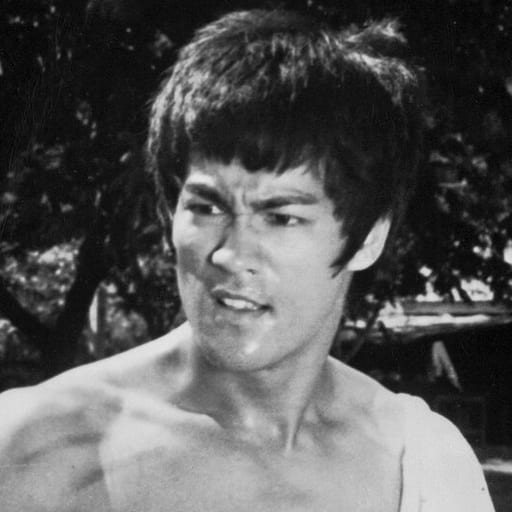
Hall of Masters

Bruce Lee

이소룡

Martial artist, actor and founder of Jeet Kune Do

131 records in all

  • Principles 31
  • Episodes 66
  • Quotes 34
Ask with this master's words

3 free questions a day, no sign-up.

Photo: National General Pictures (original photo); uploaded by User:999real, cropped by User:Wabbuh  Public domain  Original  cropped

Episodes

10 basic records of 66

Episodes are real events from public sources, summarised by us.

  • Strategic relocation for a fresh start

    After frequent street fights led to police trouble in Hong Kong, Lee's mother suggested he move to the United States to claim his citizenship. This move allowed him to escape legal trouble and pursue higher education and business opportunities in Seattle.

    LessonSometimes a change of environment is necessary to pivot away from past failures and access new markets.

  • Gaining visibility through public demonstration

    Lee used the Long Beach International Karate Championships to demonstrate his skills and speak to an audience. This event drew significant attention to his methods and helped him expand his teaching career to Los Angeles.

    LessonPublic demonstrations and speaking engagements are powerful tools for building a personal brand and attracting high-value clients.

  • The Pivot to Total Fitness

    Following a match with Wong Jack-man, Lee realized that pure martial arts skill wasn't enough if the body lacked conditioning. He overhauled his routine to include strength, endurance, and flexibility training.

    LessonAnalyze your performance gaps after a challenge and upgrade your underlying infrastructure accordingly.

  • 1969Career

    Collaboration with Stirling Silliphant

    Lee worked with screenwriter Stirling Silliphant on multiple projects, starting with the film Marlowe. This partnership allowed Lee to showcase his martial arts expertise and philosophy to a wider audience.

    LessonStrategic partnerships with key industry creators can provide the platform needed to showcase specialized skills.

  • 1972Risk

    Risky Physical Modification

    Lee had his underarm sweat glands removed because he believed sweat looked unphotogenic on film. Some experts theorize this hindered his body's ability to regulate temperature, contributing to his fatal collapse.

    LessonPrioritizing aesthetic presentation over fundamental health or operational safety can lead to catastrophic failure.

  • Turning Injury into a Treatise

    After suffering a severe back injury that prevented him from training for six months, Bruce Lee used his recovery time to compile his martial arts philosophy. He wrote a core set of writings and collected disparate notes that would eventually form his book.

    LessonInvoluntary downtime can be the most productive period for defining your core business or creative philosophy.

  • 1971Focus

    The Conflict Between Work and Documentation

    Lee intended to finish his book in 1971, but his rising film career and busy schedule prevented him from completing the project. He also worried that his work might be misinterpreted or used for the wrong purposes by others.

    LessonSuccess in one area can distract from long-term intellectual assets, requiring a balance between execution and documentation.

  • Starting Over with Minimal Capital

    Lee moved to the US with only $100 and worked at a friend's restaurant while finishing high school and studying philosophy at the University of Washington.

    LessonGreat careers often start with humble beginnings and a commitment to continuous learning.

  • Development of Jeet Kune Do Framework

    Bruce Lee experimented with various martial arts styles and techniques to extract universal principles. He used these findings to build a process-based system rather than a fixed style, allowing for personal tailoring.

    LessonA founder should build a core framework that allows for individual adaptation rather than forcing a one-size-fits-all solution.

  • Living Without a Rigid Schedule

    Bruce Lee rejected the idea of living by a strict, predetermined schedule. He chose to live freely from moment to moment, adjusting his actions based on how events unfolded naturally.

    LessonRigidity kills creativity and responsiveness; staying flexible allows a founder to seize opportunities as they arise.

You are seeing 25 basic records. Membership answers from all 131 of this master's records.

See membership

More masters in this field

See the whole field

Craft, arts and performance

These records are our compilation of public statements and sources. We are not affiliated with or endorsed by Bruce Lee or any related company. If something should come down, tell us. Takedown request form