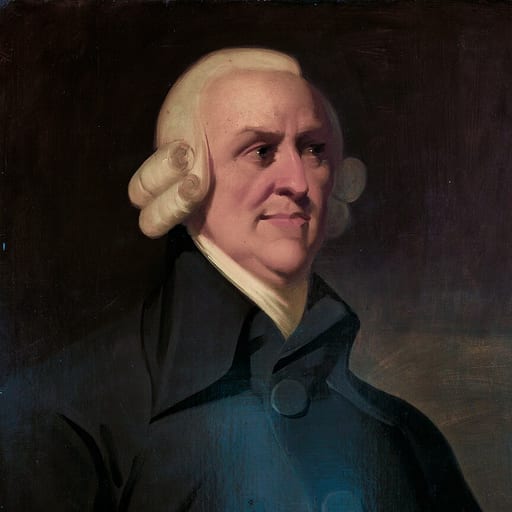
Adam Smith
애덤 스미스
Scottish economist and moral philosopher; The Wealth of Nations
743 records in all
- Principles 261
- Episodes 185
- Quotes 297
3 free questions a day, no sign-up.
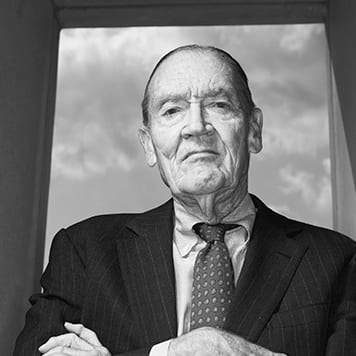
Photo: Unknown author Public domain Original cropped
Quotes
45 basic records of 297
Quotes are word for word from the source.
Clarifying complex ideas
I have likewise endeavoured to explain more fully, and examine more distinctly, some of the doctrines of that famous sect.
Our noteSmith discusses his efforts to improve the explanation of Stoic philosophy in his revised text.
Context over emotion
Sympathy, therefore, does not arise so much from the view of the passion, as from that of the situation which excites it.
Our noteSmith argues that understanding the context is key to feeling what others feel.
Conflict drives interest
The happy passion, upon this account, interests us much less than the fearful and the melancholy.
Our noteExplaining why struggle and risk are more compelling in storytelling than simple success.
Intensity of pain
Pain besides, whether of mind or body, is a more pungent sensation than pleasure, and our sympathy with pain, though it falls greatly short of what is naturally felt by the sufferer, is generally a more lively and distinct perception
Our noteSmith explains why we notice the suffering of others more sharply than their happiness.
Sympathy and Resentment
When we see one man oppressed or injured by another, the sympathy which we feel with the distress of the sufferer seems to serve only to animate our fellow-feeling with his resentment against the offender.
Our noteSmith explains how our natural empathy for a victim leads us to support their desire for justice.
Utility in society
Society may subsist among different men, as among different merchants, from a sense of its utility, without any mutual love or affection
Our noteHe describes how a functional society can exist based on mutual benefit rather than emotional bonds.
Role of fortune
As they depend, not upon the agent, but upon fortune, they cannot be {85} the proper foundation for any sentiment, of which his character and conduct are the objects.
Our noteHe explains that outcomes are often outside of a person's control.
Seeking validation
We are delighted to find a person who values us as we value ourselves, and distinguishes us from the rest of mankind, with an attention not unlike that with which we distinguish ourselves.
Our noteSmith explains the human desire to be understood and valued by others.
Objective self assessment
We can never survey our own sentiments and motives, we can never form any judgment concerning them; unless we remove ourselves, as it were, from our own natural station, and endeavour to view them as at a certain distance from us.
Our noteSmith explains that self-judgment requires looking at oneself from an outside perspective.
Weight of criticism
A man of sensibility is apt to be more humiliated by just censure than he is ever elevated by just applause.
Our noteSmith explains that negative feedback often hits harder than positive feedback.
Objective Self-Perspective
We should view ourselves, not in the light in which our own selfish passions are apt to place us, but in the light in which any other citizen of the world would view us.
Our noteSmith discusses the Stoic approach to maintaining impartiality in personal affairs.
Priority of security
Security, therefore, is the first and the principal object of prudence. It is averse to expose our health, our fortune, our rank, or reputation, to any sort of hazard.
Our noteThe core of a prudent business approach is protecting what you have already built.
Genuine understanding
The prudent man always studies seriously and earnestly to understand whatever he professes to understand, and not merely to persuade other people that he understands it
Our noteTrue professionals focus on actual competence rather than just looking competent to others.
Building reputation
For reputation in his profession he is naturally disposed to rely a good deal upon the solidity of his knowledge and abilities
Our noteA lasting professional reputation is built on solid skills, not marketing gimmicks.
Reserved speech
As he is cautious in his actions, so he is reserved in his speech; and never rashly or unnecessarily obtrudes his opinion concerning either things or persons.
Our notePrudence involves being careful about what you say and when you say it.
Habit and education
The difference between the most dissimilar characters, between a philosopher and a common street porter, for example, seems to arise not so much from nature, as from habit, custom, and education.
Our noteArguing that professional differences are largely a result of environment and practice rather than innate talent.
Protecting business secrets
Secrets in manufactures are capable of being longer kept than secrets in trade.
Our noteComparing the longevity of competitive advantages in different sectors.
Risk of overtrading
When the profits of trade happen to be greater than ordinary, over-trading becomes a general error both among great and small dealers.
Our noteSmith warns about the behavior of traders during periods of high profit.
Purpose of money
It is not for its own sake that men desire money, but for the sake of what they can purchase with it.
Our noteSmith clarifies the true value of currency as a medium of exchange.
Self interest benefits
By pursuing his own interest he frequently promotes that of the society more effectually than when he really intends to promote it.
Our noteExplaining the concept of the invisible hand in economic activity.
Freedom to compete
Every man, as long as he does not violate the laws of justice, is left perfectly free to pursue his own interest his own way, and to bring both his industry and capital into competition with those of any other man, or order of men.
Our noteSmith outlines the system of natural liberty where individuals compete freely.
Agency problem in management
The directors of such [joint-stock] companies, however, being the managers rather of other people's money than of their own, it cannot well be expected, that they should watch over it with the same anxious vigilance with which the partners in a private copartnery frequently watch over their own.
Our noteDiscussing the inherent negligence in joint-stock company management.
Skill over numbers
The abundance or scantiness of this supply, too, seems to depend more upon the former of those two circumstances than upon the latter.
Our noteEmphasizing that skill is more important than the sheer number of workers.
Market size limits specialization
As it is the power of exchanging that gives occasion to the division of labour, so the extent of this division must always be limited by the extent of that power, or, in other words, by the extent of the market.
Our noteExplaining why the scale of a market dictates how much a worker can specialize.
The paradox of value
Nothing is more useful than water; but it will purchase scarce any thing; scarce any thing can be had in exchange for it.
Our noteHe illustrates why high utility does not always translate to high market price.
Risk and reward
Part of that profit naturally belongs to the borrower, who runs the risk and takes the trouble of employing it
Our noteDiscussing how profit is shared between a lender and a borrower who takes the operational risk.
Manufacturing value add
As any particular commodity comes to be more manufactured, that part of the price which resolves itself into wages and profit, comes to be greater
Our noteExplaining how labor and capital profits grow as a product moves further through the manufacturing chain.
Asymmetry of Necessity
In the long run, the workman may be as necessary to his master as his master is to him; but the necessity is not so immediate.
Our noteSmith observes that employers can survive longer without workers than workers can survive without employment.
Tacit Employer Combinations
Masters are always and everywhere in a sort of tacit, but constant and uniform, combination, not to raise the wages of labour above their actual rate.
Our noteSmith points out that employers naturally work together to keep labor costs from rising.
Cause and effect
It is not because one man keeps a coach, while his neighbour walks a-foot, that the one is rich, and the other poor; but because the one is rich, he keeps a coach
Our noteSmith clarifies that lifestyle is a result of wealth, not the cause of it.
You are seeing 112 basic records. Membership answers from all 743 of this master's records.
See membershipMore masters in this field
See the whole fieldMoney and wealth thinking

These records are our compilation of public statements and sources. We are not affiliated with or endorsed by Adam Smith or any related company. If something should come down, tell us. Takedown request form