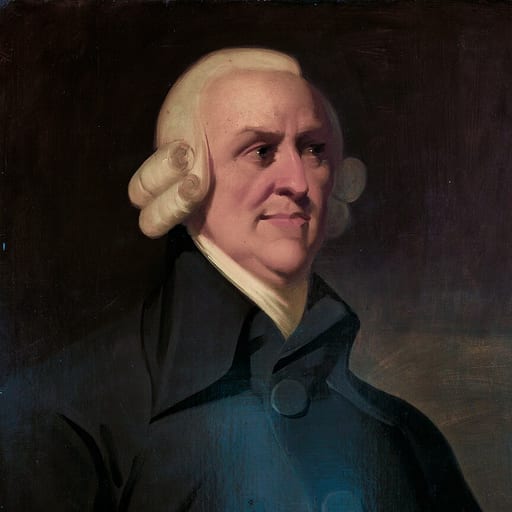
Adam Smith
애덤 스미스
Scottish economist and moral philosopher; The Wealth of Nations
743 records in all
- Principles 261
- Episodes 185
- Quotes 297
3 free questions a day, no sign-up.
Photo: Unknown author Public domain Original cropped
Quotes
45 basic records of 297
Quotes are word for word from the source.
Sustainable Productivity
It will be found, I believe, in every sort of trade, that the man who works so moderately, as to be able to work constantly, not only preserves his health the longest, but, in the course of the year, executes the greatest quantity of work.
Our noteSmith argues against overworking and in favor of a sustainable pace for long-term output.
Incentive based work
A journeyman who works by the piece is likely to be industrious, because he derives a benefit from every exertion of his industry.
Our noteSmith discusses how direct rewards for effort lead to higher productivity.
Terms of trade
The dearer the latter are sold, the cheaper the former are bought.
Our noteHe explains the relationship between the price of manufactured goods and raw materials.
Labor and capital
Whatever obstructs the free circulation of labour from one employment to another, obstructs that of stock likewise; the quantity of stock which can be employed in any branch of business depending very much upon that of the labour which can be employed in it.
Our noteSmith discusses how restrictions on hiring and labor movement also limit business investment.
Efficiency through Infrastructure
The advantage of inclosure is greater for pasture than for corn. It saves the labour of guarding the cattle, which feed better, too, when they are not liable to be disturbed
Our noteDiscussing how physical boundaries reduce labor costs and improve product quality.
Natural price convergence
Ninety years is time sufficient to reduce any commodity, of which there is no monopoly, to its natural price
Our noteSmith discusses how competition eventually drives prices down to their sustainable production cost.
Defining Relative Value
A commodity may be said to be dear or cheap not only according to the absolute greatness or smallness of its usual price, but according as that price is more or less above the lowest for which it is possible to bring it to market
Our noteSmith explains that true value is measured by how close a price is to its production cost.
Regulate your intensity
He must flatten, if I may be allowed to say so, the sharpness of its natural tone, in order to reduce it to harmony and concord with the emotions of those who are about him.
Our noteThe importance of moderating one's own emotional intensity to maintain social and professional harmony.
transience of pain
Nothing is so soon forgot as pain. The moment it is gone the whole agony of it is over, and the thought of it can no longer give us any sort of disturbance.
Our noteSmith explains why physical pain is quickly forgotten compared to mental distress.
cost of self-deceit
This self-deceit, this fatal weakness of mankind, is the source of half the disorders of human life.
Our noteHe identifies self-delusion as a primary cause of conflict and disorder in society.
Value of Variety
Variety is more pleasing than a tedious undiversified uniformity.
Our noteHe notes that human perception naturally prefers diversity over repetitive uniformity.
Basic Ethical Justice
In one sense we are said to do justice to our neighbour when we abstain from doing him any positive harm, and do not directly hurt him, either in his person, or in his estate, or in his reputation.
Our noteSmith defines the most basic level of justice as simply avoiding harm to others.
The Golden Mean
Every particular virtue, according to him, lies in a kind of middle between two opposite vices, of which the one offends from being too much, the other from being too little affected by a particular species of objects.
Our noteExplaining Aristotle's view that virtue is found in moderation between extremes.
Action Over Knowledge
Aristotle, on the contrary, was of opinion, that no conviction of the understanding was capable of getting the better of inveterate habits, and that good morals arose not from knowledge but from action.
Our noteContrasting the importance of building habits versus merely having intellectual knowledge.
Society as Machine
Human society, when we contemplate it in a certain abstract and philosophical light, appears like a great, an immense machine, whose regular and harmonious movements produce a thousand agreeable effects.
Our noteSmith describes the beauty of a well-functioning social order.
You are seeing 112 basic records. Membership answers from all 743 of this master's records.
See membershipMore masters in this field
See the whole fieldMoney and wealth thinking


These records are our compilation of public statements and sources. We are not affiliated with or endorsed by Adam Smith or any related company. If something should come down, tell us. Takedown request form