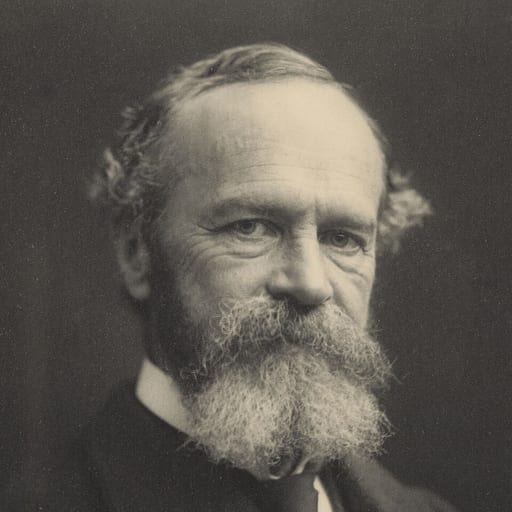
William James
윌리엄 제임스
Psychologist and pragmatist philosopher who wrote on habit
1,168 records in all
- Principles 407
- Episodes 213
- Quotes 548
3 free questions a day, no sign-up.
Photo: Notman Studios (photographer) Public domain Original cropped
Quotes
82 basic records of 548
Quotes are word for word from the source.
Movement and attention
Every such movement draws the points and lines of the object across the surface, imprints them a hundred times more sharply, and drives them home to the attention.
Our noteJames explains how active movement enhances our perception and focus on an object.
Sensitivity to change
Steady rotation gives no sensation; it is only starting or stopping, or, more generally speaking, acceleration (positive or negative), which impresses the end-organs in the ampullæ.
Our noteJames describes how our sense of rotation responds only to changes in velocity, not steady states.
useful responses
These acts of response have usually the common character of being of service.
Our noteJames notes that biological responses are generally designed to be practical and beneficial.
Obeying Absent Objects
the main difference between the hemisphereless animal and the whole one may be concisely expressed by saying that _the one obeys absent, the other only present, objects
Our noteThe ability to act based on memory and future expectations rather than just immediate surroundings.
The Virtue of Prudence
no animal without it can deliberate, pause, postpone, nicely weigh one motive against another, or compare. Prudence, in a word, is for such a creature an impossible virtue.
Our noteDeliberation and the weighing of motives are essential for prudent decision-making.
Freeing mental capacity
The more of the details of our daily life we can hand over to the effortless custody of automatism, the more our higher powers of mind will be set free for their own proper work.
Our noteJames explains why automating routine tasks is essential for focusing on high-level work.
The Fundamental Fact
The first and foremost concrete fact which every one will affirm to belong to his inner experience is the fact that _consciousness of some sort goes on.
Our noteHe identifies the continuous flow of thought as the primary reality of mental life.
Constant Change
no state once gone can recur and be identical with what it was before_. Now we are seeing, now hearing; now reasoning, now willing; now recollecting, now expecting
Our noteHe emphasizes that the mind is in a state of constant flux and never repeats exactly.
Uniqueness of thought
Every thought we have of a given fact is, strictly speaking, unique, and only bears a resemblance of kind with our other thoughts of the same fact.
Our noteHe argues that no two thoughts are ever identical because the brain is constantly modified.
The burden of identity
Everything added to the Self is a burden as well as a pride.
Our noteJames reflects on how maintaining a certain image or status requires constant effort.
The law of fusion
The law is that all things fuse that _can_ fuse, and that nothing separates except what must.
Our noteDescribing how the mind naturally groups simultaneous impressions into a single object.
Limits of will
We can say any of these things, but we are absolutely impotent to believe them
Our noteDiscussing how we cannot simply force ourselves to believe something that contradicts clear facts.
Iterative learning
I live, to be sure, by the practical faith that we must go on experiencing and thinking over our experience, for only thus can our opinions grow more true
Our noteJames explains his empiricist approach to building knowledge through constant experience.
Truth vs error
We must know the truth_; and _we must avoid error_,--these are our first and great commandments as would-be knowers; but they are not two ways of stating an identical commandment, they are two separable laws.
Our noteJames distinguishes between the drive to find truth and the fear of being wrong.
Hope vs Fear
Dupery for dupery, what proof is there that dupery through hope is so much worse than dupery through fear?
Our noteJames questions why people fear being wrong more than they value being right.
Respect Mental Freedom
We ought, on the contrary, delicately and profoundly to respect one another's mental freedom: then only shall we bring about the intellectual republic
Our noteJames advocates for tolerance and respect for different beliefs in a free society.
Efficiency of thought
a philosophic conception of nature is thus in no metaphorical sense a labor-saving contrivance.
Our noteHe explains that simplifying complex data into a single theory reduces the mental effort required to process it.
Power of Habit
The daily contemplation of phenomena juxtaposed in a certain order begets an acceptance of their connection, as absolute as the repose engendered by theoretic insight into their coherence.
Our noteJames explains how familiarity creates a sense of rationality and mental ease.
The Power of Choice
Themselves it is rather who seem to make nature continuous; and in their strange and intense function of granting consent to one possibility and withholding it from another, to transform an equivocal and double future into an inalterable and simple past.
Our noteJames describes how human decisions transform potential futures into fixed history.
The Value of Choice
What interest, zest, or excitement can there be in achieving the right way, unless we are enabled to feel that the wrong way is also a possible and a natural way
Our noteHe argues that the possibility of failure is what gives success its meaning.
Belief in Action
I cannot understand the willingness to act, no matter how we feel, without the belief that acts are really good and bad.
Our noteJames emphasizes that moral distinctions are necessary for the motivation to act.
Internal motivation
the only force of appeal to _us_, which either a living God or an abstract ideal order can wield, is found in the 'everlasting ruby vaults' of our own human hearts
Our noteHe emphasizes that moral authority only has power if it resonates with human feelings.
You are seeing 175 basic records. Membership answers from all 1,168 of this master's records.
See membershipMore masters in this field
See the whole fieldMindset and resilience



These records are our compilation of public statements and sources. We are not affiliated with or endorsed by William James or any related company. If something should come down, tell us. Takedown request form