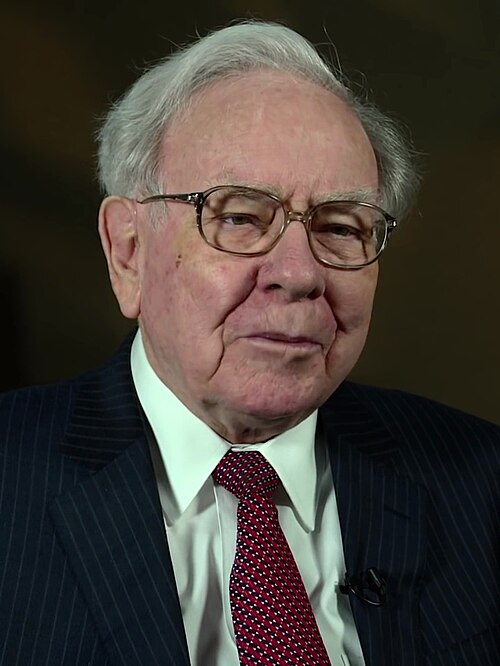
Warren Buffett
워런 버핏
Longtime leader of Berkshire Hathaway who practiced long-term compounding by investing within his circle of competence in businesses with durable economic moats and margins of safety.
1,409 records in all
- Principles 389
- Episodes 279
- Quotes 741
3 free questions a day, no sign-up.
Photo: USA International Trade Administration Public domain Original cropped
Quotes
111 basic records of 741
Quotes are word for word from the source.
Share Issuance
When we issue shares in a merger, we reduce your ownership in all of our businesses -- partly-owned companies such as Coca-Cola, Gillette and American Express, and all of our terrific operating companies as well.
Our noteIssuing shares for mergers dilutes the ownership value of existing shareholders across all underlying businesses.
Capital Allocation
we find nothing particularly noteworthy in a management performance combining, say, a 10% increase in equity capital and a 5% increase in earnings per share.
Our noteEarnings growth that lags behind the increase in equity capital does not represent impressive management performance.
Compound capital deployment
At Berkshire, we particularly favor the rare enterprise that can deploy additional capital at high returns in the future. Owning only one of these companies - and simply sitting tight - can deliver wealth almost beyond measure.
Our noteBuffett describes the ideal business model for long-term wealth creation.
Currency forecasting limits
Neither Greg nor I believe we can forecast market prices of major currencies. We also don't believe we can hire anyone with this ability.
Our noteExplaining why Berkshire hedges its Japanese investments with yen-denominated debt.
Customer price advantage
Our goal, however, is not to widen our profit margin but rather to enlarge the price advantage we offer customers.
Our noteBuffett emphasizes prioritizing long-term competitive advantage over short-term profit margins.
Book vs intrinsic value
Book value tells you what has been put in; intrinsic business value estimates what can be taken out.
Our noteBuffett distinguishes between accounting measures and the actual economic value of a company.
Value through content
Properly written and edited, a full serving of news makes our paper more valuable to the reader and contributes to our unusual penetration ratio.
Our noteBuffett explains why the Buffalo News maintains a high percentage of editorial content compared to ads.
CEO Capital Allocation
If a CEO can be expected to do this job well, the reinvestment prospects add to the company's current value; if the CEO's talents or motives are suspect, today's value must be discounted.
Our noteThe importance of management's ability to deploy retained earnings effectively.
Hiring Passionate Leaders
Many of our CEOs are independently wealthy and work only because they love what they do. They are volunteers, not mercenaries.
Our noteThe motivation of the managers who run Berkshire Hathaway's diverse businesses.
Capital Allocation Limits
Most companies limit themselves to reinvesting funds within the industry in which they have been operating. That often restricts them, however, to a "universe" for capital allocation that is both tiny and quite inferior
Our noteThe disadvantage of companies that only reinvest within their own narrow industry.
Incentive structure design
We want a compensation system that pays off big for individual success but that also fosters cooperation, not competition.
Our noteBuffett explains the logic behind the compensation structure for Berkshire's investment managers.
Investment style flexibility
At Berkshire our only style box is "smart.
Our noteBuffett rejects rigid industry categories for investment managers in favor of general intelligence.
Capital Allocation Goal
When managers are making capital allocation decisions - including decisions to repurchase shares - it's vital that they act in ways that increase per-share intrinsic value
Our noteBuffett emphasizes the primary responsibility of management when deploying company cash.
Timing of mistakes
Mistakes occur at the time of decision. We can only make our mistake-du-jour award, however, when the foolishness of the decision become obvious.
Our noteBuffett discusses how investment errors are made at the start but realized much later.
Active management failure
The problem simply is that the great majority of managers who attempt to over-perform will fail.
Our noteBuffett discusses the difficulty of finding investment managers who can consistently beat the market.
Nature of Insurance
Insurance companies offer standardized policies which can be copied by anyone. Their only products are promises. It is not difficult to be licensed, and rates are an open book.
Our noteBuffett explains why the insurance industry lacks traditional competitive moats like patents or location.
Acquiring Quality Assets
We will continue, however, to acquire quality brokerage operations when they are available at sensible prices.
Our noteBuffett discusses his strategy for HomeServices despite a terrible year for home sales.
CEO as Risk Officer
I both initiated these positions and monitor them, a set of responsibilities consistent with my belief that the CEO of any large financial organization must be the Chief Risk Officer as well.
Our noteBuffett explains why he personally manages Berkshire's derivatives portfolio.
Benefits of Float
If we break even on an underlying transaction, we will have enjoyed the use of free money for a long time.
Our noteBuffett describes the advantage of receiving premiums upfront in derivatives contracts.
Avoid small commitments
If something's not worth doing at all, it's not worth doing well
Our noteBuffett explains why Berkshire avoids small investments and focuses on significant opportunities.
Desperation pricing
insurers with large holdings of bonds valued, for accounting purposes, at nonsensically high prices would have little choice but to keep the money revolving by selling large numbers of policies at nonsensically low prices.
Our noteHe describes how poor balance sheets force companies to chase cash flow at any cost.
Friendly Acquisitions Only
At Berkshire, we go only where we are welcome.
Our noteBuffett states Berkshire's policy against hostile takeovers.
Proven earning power
Demonstrated consistent earning power (future projections are of little interest to us, nor are "turnaround" situations
Our noteBuffett lists the criteria for businesses Berkshire Hathaway is interested in acquiring.
Ignoring Academic Pedigree
I never look at where a candidate has gone to school. Never! Of course, there are great managers who attended the most famous schools. But there are plenty such as Pete who may have benefitted by attending a less prestigious institution
Our noteBuffett explains his criteria for selecting CEOs and managers.
Pricing Discipline
We must never write inadequately-priced policies in order to stay in the game. That policy is corporate suicide.
Our noteBuffett explains why maintaining pricing integrity is more important than maintaining market share in insurance.
Betting on America
Charlie and I have always considered a "bet" on ever-rising U.S. prosperity to be very close to a sure thing.
Our noteBuffett reflects on the long-term economic optimism that drives Berkshire's major investments.
Market Sentiment
A climate of fear is your friend when investing; a euphoric world is your enemy.
Our noteBuffett explains how to view market fluctuations and investor emotions.
Investing in people
Betting on people can sometimes be more certain than betting on physical assets.
Our noteBuffett emphasizes trusting extraordinary managers even when he doesn't fully understand the technical manufacturing details.
Dangers of Debt
There is simply no telling how far stocks can fall in a short period. Even if your borrowings are small and your positions aren't immediately threatened by the plunging market, your mind may well become rattled by scary headlines and breathless commentary.
Our noteWarning against using borrowed money to buy stocks because of psychological pressure during market crashes.
Beyond Simple Ratios
Sometimes there is more to stock valuation than price-earnings ratios.
Our noteBuffett reflects on the Rockwood & Co. deal where asset value mattered more than earnings.
You are seeing 211 basic records. Membership answers from all 1,409 of this master's records.
See membershipMore masters in this field
See the whole fieldInvesting and capital allocation





These records are our compilation of public statements and sources. We are not affiliated with or endorsed by Warren Buffett or any related company. If something should come down, tell us. Takedown request form