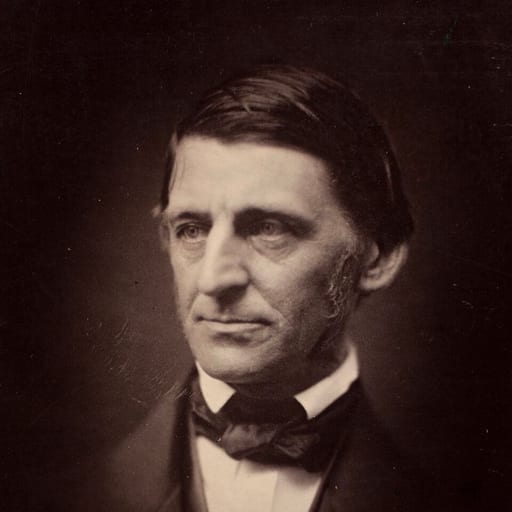
Ralph Waldo Emerson
랠프 월도 에머슨
Essayist and lecturer; author of Self-Reliance
1,253 records in all
- Principles 399
- Episodes 233
- Quotes 621
3 free questions a day, no sign-up.
Photo: Josiah Johnson Hawes Public domain Original cropped
Quotes
93 basic records of 621
Quotes are word for word from the source.
Fairness of value
The gods sell anything to everybody at a fair price.
Our noteEmerson comments on the nature of originality and the cost of things.
Encouraging others
There is a power in love to divine another's destiny better than that other can, and by heroic encouragements, hold him to his task.
Our noteEmerson discusses how belief in a partner or employee can help them stay committed to their work.
Style and Substance
The grandeur of the topics makes the grandeur of the style.
Our noteEmerson explains how Swedenborg's deep knowledge of nature elevated his writing style.
Shared Vision
Do you love me? means, Do you see the same truth? If you do, we are happy with the same happiness; but presently one of us passes into the perception of new truth
Our noteEmerson reflects on how relationships and partnerships are fundamentally based on a shared perception of truth.
Fluid Collaboration
We meet, and dwell an instant under the temple of one thought, and part as though we parted not, to join another thought in other fellowships of joy.
Our noteEmerson describes the transient but meaningful nature of intellectual and professional connections.
Prudence in property
Things always bring their own philosophy with them, that is, prudence. No man acquires property without acquiring with it a little arithmetic, also.
Our noteHe discusses how practical ownership naturally teaches a person the necessity of calculation and caution.
Vitality in writing
It is the language of conversation transferred to a book. Cut these words, and they would bleed; they are vascular and alive.
Our noteEmerson praises writing that feels as direct and alive as a real conversation.
Collective Genius
It is easy to see that what is best written or done by genius, in the world, was no man's work, but came by wide social labor, when a thousand wrought like one, sharing the same impulse.
Our noteEmerson explains that great works are often the culmination of many people's efforts over time.
Everything is material
Whatever he beholds or experiences, comes to him as a model, and sits for its picture. He counts it all nonsense that they say, that some things are undescribable.
Our noteA true creator views every life event as raw material for their work and believes everything can be expressed.
Direct observation
Eyes are better, on the whole, than telescopes or microscopes.
Our noteEmphasizing the value of human perception over artificial tools for understanding nature.
Practical Common Sense
The practical common-sense of modern society, the utilitarian direction which labor, laws, opinion, religion, take, is the natural genius of the British mind.
Our noteEmerson identifies the core strength of British influence as its relentless focus on utility and common sense.
Fusion of opposites
Everything English is a fusion of distant and antagonistic elements.
Our noteHe observes that the strength of the English character comes from blending conflicting traits.
Reliability and trust
Faithful performance of what is undertaken to be performed, they honor in themselves, and exact in others, as certificate of equality with themselves.
Our noteReliability is the foundation of professional respect and social standing.
Focus on net results
It is their maxim, that the weight of taxes must be calculated, not by what is taken, but by what is left.
Our noteThe English evaluate their financial burden by looking at their remaining capital rather than the amount paid out.
Tools of power
The tools of our time, namely, steam, ships, printing, money, and popular education, belong to those who can handle them
Our noteEmerson explains how industrial and educational tools shifted power from the aristocracy to the capable middle class.
Resilience through courage
it might now and then bear the brunt of formidable combinations, but no journal is ruined by wise courage.
Our noteEmerson suggests that standing for the right cause provides a long-term invincibility that outweighs temporary opposition.
Learning from the world
If you would learn to write, 'tis in the street you must learn it. Both for the vehicle and for the aims of fine arts, you must frequent the public square.
Our noteEmerson explains that practical experience in society is essential for mastering any craft or art.
Power of association
Concert fires people to a certain fury of performance they can rarely reach alone. Here is the use of society: it is so easy with the great to be great
Our noteHe discusses how being around high-performing people raises one's own standard of performance.
Art and Nature
Art must be a complement to nature, strictly subsidiary.
Our noteHe explains that useful arts must follow natural laws to be effective.
Power of Common Sense
Lord Mansfield's merit is the merit of common sense. It is the same quality we admire in Aristotle, Montaigne, Cervantes, or in Samuel Johnson, or Franklin.
Our noteHe argues that the greatest intellectual masters rely on common sense rather than technical jargon.
Moral eloquence
The highest platform of eloquence is the moral sentiment. It is what is called affirmative truth, and has the property of invigorating the hearer
Our noteHe describes how moral truth is the most powerful tool for moving an audience.
Value of networking
The ornament of a house is the friends who frequent it. There is no event greater in life than the appearance of new persons about our hearth
Our noteHe emphasizes that the true value of a home lies in the quality of its visitors.
Radiating influence
If by love and nobleness we take up into ourselves the beauty we admire, we shall spend it again on all around us.
Our noteHe explains how internalizing virtues allows one to positively influence others.
Leveraging Natural Systems
the earth is a machine which yields almost gratuitous service to every application of intellect. Every plant is a manufacturer of soil.
Our noteOn how human intellect can harness natural processes for production.
The present moment
This element of illusion lends all its force to hide the values of present time.
Our noteHow distractions and future-thinking prevent us from valuing the work we have now.
Self defense necessity
Nature has made up her mind that what cannot defend itself shall not be defended. Complaining never so loud, and with never so much reason, is of no use.
Our noteEmerson argues that external protection follows internal strength and self-defense.
Expanding your world
The world is enlarged for us, not by new objects, but by finding more affinities and potencies in those we have.
Our noteHe suggests that growth comes from deeper perception of existing resources rather than constant acquisition.
The ultimate enterprise
The main enterprise of the world for splendor, for extent, is the upbuilding of a man.
Our noteEmerson discusses the primary purpose of human existence and effort.
Value in common
I embrace the common, I explore and sit at the feet of the familiar, the low.
Our noteEmerson explains his preference for finding insight in everyday things rather than the remote.
Authentic expression
Speak what you think now in hard words, and to-morrow speak what to-morrow thinks in hard words again, though it contradict everything you said to-day.
Our noteEmerson encourages speaking one's current truth without being bound by previous statements.
You are seeing 188 basic records. Membership answers from all 1,253 of this master's records.
See membershipMore masters in this field
See the whole fieldPhilosophy and wisdom traditions
These records are our compilation of public statements and sources. We are not affiliated with or endorsed by Ralph Waldo Emerson or any related company. If something should come down, tell us. Takedown request form