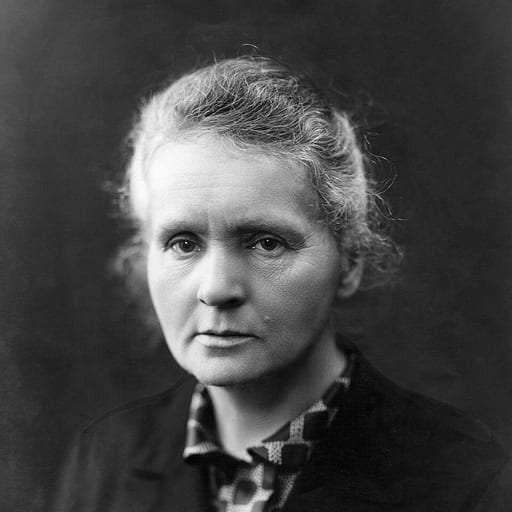
Marie Curie
마리 퀴리
Physicist and chemist; first person to win two Nobel Prizes
437 records in all
- Principles 156
- Episodes 112
- Quotes 169
3 free questions a day, no sign-up.
Photo: Henri Manuel Public domain Original cropped
Quotes
25 basic records of 169
Quotes are word for word from the source.
Observation skills
Guided by his father, he learned to observe facts and to interpret them correctly.
Our notePierre's father taught him the fundamental scientific skill of objective observation.
Intrinsic motivation
He felt that the desire to obtain them is a cause of trouble, and that it can degrade the worthiest aim of man, which is, work for the pure love of it.
Our noteMarie Curie explains why Pierre Curie avoided seeking honorary distinctions and awards.
Invariable natural laws
Pierre Curie demonstrated by a searching examination the rigorous and invariable law according to which the emanation destroys itself, no matter what the conditions are in which it finds itself.
Our noteMarie Curie describes her husband's discovery of the predictable decay of radium emanation.
Data driven decisions
Technical considerations make its employment preferable to the direct use of radium, and in this case no physician can proceed without consulting the numerical chart which tells how much of this emanation has disappeared each day
Our noteShe explains how physicians must rely on precise data charts for effective medical treatment.
Precision in measurement
It seemed to me that the first thing to do was to measure the phenomenon with precision.
Our noteMarie describes her initial approach to studying uranium rays using precise instrumentation.
Cost of publicity
The overturn of our voluntary isolation was a cause of real suffering for us and had all the effect of disaster.
Our noteThe Curies struggled with the loss of privacy after winning the Nobel Prize.
Holistic education approach
in the education of children the requirement of their growth and physical evolution should be respected, and that some time should be left for their artistic culture.
Our noteCurie shares her philosophy on the importance of physical and artistic development alongside academics.
Sharing knowledge
No detail was kept secret, and it is due to the information we gave in our publications that the industry of radium has been rapidly developed.
Our noteThe impact of their transparency on the growth of the radium industry.
The role of dreamers
But it also needs dreamers, for whom the unselfish following of a purpose is so imperative that it becomes impossible for them to devote much attention to their own material benefit.
Our noteDescribing the necessity of idealistic researchers in society.
Contextualizing individual work
Whilst endeavouring to keep strictly to the limits of this work and to publish my individual research only, I have been obliged at the same time to mention results of other researches
Our noteShe explains the necessity of acknowledging the broader field to make her own work understandable.
Challenging assumptions
I undertook this research with the idea that it was scarcely probable that radio-activity, considered as an atomic property, should belong to a certain kind of matter to the exclusion of all other.
Our noteCurie explains her hypothesis that radioactivity might be a more widespread property than previously thought.
Choosing the Method
The difficulty of finding a very perfect means of separating closely allied elements is well known; methods of fractionation are therefore quite suitable.
Our noteMarie Curie explains why she chose fractionation to isolate new elements.
Resource Constraints
Pitchblende is an expensive ore, and we have given up the treatment of it in large quantities.
Our noteMarie Curie explains why they had to stop using expensive raw materials.
Resource management
The number of portions is not allowed to increase indefinitely. The activity of the most soluble portion diminishes as the number increases. When its activity becomes inconsiderable, it is withdrawn from the fractionation.
Our noteDescribing the systematic removal of low-value material to focus on high-value output.
Validating small samples
I thus saw that the method gives satisfactory results, even with a very small quantity of material.
Our noteShe confirms that her measurement technique works even when resources are extremely limited.
Unique product properties
Radium is the first example of a body which is spontaneously charged with electricity.
Our noteMarie Curie explains the groundbreaking discovery of radium's spontaneous electrical charge.
Applying existing frameworks
In the study of the emission of the β-rays of radium, we are therefore led to make use of the theory which is in vogue for the study of cathode rays.
Our noteCurie explains the importance of using established theories to understand new phenomena.
Constraints in experimentation
The experiments are not easily carried out, except with very intense radio-active sources, because, independently of the absorption by the air, the action upon a given receiver varies inversely as the square of the distance
Our noteExplaining why high-intensity sources are necessary to measure radiation at a distance.
Experimental methodology
I endeavoured to demonstrate a transformation of the rays of polonium by using the method of interchangeable screens.
Our noteCurie explains her specific approach to testing how radiation changes when passing through different materials.
Evidence based conclusions
The results obtained prove that the radiation is modified in passing through a solid screen.
Our noteShe confirms that her experiments successfully demonstrated the transformation of radiation through matter.
Stability of radiation
This leads to the conclusion that the radiation of radium does not vary with the temperature, and remains unaltered even at the temperature of liquid air.
Our noteMarie Curie explains that radium's core properties remain consistent regardless of extreme environmental temperature changes.
Unprecedented energy sources
So great an evolution of heat can be explained by no ordinary chemical reaction, more particularly as the condition of the radium remains unaffected for years.
Our noteMarie Curie explains the mysterious and continuous heat generated by radium.
Precision and purity
If we realise what an infinitesimal quantity of radium suffices to produce very considerable radio-activity in 1 grm. of material, it is difficult to believe in the possibility of sufficiently washing and purifying the active product.
Our noteDiscussing the difficulty of removing trace elements that have a massive impact.
Environmental contamination
In our laboratory the evil has become acute, and we no longer have any apparatus properly insulated.
Our noteMarie Curie describes how radioactive dust and air affected every piece of equipment in her lab.
Pure research value
scientific work must not be considered from the point of view of the direct usefulness of it. It must be done for itself
Our noteShe delivered a lecture at Vassar College about the discovery of radium.
You are seeing 65 basic records. Membership answers from all 437 of this master's records.
See membershipMore masters in this field
See the whole fieldScience and first-principles thinking

These records are our compilation of public statements and sources. We are not affiliated with or endorsed by Marie Curie or any related company. If something should come down, tell us. Takedown request form