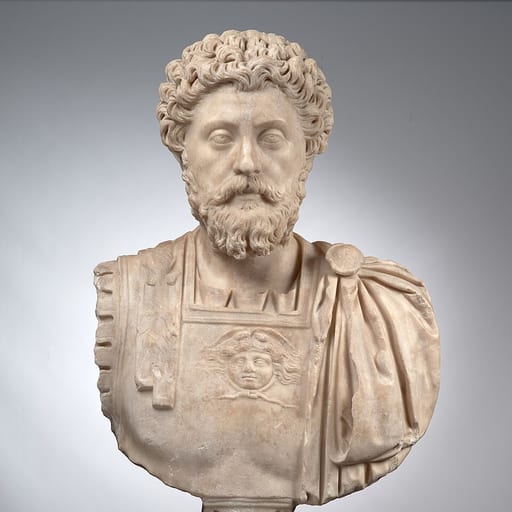
Marcus Aurelius
마르쿠스 아우렐리우스
Roman emperor and Stoic; author of Meditations
812 records in all
- Principles 254
- Episodes 188
- Quotes 370
3 free questions a day, no sign-up.
Photo: Daniel Martin CC BY-SA 4.0 Original cropped
Quotes
56 basic records of 370
Quotes are word for word from the source.
Learning from mentors
Antoninus means to commemorate the merits of his several teachers, what they taught, and what a pupil might learn from them.
Our noteThe author explains why Marcus Aurelius recorded the virtues of his teachers in his writings.
Consistent evaluation
A man can only act consistently by accepting all this letter or rejecting it all, and we cannot blame him for either.
Our noteThe importance of maintaining logical consistency when evaluating the reliability of a source.
Protecting the innocent
innocent people must not be troubled, and false accusers must not be allowed to extort money from them
Our noteHadrian's rescript instructed governors to prevent false accusations and extortion against minority groups.
Purposeful action
As plants and animals do the uses of their nature, so man must do his
Our noteMarcus emphasizes that humans are built for action and fulfilling their specific role in the world.
Investing in education
From my great-grandfather,[D] not to have frequented public schools, and to have had good teachers at home, and to know that on such things a man should spend liberally.
Our noteHe emphasizes the value of high-quality private instruction and the willingness to pay for it.
Leading Without Excess
it is possible for a man to live in a palace without wanting either guards or embroidered dresses, or torches and statues, and such-like show
Our noteRealizing that high office does not require expensive displays to be effective or respected.
Purposeful action
it being right that even the smallest things be done with reference to an end
Our noteHe advises that every action, no matter how small, should have a goal.
Eliminate the unnecessary
For the greatest part of what we say and do being unnecessary, if a man takes this away, he will have more leisure and less uneasiness.
Our noteHe advises focusing only on essential tasks to improve productivity and mental peace.
Master your craft
Love the art, poor as it may be, which thou hast learned, and be content with it
Our noteMarcus encourages finding contentment and purpose in one's specific vocation or skill set.
Power of thought
Such as are thy habitual thoughts, such also will be the character of thy mind; for the soul is dyed by the thoughts.
Our noteAurelius explains how repeated thoughts shape one's internal character and mental state.
Natural endurance
Nothing happens to any man which he is not formed by nature to bear.
Our noteAurelius encourages resilience by stating that humans are built to handle life's challenges.
Focus on duty
every duty is made up of certain parts. These it is thy duty to observe, and without being disturbed or showing anger towards those who are angry with thee, to go on thy way and finish that which is set before thee.
Our noteMarcus advises staying composed and finishing tasks despite the emotional reactions of others.
Mental endurance
It is a shame for the soul to be first to give way in this life, when thy body does not give way.
Our noteHe emphasizes the importance of mental resilience when the body is still capable.
Plain communication
Speak both in the senate and to every man, whoever he may be, appropriately, not with any affectation: use plain discourse.
Our noteAdvice on communicating effectively and authentically without unnecessary complexity.
Sins of omission
He often acts unjustly who does not do a certain thing; not only he who does a certain thing.
Our noteHe points out that failing to act can be just as harmful as acting wrongly.
Accepting the end
Depart then satisfied, for he also who releases thee is satisfied.
Our noteMarcus uses the metaphor of an actor leaving the stage to describe accepting the end of one's work or life.
Avoiding partisan bias
From my governor, to be neither of the green nor of the blue party at the games in the Circus, nor a partisan either of the Parmularius or the Scutarius
Our noteThe importance of remaining neutral and not getting swept up in tribalism or popular factions.
Anticipating difficult people
Begin the morning by saying to thyself, I shall meet with the busybody, the ungrateful, arrogant, deceitful, envious, unsocial.
Our notePreparing the mind for the inevitable friction of dealing with difficult personalities in business.
Continuous learning
Give thyself time to learn something new and good, and cease to be whirled around.
Our noteHe advises taking time for meaningful learning to avoid being distracted by external chaos.
Efficiency through reason
Always run to the short way; and the short way is the natural: accordingly say and do everything in conformity with the soundest reason.
Our noteHe suggests that following nature and reason is the most direct path to effective action.
Objective reality
Things stand outside of us, themselves by themselves, neither knowing aught of themselves, nor expressing any judgment. What is it, then, which does judge about them? The ruling faculty.
Our noteHe emphasizes that external objects are neutral; only our minds assign them value or judgment.
Social purpose
Whatever act of thine then has no reference either immediately or remotely to a social end, this tears asunder thy life, and does not allow it to be one
Our noteHe stresses that every action should contribute to the greater good to maintain a cohesive life.
Correcting others
If a man is mistaken, instruct him kindly and show him his error. But if thou art not able, blame thyself, or blame not even thyself.
Our noteA simple rule for dealing with the mistakes of others in a team or society.
Focus on your actions
Suppose any man shall despise me. Let him look to that himself. But I will look to this, that I be not discovered doing or saying anything deserving of contempt.
Our noteHe explains that one should focus on their own character rather than others' opinions.
Internalized skills
In the application of thy principles thou must be like the pancratiast, not like the gladiator; for the gladiator lets fall the sword which he uses and is killed; but the other always has his hand, and needs to do nothing else than use it.
Our noteAdvocating for skills and principles that are part of oneself rather than external tools.
frugal living
He was taught to dress plainly and to live simply, to avoid all softness and luxury.
Our noteThe passage describes the Stoic upbringing that shaped Marcus's disciplined lifestyle.
Rejecting empty praise
how all acclamations and flattery were repressed by him: how carefully he observed all things necessary to the government
Our noteFocusing on the actual health of the organization rather than being distracted by ego-stroking flattery.
Power of perception
Remember that all is but opinion and conceit
Our noteHe discusses how our internal judgment shapes our reality more than external events.
Self reliance
never to do anything either rashly, or feignedly, or hypocritically: wholly to depend from himself and his own proper actions
Our noteAurelius outlines the core of his personal philosophy for leadership and life.
Commit to excellence
Do thou therefore I say absolutely and freely make choice of that which is best, and stick unto it.
Our noteEncouragement to identify the highest good and remain committed to it.
You are seeing 122 basic records. Membership answers from all 812 of this master's records.
See membershipMore masters in this field
See the whole fieldPhilosophy and wisdom traditions
These records are our compilation of public statements and sources. We are not affiliated with or endorsed by Marcus Aurelius or any related company. If something should come down, tell us. Takedown request form