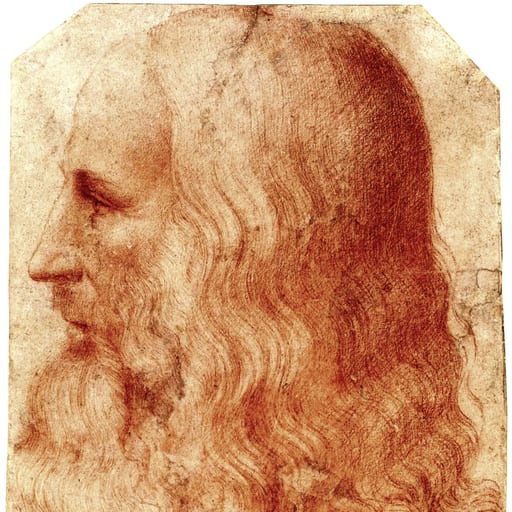
Leonardo da Vinci
레오나르도 다 빈치
Renaissance painter, engineer and notebook keeper
873 records in all
- Principles 297
- Episodes 206
- Quotes 370
3 free questions a day, no sign-up.
Photo: Attributed to Francesco Melzi Public domain Original cropped
Quotes
56 basic records of 370
Quotes are word for word from the source.
Value of feedback
That a Painter should take Pleasure in the Opinion of every Body.
Our noteLeonardo emphasizes the importance of listening to diverse opinions on one's work.
Mastering the basics
In order to acquire a true notion of the form of things, he must begin by studying the parts which compose them, and not pass to a second till he has well stored his memory
Our noteLeonardo explains the necessity of learning components thoroughly before moving to complex structures.
Testing for grit
Many/ are very desirous of learning to draw, and are very fond of it, who are, notwithstanding, void of a proper disposition for it. This may be known by their want of perseverance
Our noteHe identifies perseverance as the true indicator of talent and suitability for a craft.
Danger of over-specialization
It/ reflects no great honour on a painter to be able to execute only one thing well, such as a head, an academy figure, or draperies, animals, landscape, or the like
Our noteHe warns against limiting one's skills to a single niche or subject.
Stimulating the mind
By these confused lines the inventive genius is excited to new exertions.
Our noteHe describes how abstract shapes can push a creator toward original work.
Evidence based decisions
The best way is to steer a middle course, and not to admit of any reflected light, but when the cause of it is evident to every eye
Our noteAdvising painters on how to handle controversial techniques by relying on clear evidence.
Surface area impact
The/ colour of any object will appear more or less distinct in proportion to the extent of its surface.
Our noteLeonardo notes that the size of a surface affects how clearly its color is perceived.
Infinite Variety
Endeavour to vary the colour of meadows, stones, trunks of trees, and all other objects, as much as possible, for Nature abounds in variety _ad infinitum
Our noteEncouraging artists to avoid uniformity and embrace the natural diversity found in the world.
Immediate error correction
Remember/, that when, by the exercise of your own judgment, or the observation of others, you discover any errors in your work, you immediately set about correcting them
Our noteLeonardo advises against delaying fixes, as unfinished or flawed work remains a monument to one's ignorance.
Perspective and movement
Heigh light or lustre on any object is not situated [necessarily] in the middle of an illuminated object, but moves as and where the eye moves in looking at it.
Our noteHe describes how the observer's position changes the appearance of a product.
Proximity to source
That portion of an illuminated object which is nearest to the source of light will be the most strongly illuminated.
Our noteA fundamental rule about how distance affects the intensity of light on a surface.
Environmental influence
Shadows fade and are lost at long distances because the larger quantity of illuminated air which lies between the eye and the object seen tints the shadow with its own colour.
Our noteHe describes why visual details lose clarity over long distances due to atmospheric interference.
True Color Visibility
It is the light side of an object in light and shade which shows the true colour.
Our noteIdentifying where the authentic essence of a product or object is best observed.
Avoid visual confusion
Never paint leaves transparent to the sun, because they are confused; and this is because on the transparency of one leaf will be seen the shadow of another leaf which is above it.
Our noteLeonardo explains why painting overlapping transparent leaves creates a messy and indistinct image for the viewer.
Identifying true talent
Many are they who have a taste and love for drawing, but no talent; and this will be discernible in boys who are not diligent and never finish their drawings with shading.
Our noteLeonardo explains how to distinguish between a mere hobbyist and someone with professional potential.
Self-Correction Bias
We know very well that errors are better recognised in the works of others than in our own; and that often, while reproving little faults in others, you may ignore great ones in yourself.
Our noteLeonardo explains why it is difficult to judge one's own work objectively.
The Value of Distance
Again, it is well that you should often leave off work and take a little relaxation, because, when you come back to it you are a better judge; for sitting too close at work may greatly deceive you.
Our noteHe advises taking breaks to regain an objective perspective on a project.
Prioritizing technical depth
I have given the precedence to those which treat of the casting of the monument, not merely because they are the fullest, but more especially with a view to reconstructing the monument
Our noteThe translator explains why he prioritized notes about the casting process of the Sforza monument.
Focus on big goals
Believe me, Leonardo the Florentine, who has to do the equestrian bronze statue of the Duke Francesco that he does not need to care about it, because he has work for all his life time
Our noteLeonardo asserts his value and the scale of his commitment to a major project.
Problem before solution
First write the treatise on the causes of the giving way of walls and then, separately, treat of the remedies.
Our noteLeonardo outlines his methodical approach to solving architectural failures.
Uneven settlement
The heaviest part of the foundations of buildings settles most, and leaves the lighter part above it separated from it.
Our noteDiscussing how different weights on a foundation cause cracks and structural failure.
Overcoming mental barriers
And if you should have a love for such things you might be prevented by loathing, and if that did not prevent you, you might be deterred by the fear
Our noteLeonardo lists the psychological hurdles that stop most people from pursuing difficult scientific work.
Observe changing states
observe that that part which on the surface of a fat person is most concave, when he grows lean becomes more prominent.
Our noteLeonardo notes how the same structure changes appearance under different conditions.
Efficiency of Nature
Nature does; because in her inventions nothing is wanting, and nothing is superfluous, and she needs no counterpoise when she makes limbs proper for motion in the bodies of animals.
Our noteLeonardo explains why human inventions can never surpass the simplicity and purpose of natural designs.
Root cause analysis
Describe all the forms taken by water from its greatest to its smallest wave, and their causes.
Our noteHe encourages looking at both the macro and micro levels to understand causality.
Durability of resources
But as experience teaches us that it does not die, as is evident by fire, which does not consume it, and by water which becomes salt in proportion to the quantity dissolved in it
Our noteLeonardo discusses the eternal nature of salt and how it cycles through the environment.
Evidence based reasoning
such an opinion cannot exist in a brain of much reason; because here are the years of their growth, numbered on their shells
Our noteRefuting the idea that shells were created spontaneously by showing physical evidence of growth.
Observation of cycles
In many places there are streams of water which swell for six hours and ebb for six hours; and I, for my part, have seen one above the lake of Como called Fonte Pliniana
Our noteLeonardo describes a natural fountain that functions like a tide to power mills.
Mechanical automation
Therefore I here make a wheel with 4 teeth so that each tooth takes by itself the part of a singer.
Our noteHe describes using a mechanical wheel to automate the parts of a musical canon.
Cause and effect
This earth therefore seeks to lose its life, desiring only continual reproduction; and as, by the argument you bring forward and demonstrate, like effects always follow like causes
Our noteDiscussing the cyclical nature of life and the law of causality in the natural world.
You are seeing 132 basic records. Membership answers from all 873 of this master's records.
See membershipMore masters in this field
See the whole fieldCraft, arts and performance

These records are our compilation of public statements and sources. We are not affiliated with or endorsed by Leonardo da Vinci or any related company. If something should come down, tell us. Takedown request form