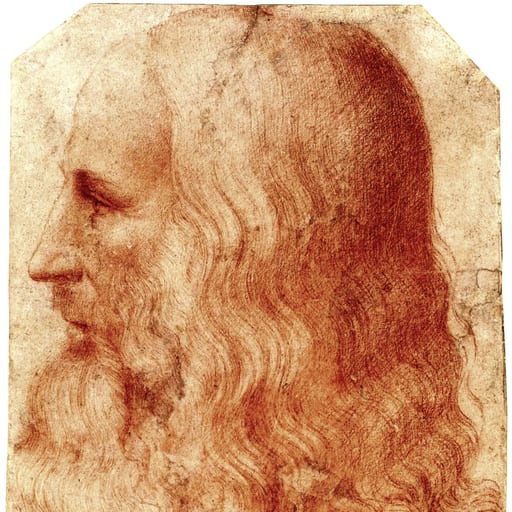
Leonardo da Vinci
레오나르도 다 빈치
Renaissance painter, engineer and notebook keeper
873 records in all
- Principles 297
- Episodes 206
- Quotes 370
3 free questions a day, no sign-up.
Photo: Attributed to Francesco Melzi Public domain Original cropped
Quotes
56 basic records of 370
Quotes are word for word from the source.
Nature of Constancy
Constancy does not begin, but is that which perseveres.
Our noteDefining the essence of perseverance and steady effort.
Prototyping Before Execution
If you wish to make a figure in marble, first make one of clay
Our noteGiving technical advice on the process of sculpture.
Scaling Through Models
To manage the large mould make a model of the small mould, make a small room in proportion.
Our noteExplaining how to handle large-scale engineering or art projects.
Theory and practice
Science is the captain, and practice the soldiers.
Our noteDiscussing the relationship between scientific principles and their practical application.
Danger of intemperance
The unicorn, through its intemperance and not knowing how to control itself, for the love it bears to fair maidens forgets its ferocity and wildness
Our noteUsing the unicorn as a humorous example of lack of self-control.
Power of growth
One shall be born from small beginnings which will rapidly become vast. This will respect no created thing, rather will it, by its power, transform almost every thing
Our noteDescribing the nature of fire as a metaphor for rapid transformation.
Valuing talent
If you meet with any one who is virtuous do not drive him from you; do him honour, so that he may not have to flee from you
Our noteHe was advising on how to treat virtuous and talented individuals.
Synergy and wholeness
Every part is disposed to unite with the whole, that it may thereby escape from its own incompleteness.
Our noteHe was philosophizing about the relationship between parts and the whole.
Learning from history
Happy will be those who give ear to the words of the dead: - The reading of good works and the observing of their precepts.
Our noteHe reflects on the value of reading classical works and following the wisdom of ancestors.
Selecting the best model
I answer that you must look at many men of 3 braccia, and out of the larger number who are alike in their limbs choose one of those who are most graceful
Our noteHe advises on how to establish a standard by observing a large sample and picking the best example.
Using mirrors for accuracy
When you want to see if your picture corresponds throughout with the objects you have drawn from nature, take a mirror and look in that at the reflection of the real things, and compare the reflected image with your picture
Our noteLeonardo explains how to use a mirror as a tool to verify the realism of a work.
Excellence through universality
That art was of highest excellence, he wrote, which possessed most elements of variety and universality.
Our noteHe defines the criteria for high-quality work as having broad appeal and diverse elements.
Experience over theory
Avoid the precepts of those thinkers whose reasoning is not confirmed by experience.
Our noteLeonardo warns against following intellectual ideas that lack practical evidence.
Power of observation
The eye, which is called the window of the soul, is the principal means by which the brain can most abundantly and splendidly contemplate the infinite works of nature
Our noteLeonardo emphasizes the importance of visual observation in understanding the world.
Instant understanding
But the works of the painter are immediately understood by those who behold them.
Our noteHe contrasts the time-consuming nature of reading with the instant comprehension of a painting.
Universal visual language
While painting embraces in itself all the forms of nature, you have nothing save words, which are not universal, like forms.
Our noteLeonardo argues that visual representation is more powerful and universal than written words.
Reward for labor
Although I do not say this to blame such opinions, because all labour expects its reward
Our noteLeonardo acknowledges that seeking payment for professional work is natural and not an error.
Honor over wealth
Therefore, O painter, beware lest in thee the lust of gain should overcome the honour of thy art, for the acquisition of honour is a much {93} greater thing than the glory of wealth.
Our noteLeonardo advises artists to prioritize the integrity and quality of their work over immediate financial gain.
Iterative creative process
first strive in drawing to express to the eye in a manifest shape the idea and the fancy originally devised by thy imagination; then go on adding or removing until thou art satisfied
Our noteHe describes the process of starting with a rough idea and refining it through iteration.
Incremental progress
acting on sound rules, he will remove so little at a time that his work will be brought to a successful close.
Our noteLeonardo emphasizes that a skilled master avoids big mistakes by working carefully and incrementally.
Interpreting nature
the painter is by necessity constrained to amalgamate his mind with the very mind of nature and to be the interpreter between nature and art
Our noteHe defines the role of the creator as a bridge between natural laws and artistic expression.
Surpassing the master
He is a poor disciple who does not surpass his master.
Our noteLeonardo discusses the necessity of growth and improvement beyond one's initial training.
Environment for focus
Small rooms or dwellings help the mind to concentrate itself; large rooms are a source of distraction.
Our noteHe explains how physical space affects mental clarity and productivity.
Friction and sound
The friction of polished bodies produces no sound, and similar result would be produced in the contact or friction of the spheres
Our noteExplaining why the movement of celestial spheres does not produce audible sound.
Foundational learning
In order to arrive at knowledge of the motions of birds in the air, it is first necessary to acquire knowledge of the winds
Our noteLeonardo explains that understanding a complex system requires mastering the environment that influences it.
Necessity of physical tools
There can be no voice where there is no motion or percussion of the air, there can be no percussion of the air where there is no instrument, there can be no such thing as an immaterial instrument
Our noteHe argues that any output or effect requires a physical medium or instrument to produce it.
You are seeing 132 basic records. Membership answers from all 873 of this master's records.
See membershipMore masters in this field
See the whole fieldCraft, arts and performance

These records are our compilation of public statements and sources. We are not affiliated with or endorsed by Leonardo da Vinci or any related company. If something should come down, tell us. Takedown request form