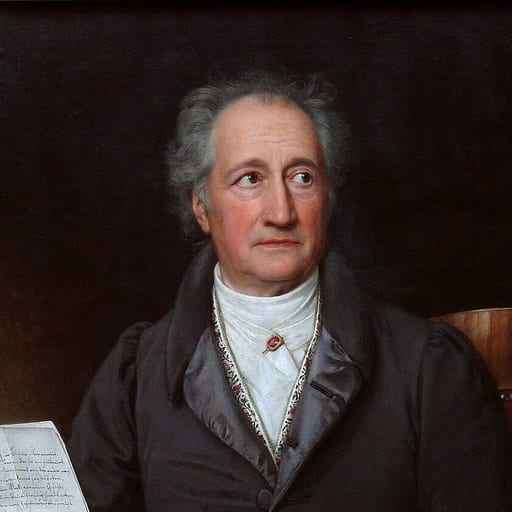
Johann Wolfgang von Goethe
요한 볼프강 폰 괴테
German poet, novelist and polymath; author of Faust
945 records in all
- Principles 342
- Episodes 267
- Quotes 336
3 free questions a day, no sign-up.
Photo: Joseph Karl Stieler Public domain Original cropped
Quotes
50 basic records of 336
Quotes are word for word from the source.
Mastery through constraints
In limitations he first shows himself the master, And the law can only bring us freedom.
Our noteGoethe explains how working within boundaries actually enables creative mastery.
Protecting creative work
The artist may be well advised to keep his work to himself till it is completed, because no one can readily help him or advise him with it.
Our noteGoethe discusses the difference between artistic creation and scientific collaboration in his essay.
Dangers of useful errors
Conversely, even a useful error is harmful, for it can be useful only for the moment, enticing us into other errors, which become more and more harmful.
Our noteGoethe explains how temporary fixes or false beliefs lead to long-term failure.
Action and thought
To act is easy, to think is hard; to act according to our thought is troublesome.
Our noteHe discusses the difficulty of aligning one's actions with their internal convictions.
Process over goals
The height charms us, the steps to it do not: with the summit in our eye, we love to walk along the plain.
Our noteGoethe notes how people desire results without wanting to endure the necessary steps.
Dangers of Ignorance
Nothing is more frightful than to see ignorance in action.
Our noteGoethe comments on the danger of people acting without understanding or knowledge.
Simplicity and complexity
Everything is simpler than one can imagine, at the same time more involved than can be comprehended.
Our noteGoethe observes the dual nature of reality and systems.
Transforming ideas into life
The first is his singularly emblematic intellect; his perpetual never-failing tendency to transform into /shape/, into /life/, the opinion, the feeling that may dwell in him
Our noteThe author describes Goethe's ability to give concrete form to abstract thoughts.
Motivation for activity
in our later days, it becomes highly advantageous to us, should any sympathy excite and determine us, cordially, to new activity.
Our noteGoethe explains how external encouragement can spark new work in one's later years.
Context of progress
this seems to be the main object of biography,--to exhibit the man in relation to the features of his time, and to show to what extent they have opposed or favored his progress
Our noteGoethe defines the purpose of documenting a life in relation to its environment.
Diverse market segments
From the ornamental and show gardens of the rich, to the orchards of the citizen, anxious about his necessities; from thence to the factories, bleaching-grounds, and similar establishments
Our noteHe observed the full spectrum of economic life within the city walls.
Understanding market dynamics
At the same time, he obtained a notion of what the world produces, what it wants, and what the inhabitants of its different parts exchange with each other.
Our noteObserving the Frankfurt fairs taught the young Goethe about global trade and demand.
Internal development
These were not hard for me to accomplish, but were so far troublesome, that they hindered, and, to a certain extent, repressed, my inward development, which had taken a decided direction.
Our noteGoethe reflects on how rigid educational schedules can stifle a student's natural growth.
Personalized storytelling
To him, as well as other well-wishers, I could render myself very agreeable by telling tales, which they most delighted to hear when I was the hero of my own story.
Our noteHe discovered that audiences are most engaged when the speaker is the protagonist of the narrative.
Practical language skills
I soon picked up so much, that, if I could not join in conversation, I could at any rate manage single questions and answers.
Our noteHe describes his method of learning a language through immersion and listening.
Prudence in danger
He therefore considered it more prudent to go back, and learned on inquiry what the report of the firing might have before informed him
Our noteGoethe's father realizes the danger of staying near the battlefield and decides to retreat.
Failure of forced collaboration
as the parts worked into each other in one picture by several hands produced no good effect after all the trouble, every one at last fancied that his own work had been spoiled
Our noteGoethe observed how a patron's attempt to combine different artists' talents on a single canvas failed.
Joy in learning
Fingering and time seemed to become perfectly easy and obvious; and, while the scholar was put into the best humor, every thing else succeeded beautifully.
Our noteGoethe observed a music teacher who used humor and nicknames to make complex tasks feel easy.
Benefits of dictation
I found it no less convenient, during the intervals, to see all that passed through my head fixed upon paper by the hand of another
Our noteGoethe explains how using a scribe helped him capture his thoughts more efficiently.
Maintaining creative confidence
We consoled ourselves, however, as we considered it our very best work, and could, therefore, declare the other a bad judge.
Our noteGoethe explains how his group maintained their morale after a client rejected their work.
Action cures depression
These depressing reflections, as I was soon convinced, were only to be banished by activity; but of what was I to take hold?
Our noteGoethe realized that staying busy is the only way to overcome negative thoughts.
Power of detail
Only by the minutest detail, by endless particularities which bear vividly all the character of the whole, and, as they spring up from a wonderful depth, give some feeling of that depth
Our noteGoethe explains how to represent a complex personality through writing.
Self acceptance
To nobody can his own form be repugnant; the ugliest, as well as the most beautiful, has a right to enjoy his own presence
Our noteGoethe reflects on how individuals perceive their own physical appearance.
Capturing the moment
the spring can be apprehended only while it is flowing.
Our noteHe describes the difficulty of capturing a living, changing personality in art.
Orderly acquisition
The acquisition of new books, as well as their binding and arrangement, he pursued with great composure and love of order
Our noteGoethe describes his father's systematic approach to building and maintaining his library.
Disdain for public opinion
I trace here the germ of that disregard and even disdain of the public, which clung to me for a whole period of my life, and only in later days was brought within bounds by insight and cultivation.
Our noteGoethe reflects on how witnessing unfair political slander as a child made him distrust public judgment.
Hardening against adversity
Thus we learned once more, that instead of sinking into effeminacy and fantastic delights, there was reason rather for hardening ourselves, in order either to bear or to counteract inevitable evils.
Our noteGoethe reflects on the necessity of developing mental and physical toughness to face life's inevitable challenges.
Recognizing early talent
But as great endowments often announce themselves in youth in the form of singularity and awkwardness, so was it also in this case.
Our noteGoethe observes that the eccentric Senkenberg brothers eventually achieved great things.
Efficient learning
It occurred to me, therefore, that I might despatch all at once, and I invented a romance
Our noteGoethe created a creative project to practice multiple languages simultaneously.
Self awareness
Thus my exercise-books became much more voluminous, my father was better satisfied, and I was much sooner made aware of the acquirements and the sort of readiness in which I was wanting.
Our noteGoethe reflects on how his creative writing project helped him identify his own skill gaps.
You are seeing 141 basic records. Membership answers from all 945 of this master's records.
See membershipMore masters in this field
See the whole fieldCraft, arts and performance

These records are our compilation of public statements and sources. We are not affiliated with or endorsed by Johann Wolfgang von Goethe or any related company. If something should come down, tell us. Takedown request form