
Jim O'Shaughnessy
짐 오쇼너시
Quantitative investor, author of What Works on Wall Street, founder of O'Shaughnessy Ventures
2,844 records in all
- Principles 974
- Episodes 563
- Quotes 1,307
3 free questions a day, no sign-up.
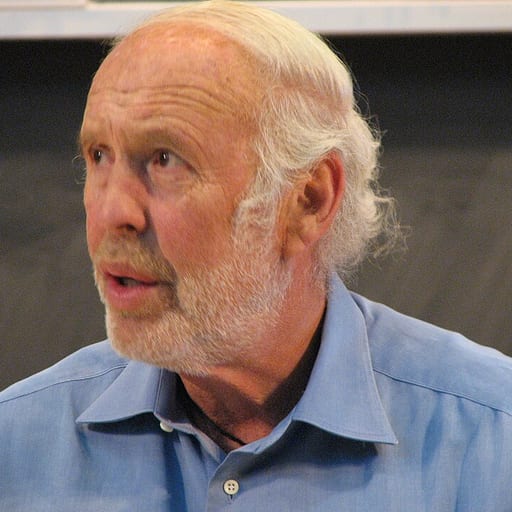
Photo: Matthew Ryan CC BY-SA 2.0 Original cropped
Quotes
196 basic records of 1,307
Quotes are word for word from the source.
Modern power laws
I have the view that the power laws are actually going to be more available to more people now because the tails have gotten much longer in the distribution.
Our noteJim explains how technology allows more people to find success in niche markets.
Human cultural lag
cultural lag is a real thing, and that it takes humanity a while to adapt to a new way of doing things.
Our noteJim notes that human systems often resist or slow down technological adaptation.
AI First Mindset
We started at O'Shaughnessy Ventures to be AI-first in every aspect of everything it does. And if you're 66 years old, that requires a lot of open-mindedness about the way things are going to get done.
Our noteJim discusses his commitment to integrating AI into his venture firm.
Social media function
I kind of thought riffing on that movie, maybe social media actually does serve a reasonably good function in just that alone where people are able to spew their anger and then hopefully get over it.
Our noteJim discusses his theory that social media acts as a psychological steam valve for societal anger.
Global intelligence network
Twitter was, in my sense, it was the lead horse on creating a global intelligence network where you can literally meet lots of people that you would under any other circumstance not have an opportunity to make any exchanges with.
Our noteJim explains his long-held view of Twitter as a tool for connecting diverse minds.
Cognitive diversity
Cognitive diversity, I think is very important. And being able to meet people who think differently than you do, who have different ideas about things is very refreshing.
Our noteJim emphasizes the value of interacting with people who hold different perspectives.
The rebel mindset
as unbelievable as it seems, we're kind of the rebel alliance here, and we're going after the empire with its Death Star.
Our noteJim uses a Star Wars analogy to describe his firm's position against established systems.
Adapting to magic
We get so accustomed to what in an earlier era would have been viewed as magic. Right like magic.
Our noteReflecting on how people take modern technological marvels for granted.
The confirmation bias trap
We all love our priors, and that turns us into confirmation bias machines where we literally are blinded to information that conflicts with our priors.
Our noteJim discusses how human psychology makes us ignore facts that don't fit our existing beliefs.
The reality of conspiracies
By the way, I'm amused by most conspiracy theorists, because the real conspiracy is there really is no conspiracy except in filing.
Our noteJim shares his skeptical view on the existence of grand conspiracies in the real world.
Learning from absence
I always loved the story where he knew that the intruder was known to the family because the dog didn't bark. And that's something people just have a hard time getting their heads around, right?
Our noteJim discusses the concept of 'via negativa' and learning from what is missing in data.
Economic model shift
Your model changes the economics of finding needles in haystacks, right?
Our noteJim discusses how AI changes the cost of investigative research.
Cognitive security need
But now we're doing it at weapons-grade and it scales. And so I definitely think some form of cognitive security for everyone might be a good idea.
Our noteJim suggests developing tools to protect people from AI-driven manipulation.
Routine and cognition
But it just got to the point where it's like, just doing the same thing, it just turns your brain off, I think.
Our noteJim reflects on how repetitive tasks can lead to mental stagnation.
Pivoting vs stability
I'm willing to pivot on a dime, and a lot of people really resist that. And so I wondered, maybe I'm just a horrible leader.
Our noteQuestioning his own leadership style regarding frequent changes in direction.
Institutional capture trap
whenever you get an institution that wants to capture attention, wants to capture value, wants to capture all of that sort of stuff, a lot of that fun stuff, the stuff that got them there in the first place, stops happening.
Our noteJim discusses how institutionalization can kill the creative spark that built the organization.
AI for feedback
I wrote a very long prompt that created one of the best-educated, most erudite critics, who is going to hate every chapter that I write. And Derek, I gotta tell you, that was the best of any of the feedback I got.
Our noteJim explains how he uses a custom AI prompt to get harsh but useful criticism on his writing.
Overcoming nihilism
one of the things that I learned, at least in my life, was you've got to walk across the bridge of nihilism.
Our noteJim discusses the necessity of facing the lack of inherent meaning to find personal agency.
Using AI tools
And I, with the help of AI, started to say, "Okay, what common characteristics, personality type, psychological background would these people share?
Our noteJim explained how he researched the traits of famous historical mathematicians using technology.
Teaching through play
bringing play and fun into it is probably a better way to teach, especially kids.
Our noteJim advocates for using games to make complex subjects like math more engaging.
Law of small numbers
They don't intuitively understand that the small sample is going to have much wider deviations.
Our noteJim discusses why people struggle to understand statistical deviations in small versus large samples.
Foundational concepts
negative numbers make zero sense until you have zero.
Our noteJim discusses how mathematical concepts like negative numbers require a reference point like zero.
math in history
one thing I try was to look historically at what empowered certain cultures and civilizations. And we're back to the Sumerians now, right? What empowered certain cultures to rise, become powerful, etc. And there's always math lurking.
Our noteJim discusses how mathematical knowledge has historically been a foundation for the rise of powerful civilizations.
engaging metaphors
But the ultimate thing was probably the math. And I just wonder what metaphors would you find particularly attractive? Like you note power for kids. Are there others that get them excited that get them like, "Oh wow, maybe I should be interested in this.
Our noteJim asks about effective ways to frame complex subjects like math to make them exciting for learners.
gamified learning
If you were going to create a mathematical escape room, like you're in danger and you've got to solve this puzzle to get in that safe room, what would it look like?
Our noteJim explores the idea of using high-stakes puzzles and gamification to teach mathematical concepts.
Time to experiment
Now is the time to take those leaps of faith. Now is the time. Because you could experiment. Because if it doesn't work, you've still got all that time.
Our noteJim encourages young people to take risks while they have the advantage of time.
True life priorities
You're not going to be thinking about how many zeros are in my bank account or what did I personally accomplish through my "career" for people who are just listening and not watching.
Our noteJim reflects on what truly matters at the end of life compared to career success.
Micro habits for compounding
Just do five push-ups this morning, that's all. If you've never done, do one, don't even do five, just do one and then try one the next day and then maybe try two.
Our noteJim explains how to build momentum through extremely small, manageable tasks.
Power of memes
These memes can be weapons of mass destruction and/or creation, right?
Our noteDiscussing how the ancient Babylonians used a new myth to gain political power.
Mass market appeal
if you're a capitalist or a TV show producer, what are you going to do? You're going to try to make something that appeals to that 68.5
Our noteDescribing the old 'log normal' world where businesses targeted the center of the bell curve.
You are seeing 426 basic records. Membership answers from all 2,844 of this master's records.
See membershipMore masters in this field
See the whole fieldInvesting and capital allocation



These records are our compilation of public statements and sources. We are not affiliated with or endorsed by Jim O'Shaughnessy or any related company. If something should come down, tell us. Takedown request form