
Jim O'Shaughnessy
짐 오쇼너시
Quantitative investor, author of What Works on Wall Street, founder of O'Shaughnessy Ventures
2,844 records in all
- Principles 974
- Episodes 563
- Quotes 1,307
3 free questions a day, no sign-up.
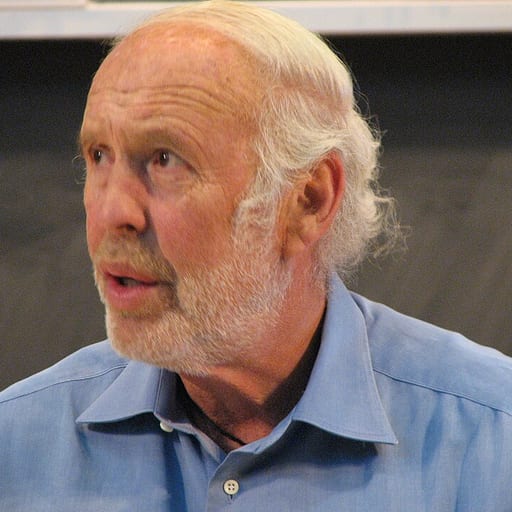
Photo: Matthew Ryan CC BY-SA 2.0 Original cropped
Quotes
196 basic records of 1,307
Quotes are word for word from the source.
Scaling through transparency
The allowing transparency, innovation, lots of different paths leads you to be able to scale much faster, compound much faster, et cetera.
Our noteJim contrasts open innovation with old networks that try to limit information and control.
Experimenting with solutions
all of these ideas, I think, are worthy of thinking about And experimenting with, because I think you are right that the dislocation is going to be bumpy.
Our noteJim agrees that the transition to an AI-driven economy will be difficult and requires proactive experimentation.
Blaming others in business
He was really interesting because he would always blame the other guy, especially in business, never in writing, which I thought was really interesting.
Our noteJim was discussing Mark Twain's tendency to blame his hand-picked managers for business failures.
Rapid skill acquisition
He was just like, "Huh, I need to learn to be good at something really fast.
Our noteJim was talking about Andrew Carnegie's approach to starting his career.
Learning from reality
And so reality comes at you real fast and you learn to be very pragmatic.
Our noteJim discusses how facing life-and-death situations forces a person to become pragmatic.
Predictable interview questions
You and I both, as authors, we know we could recite ahead of time what we're going to get asked.
Our noteJim discusses how authors often face the same repetitive questions and develop stock answers.
Preference falsification
I think on the good side, it allows people who are always worried and terrified what other people will think of them to stop falsifying their preferences and actually like material
Our noteJim reflects on the impact of hiding social media likes on user behavior.
Ignoring trolls
I ignore them, but I know that other people get really worked up about it.
Our noteJim shares his approach to dealing with online trolls and bots.
Media training tactic
How do you think I made it through being in the media all those years? I completely ignored the question and then answered the one I wanted to.
Our noteJim explains how he handled difficult or irrelevant questions during his years in the public eye.
Information and surprise
a political speech has zero information because it has no new or surprising things. A poem is just chock-a-block full of information because people are surprised.
Our noteJim discusses Claude Shannon's information theory and why predictability lacks value.
Data vs Behavior
as much data as we have, and this drives guys like you and me crazy, we have mountains of data showing people don't do that, don't do that, don't do that. And yet they do that.
Our noteJim reflects on how people ignore data-driven advice during market cycles.
Defying human nature
I think in the first book, my first book, Invest like the Best , I said that like really successful investors do not comply with human nature. They defy it.
Our noteJim discusses why successful investing requires resisting natural emotional impulses.
Emotional decision making
short-term emotions driving us to make horrible and often irrevocable long-term choices in the heat of the moment, right.
Our noteJim warns against letting temporary feelings dictate permanent financial strategies.
Confidence in uncertainty
they comply to the wider error estimates, but they still bet on their own estimate.
Our noteJim describes the paradoxical behavior of centimillionaires who understand probability but trust their gut.
Survivorship bias advice
he basically says they might innocently and honestly mislead you because their internal locus of control and updating of their memories and everything, they kind of forget what they were like from 0 to 50.
Our noteJim warns against blindly following advice from the ultra-successful who forget their early struggles.
Signs of Change
I think we're seeing some rot in the Death Star right now, and at least some hesitancy. And as an example there, I would say that there are these growing abundance conferences.
Our noteJim observes that established, bureaucratic systems are starting to lose their absolute grip.
Disrupting entrenched systems
if they're not going to change, I can start a publishing company that uses all these new technologies and innovations that writers are gonna love.
Our noteJim explains why he started a new publishing company to compete with traditional firms stuck in old ways.
Value of disagreement
I am a big believer in conversation, especially if you disagree with the other person.
Our noteJim discusses the importance of civil debate between people with different outlooks.
Proactive client communication
And the number of anecdotes I can give you, I mean, I wish I would have kept hard data on it, but they're anecdotes where the people would say, you know, you are the only manager who's calling me.
Our noteJim notes that being the only manager to call during a crisis built immense trust.
Belief in free will
I'm not going to be so arrogant to determine that this tiny little human brain of mine is going to be able to conclude with 100% certainty and no ability to falsify that free will does not exist.
Our noteJim discusses his philosophical stance on free will and human agency.
The co-creator mindset
I am at best a co-creator. At best, right? To say, no, this is mine. I did this. No one else could have done this. You're just feeding your own ego and that leads to bad stuff.
Our noteJim talks about humility in creativity and avoiding ego-driven ownership of ideas.
Low friction conversion
It was the original big tent approach to converting people and they made it extra easy to convert. And then they added just brilliant things like you're referring to, the Catholic experience.
Our noteJim analyzes the early Christian strategy for rapid growth and adoption.
Talent diaspora
Do you still see a diaspora of people of some of the brightest minds and who would make natural entrepreneurs?
Our noteJim was asking about whether India's brightest minds are still leaving for the United States.
Adapting global trends
I think I am fascinated by the differences, but also by just opportunities you just mentioned. Those are very exciting to me because they're very unique to the country itself, and yet there might be, people who pay attention to what's hot elsewhere might be able to adopt it to their home country
Our noteJim discusses how unique business models in India could be adapted by entrepreneurs in other countries.
Path dependency risk
Isn't one of the risks of doing that locking in a path dependency where you're focusing on metro expertise, and you're looking at great 20th century transit solutions
Our noteJim questions if sticking to old infrastructure models prevents adopting future technologies.
Goodhart's Law
One of the contradictions that I see in that approach is what I guess they refer to as Charles Goodhart's Law, that a metric loses value when it becomes a target goal.
Our noteQuestioning the risks of using specific metrics to fund and evaluate scientific progress.
Failure as Progress
failure is a ladder. So many of these people are really terrified of failing publicly. And I'm like, that's the only way that you're going to make any progress because mistakes are portals of opportunity.
Our noteJim explains his advice to young founders about overcoming the fear of failure.
Intellectual humility
The people I'm attracted to are people who basically admit, wow, I have so many wrong ideas and I got to try to root them out.
Our noteJim describes the quality of people who are constantly looking to upgrade their skill sets.
Simple vs Simplistic
And also, you make a good point that there is a huge difference between simplistic and simple.
Our noteJim discusses the distinction between profound simplicity and being overly simplistic.
Agency over IQ
the idea of agency also is something I think a lot about because it alone can trump like, agency and persistence can trump IQ, can trump most things.
Our noteJim emphasizes that taking action and being persistent are more critical for success than raw intelligence.
You are seeing 426 basic records. Membership answers from all 2,844 of this master's records.
See membershipMore masters in this field
See the whole fieldInvesting and capital allocation


These records are our compilation of public statements and sources. We are not affiliated with or endorsed by Jim O'Shaughnessy or any related company. If something should come down, tell us. Takedown request form