
Jim O'Shaughnessy
짐 오쇼너시
Quantitative investor, author of What Works on Wall Street, founder of O'Shaughnessy Ventures
2,844 records in all
- Principles 974
- Episodes 563
- Quotes 1,307
3 free questions a day, no sign-up.
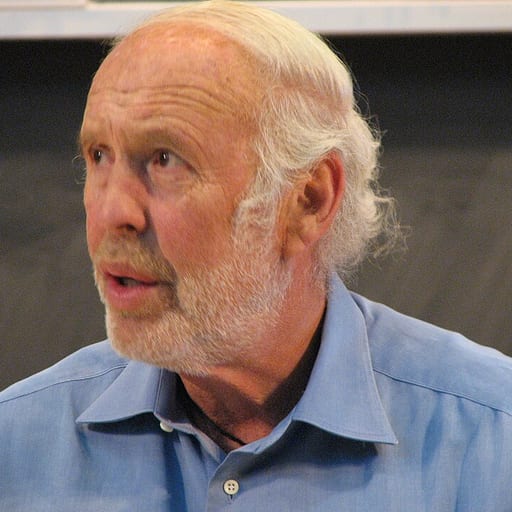
Photo: Matthew Ryan CC BY-SA 2.0 Original cropped
Quotes
196 basic records of 1,307
Quotes are word for word from the source.
Avoiding ad hominem
It's really easy. Again, we fall into these super easy reactionary modes, right? Like argument ad hominem, oldest trick in the book.
Our noteJim explains how people often react emotionally to a person's character rather than analyzing their actions.
Human fragility
as I grew older, one of the things that I really did understand better was the fragility of all humans, not just you and me.
Our noteJim reflects on how his perspective shifted from being a rigid proselytizer to understanding human weakness.
Understanding Communication Styles
I did find that if I listened closely, I could pretty much grok what style my conversant preferred.
Our noteJim talks about identifying whether someone is a visual, auditory, or kinesthetic thinker.
Personal goal setting
I first discovered that, I think, when I was a teenager, and I'm like, "Okay, I'm going to do written goals," which I did, and it worked out actually pretty well.
Our noteJim discusses his early experience with writing down goals based on a famous anecdote.
Unlocking hidden thoughts
What are all the good things that might happen because you didn't graduate law school, versus all of the... And I found that it unlocks all sorts of things that you don't even know you're thinking about.
Our noteJim describes how considering failure can reveal subconscious priorities.
Data mining bias
in my prior life as an asset manager, we were quantitative, algorithmic factor investors. And one of the things that I continually observed, and tried to guard against as much as I could when I was doing the tests, is what I call honest-minded data mining.
Our noteJim talks about the unconscious bias that occurs when analyzing data for investment strategies.
Currency and national stability
And back to the fiction idea, back in the '80s I wrote a treatment about the easiest way to destroy a country would be through destroying its currency.
Our noteJim discusses his early writing about how currency collapse can lead to national ruin.
Refusing free money
I don't yell, I don't shout, but I was like, absolutely not. And they looked at me like, what's wrong with you? You're saying no to free money. And I'm like, money is never free, and we don't need that.
Our noteJim explains why he refused government loans for his firm during a crisis.
Environment for inquiry
I was very lucky to go to Montessori, to grow up in a household that was filled with books, and all of those things that do lead to inquiry
Our noteJim reflects on how his early environment fostered his natural curiosity and agency.
Acceptance of failure
Acceptance of failure is part of the deal. It is always part of it. It's the only way, in my opinion, that progress can happen at all, right?
Our noteJim discusses why failure is a necessary component of progress and experimentation.
Revealed Preferences
If you have a predictive market where people actually bet, so they're putting money on the line, they tend to ignore all of the stated preferences that they have publicly
Our noteJim highlights how financial incentives in prediction markets reveal people's true beliefs.
Acknowledge Human Bias
I'm just as guilty of human biases as anyone else because I happen to be a human, and understand that it's going to be a continual process and fight.
Our noteJim discusses the importance of being mindful of human nature and our inherent cognitive biases.
Housing cost problem
The houses that we have are very costly right now. What's the solution? Why can't we come up with one?
Our noteJim asks Brian Potter about the underlying causes of the high cost of housing in America.
Lawyerly vs engineering societies
I had a guest on who wrote a book contrasting and comparing America and China and his thesis was America is now a lawyerly society, whereas China is an engineering society.
Our noteJim discusses the shift in American institutional focus compared to China.
Fear of novelty
I think that the king of the emotions that drive it is fear, specifically fear of new things, novel fears.
Our noteJim identifies the fear of the unknown as a major psychological barrier to progress.
Activity vs Effectiveness
The other trend that I am baffled by, which is confusing activity with effectiveness and this onslaught of busyness, busy work.
Our noteJim discusses the common mistake of mistaking being busy for being productive.
The power of asking
I've always operated under the assumption that you can't tell until you ask.
Our noteJim discusses why founders often fail to ask for what they need from talented people.
Managing dangerous tech
Instead of banning it, we created fire departments and fire alarms and fire drills. Do you see that happening with all of the technologies that are emerging today?
Our noteJim compares the risks of AI to the historical risks of fire and how society adapts.
Open source advocacy
I'm such a proponent of open source as opposed to closed because the world's creatives and the world's people like you.
Our noteJim explains his preference for open source technology to empower creators.
Technology adoption patterns
If you study new technologies from the past and you look at how they were initially adopted, it's really freaky. Because for example, when they introduced movie cameras, people were like, "Well, I guess we should film plays.
Our noteJim explains how people initially use new technology to mimic old formats.
Fear of novelty
I think that the governing body men in our operating system, if you just look evolutionarily, is fear, especially fear of novel things.
Our noteJim explains why humans naturally resist new technologies and artistic shifts.
Finding new channels
They found different distribution channels. They found different audiences. And the rest is history.
Our noteDescribing how the Impressionist painters bypassed the gatekeepers of their time.
Probabilistic thinking
things are not, yes, no, things are not zero 100. And so we have this deterministic thought pattern that thinks that we are in control
Our noteJim argues against binary thinking and the false sense of total control.
Awareness over prohibition
rather than saying, "That's bad, let's ban it. No, you can't do that. Let's make math illegal." Rather than that, let's be cognizant of these types of occurrences.
Our noteJim suggests understanding the root causes of societal issues instead of just banning new tools.
Voracious curiosity
And one of the things I think I've been lucky in that I've always been incredibly, voraciously curious about, I love new tech, I love all kinds of new tech.
Our noteJim reflects on how his love for new technology has shaped his perspective.
Nature of markets
Schumpeter, an economist, called it creative destruction. That's what markets are. Markets are perpetual creative destruction machines.
Our noteDiscussing how markets naturally evolve by replacing old winners with new innovators.
Growth as limitation
I think that the idea that you really want to grow huge might be the limiting factor there.
Our noteJim talks about the potential pitfalls of focusing solely on massive scale in podcasting.
Global intelligence networks
I originally kind of thought Twitter could emerge and maybe still can. I don't know. As kind of the world's first global intelligence network.
Our noteJim shares his vision for social platforms as interconnected intelligence systems.
Value of evidence
I'm a fan of trying a lot of different things, but I really do like some empirical evidence that it might work.
Our noteJim discusses his preference for empirical data when experimenting with new ideas.
Technological leverage
when a new tool comes on, the leverage it gives you. Just one example. one of the things that I needed to research for the book was the history of art theft
Our noteJim explains how AI drastically reduced the time needed for deep research for his fiction book.
You are seeing 426 basic records. Membership answers from all 2,844 of this master's records.
See membershipMore masters in this field
See the whole fieldInvesting and capital allocation


These records are our compilation of public statements and sources. We are not affiliated with or endorsed by Jim O'Shaughnessy or any related company. If something should come down, tell us. Takedown request form