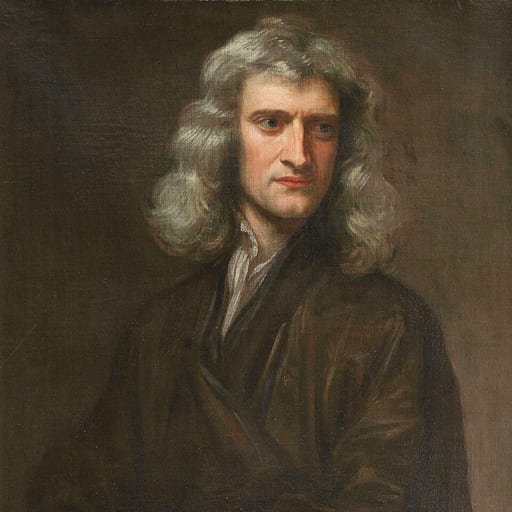
Isaac Newton
아이작 뉴턴
Physicist and mathematician; laws of motion and gravitation
877 records in all
- Principles 319
- Episodes 292
- Quotes 266
3 free questions a day, no sign-up.
Photo: Godfrey Kneller Public domain Original cropped
Quotes
40 basic records of 266
Quotes are word for word from the source.
Resourceful prototyping
But for want of solid Glass Prisms with Angles of convenient Bignesses, there may be Vessels made of polished Plates of Glass cemented together in the form of Prisms and filled with Water.
Our noteNewton suggests a workaround when the ideal tools for an experiment are unavailable.
Understanding components
But he is first to know what Colours will arise from any others mix'd in any assigned Proportion.
Our noteNewton emphasizes the importance of understanding how individual parts contribute to a whole mixture.
Dilution through composition
And those Colours by how much they are more compounded by so much are they less full and intense, and by too much Composition they maybe diluted and weaken'd till they cease
Our noteNewton explains how adding too many variables or components can weaken the primary quality of a product.
Inference from observation
The bigness of the component parts of natural Bodies may be conjectured by their Colours.
Our noteUsing visible data to estimate invisible properties of a material.
Identifying hidden patterns
I suspected that there were many more of them which spread into one another, and by interfering mix'd their Colours, and diluted one another so that they could not be seen apart.
Our noteNewton explains why certain details are not immediately visible to the naked eye.
Matching data to theory
Now, these Diameters of the bright yellow Rings, thus found by Computation are the very same with those found in the third of these Observations by measuring them
Our noteNewton notes the success of his mathematical model when it matches real-world measurements.
Removing noise
But because the Sun's direct Light by its brightness upon the Paper obscured these faint streams, so that I could scarce see them, I made a little hole in the midst of the Paper for that Light to pass through
Our noteNewton explains how he modified his environment to see subtle details that were being drowned out by bright light.
Smallness and force
The exceeding smallness of its Particles may contribute to the greatness of the force by which those Particles may recede from one another, and thereby make that Medium exceedingly more rare and elastick
Our noteHe explains how tiny particles can create immense elastic force.
Questioning existing hypotheses
Are not all Hypotheses erroneous which have hitherto been invented for explaining the Phænomena of Light, by new Modifications of the Rays?
Our noteNewton challenges the prevailing scientific theories that explain light through temporary modifications rather than inherent properties.
Inherent properties matter
For those Phænomena depend not upon new Modifications, as has been supposed, but upon the original and unchangeable Properties of the Rays.
Our noteHe argues that fundamental truths are based on unchangeable characteristics rather than external influences.
Nature of Change
The changing of Bodies into Light, and Light into Bodies, is very conformable to the Course of Nature, which seems delighted with Transmutations.
Our noteNewton observes that nature is constantly transforming matter from one state to another.
Commitment to truth
Plato is my friend - Aristotle is my friend - but my greatest friend is truth.
Our noteNewton wrote these notes to himself in his early philosophical studies.
Leveraging existing knowledge
If I have seen further it is by standing on ye sholders of Giants.
Our noteNewton acknowledging the work of his predecessors in a letter to Robert Hooke.
Precision in creation
God created everything by number, weight and measure.
Our noteNewton writes about the mathematical and orderly nature of the universe.
Avoid tedious computation
Geometry was invented that we might expeditiously avoid, by drawing Lines, the Tediousness of Computation. Therefore these two Sciences ought not to be confounded.
Our noteExplaining why geometry and arithmetic should be kept distinct to maintain efficiency.
Utility over speculation
Geometrical Speculations have just as much Elegancy as Simplicity, and deserve just so much praise as they can promise Use.
Our noteDefining the value of theoretical work based on its practical utility.
Consistency in records
Where they agree in sense, there they agree in words also.
Our noteNewton was observing how different historical books of the Bible used identical phrasing when describing the same events.
Mastering the language
For understanding the Prophecies, we are, in the first place, to acquaint our-selves with the figurative language of the Prophets.
Our noteNewton explains the necessity of learning the specific terminology used in prophetic texts.
Self-reliance in crisis
The _Britons_ therefore taking up arms, and hazarding themselves for their own safety, freed their cities from the imminent _Barbarians
Our noteNewton describes how the Britons took independent action to protect themselves when the Roman Empire could no longer help.
Strategic political alliances
Pope _Zechary_ deposed _Childeric_, a slothful and useless King of _France_, and the last of the race of _Merovæus_; and absolving his subjects from their oath of allegiance, gave the kingdom to _Pipin
Our noteNewton describes how the Pope gained a powerful ally by replacing a weak king with a strong one.
Training for expansion
In the beginning of his preaching he completed the number of the twelve Apostles, and instructed them all the first year in order to send them abroad.
Our noteNewton notes that Jesus prioritized training his team before scaling his mission.
Mastery of parables
And _Christ_ being endued with a nobler prophetic spirit than the rest, excelled also in this kind of speaking, yet so as not to speak by his own actions, that was less grave and decent, but to turn into parables such things as offered themselves.
Our noteNewton highlights the effectiveness of using external, observable objects to convey complex messages.
Ineffective leadership
Seleucus Philopator_ succeeded his father _Antiochus_, _Anno Nabonass._ 561, and reigned twelve years, but did nothing memorable, being sluggish, and intent upon raising money for the _Romans_ to whom he was tributary.
Our noteNewton notes that a ruler who focuses only on debt and lacks initiative leaves no lasting legacy.
Adapting to customer habits
The heathens were delighted with the festivals of their Gods, and unwilling to part with those delights; and therefore _Gregory_, to facilitate their conversion, instituted annual festivals to the _Saints_ and _Martyrs
Our noteNewton explains how the church adopted pagan traditions to make conversion easier for the masses.
Return to basics
Remember therefore from whence thou art fallen, and repent, and do the first works; or else I will come unto thee quickly, and will remove thy candlestick out of its place, except thou repent.
Our noteNewton cites the admonition to the Church of Ephesus to return to its original passion and works.
Expanding existing expertise
The _Phœnician_ mariners who fled from the _Red Sea_, being used to long voyages for the sake of traffic, begin the like voyages on the _Mediterranean_ from _Zidon
Our noteNewton explains how experienced traders applied their skills to new markets.
Reliability of records
And things said to be done above one or two hundred years before the use of letters, are of little credit.
Our noteNewton discusses the lack of written records in early civilizations like Scythia and Germany.
Natural averages
For by the ordinary course of nature Kings Reign, one with another, about eighteen or twenty years a-piece
Our noteNewton argues that historical timelines must align with biological and social realities.
First ship builders
the _Corinthians_ were the first of the _Greeks_ who built such ships, and that a ship-carpenter of _Corinth_ went thence to _Samos_, about 300 years before the end of the _Peloponnesian_ war, and built also four ships for the _Samians
Our noteNewton discusses the technological advancement of navigation and the spread of shipbuilding expertise across ancient Greece.
Leadership and Justice
Minos_ alone was that _Jupiter_ who was most famous among the _Greeks_ for Dominion and Justice, being the greatest King in all _Greece_ in those days, and the only legislator.
Our noteNewton describes the historical basis for the legendary King Minos of Crete.
You are seeing 132 basic records. Membership answers from all 877 of this master's records.
See membershipMore masters in this field
See the whole fieldScience and first-principles thinking
These records are our compilation of public statements and sources. We are not affiliated with or endorsed by Isaac Newton or any related company. If something should come down, tell us. Takedown request form