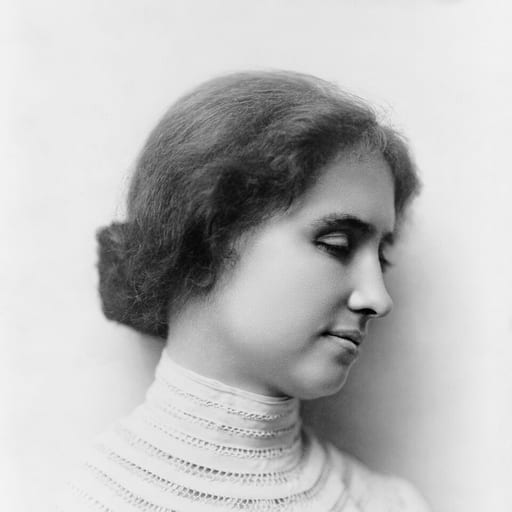
Helen Keller
헬렌 켈러
Deafblind author and activist
766 records in all
- Principles 223
- Episodes 184
- Quotes 359
3 free questions a day, no sign-up.
Photo: Unknown author Public domain Original cropped
Quotes
54 basic records of 359
Quotes are word for word from the source.
Ambition and drive
One can never consent to creep when one feels an impulse to soar.
Our noteShe was addressing the American Association to Promote the Teaching of Speech to the Deaf.
Incremental learning
Gradually from naming an object we advance step by step until we have traversed the vast distance between our first stammered syllable and the sweep of thought in a line of Shakespeare.
Our noteShe was explaining the slow process of acquiring language as a deaf child.
Active optimism
My optimism, then, does not rest on the absence of evil, but on a glad belief in the preponderance of good and a willing effort always to cooperate with the good
Our noteDefining the foundation of her personal philosophy.
Practicality of beliefs
The test of all beliefs is their practical effect in life. If it be true that optimism compels the world forward, and pessimism retards it, then it is dangerous to propagate a pessimistic philosophy.
Our noteEvaluating philosophies based on their impact on progress.
Faith and achievement
Optimism is the faith that leads to achievement; nothing can be done without hope.
Our noteDiscussing the necessity of a positive outlook for success.
Dignity in support
It is imperative that colored people without sight be granted financial aid worthy of their human dignity and courage in the face of fearful obstacles.
Our noteAdvocating for financial aid for blind people of color during a Congressional testimony.
Unity in struggle
While countless women and children are breaking their hearts and ruining their bodies in long days of toil, we are fighting one another. Shame upon us!
Our noteCriticizing factional infighting within a social movement during a critical period.
Learning through play
I built dams of pebbles, made islands and lakes, and dug river-beds, all for fun, and never dreamed that I was learning a lesson.
Our noteHelen explains how geography became intuitive when taught through physical play rather than textbooks.
Mastery takes time
It is only after years of this sort of practice that even great men have learned to marshal the legion of words which come thronging through every byway of the mind.
Our noteHelen reflects on the long journey required to master the art of expression.
Persistence in craft
But we keep on trying because we know that others have succeeded, and we are not willing to acknowledge defeat.
Our noteHelen discusses why writers persevere despite the inherent difficulties of the craft.
Resilience in writing
I wrote timidly, fearfully, but resolutely, urged on by my teacher, who knew that if I persevered, I should find my mental foothold again
Our noteHelen explains how she regained her confidence through persistent writing.
Critical reading
I learned for the first time to know an author, to recognize his style as I recognize the clasp of a friend's hand.
Our noteHelen describes the shift from passive reading to critical analysis.
Avoiding logical shortcuts
I hung about the dangerous frontier of "guess," avoiding with infinite trouble to myself and others the broad valley of reason.
Our noteHelen describes her early difficulties with arithmetic and the tendency to guess instead of reason.
Overcoming through tools
Little by little, however, my difficulties began to disappear. The embossed books and other apparatus arrived, and I threw myself into the work with renewed confidence.
Our noteOnce the necessary equipment arrived, Helen was able to regain her focus and confidence in her studies.
Logical reasoning training
He kept my mind alert and eager, and trained it to reason clearly, and to seek conclusions calmly and logically, instead of jumping wildly into space and arriving nowhere.
Our noteHelen describes how her tutor Mr. Keith helped her master difficult subjects like mathematics.
Learning versus thinking
in college there is no time to commune with one's thoughts. One goes to college to learn, it seems, not to think.
Our noteHelen reflects on the fast-paced nature of college life compared to her previous solitary study.
Trusting your own intuition
I used to try to remember their interpretations, but they discouraged and vexed me; so I made a secret compact with myself not to try any more.
Our noteDiscussing the frustration of trying to follow academic commentators instead of enjoying literature directly.
Empathy for struggle
I have felt their hard, rough hands and realized what an endless struggle their existence must be--no more than a series of scrimmages, thwarted attempts to do something.
Our noteHelen reflects on the difficult lives of the poor she encountered in the city.
Authentic communication
I also dislike people who try to talk down to my understanding. They are like people who when walking with you try to shorten their steps to suit yours
Our noteHelen expresses her frustration with people who treat her with condescension or hypocrisy.
Art of explanation
Dr. Bell is proficient in many fields of science, and has the art of making every subject he touches interesting, even the most abstruse theories.
Our noteHelen admires Alexander Graham Bell's ability to make complex scientific topics engaging.
Learning from masters
I could not keep pace with all these literary folk as they glanced from subject to subject and entered into deep dispute, or made conversation sparkle with epigrams and happy witticisms.
Our noteHelen reflects on her experience interacting with famous writers like Mark Twain and William Dean Howells.
Early learning progress
I can read stories in my book. I can write and spell and count. good girl.
Our noteHelen describes her basic academic skills to Alexander Graham Bell in 1887.
Adopting new tools
I shall be delighted to have a typewriter.
Our noteHelen expresses her excitement about getting a typewriter to improve her communication.
Inner vision
I cannot see the lovely things with my eyes, but my mind can see them all, and so I am joyful all the day long.
Our noteHelen explains how she perceives the world's beauty despite being blind.
Unexpected impact
I did not imagine, when I studied about the forests of Maine, that a strong and beautiful ship would go sailing all over the world, carrying wood from those rich forests
Our noteHelen expresses wonder at how raw materials from one place build homes and schools globally.
Vivid communication
none of my friends describe things to me so vividly and so beautifully as he does...
Our noteHelen praised Mr. Munsell for his ability to paint word-pictures of Venice.
Performance under pressure
Indeed, I am not sure now that I read all the signs correctly, especially as I was much distressed, and found it very hard to keep my wits about me.
Our noteHelen describes the mental strain of taking a math exam with unfamiliar braille notation.
Business vs Humanity
I could not help feeling that they spoke more from a business than a humanitarian point of view.
Our noteHelen reflects on friends' advice to open a small home school for her own benefit.
Standardization of tools
There is nothing more absurd, I think, than to have five or six different prints for the blind.
Our noteShe argues for a unified braille system to improve efficiency and accessibility.
Need for play
"Yes," she replied, "but I like to play also, and I feel sometimes as if I were a music box with all the play shut up inside me."
Our noteHelen explains that despite her rigorous studies, she values leisure and fun.
You are seeing 115 basic records. Membership answers from all 766 of this master's records.
See membershipMore masters in this field
See the whole fieldMindset and resilience

These records are our compilation of public statements and sources. We are not affiliated with or endorsed by Helen Keller or any related company. If something should come down, tell us. Takedown request form