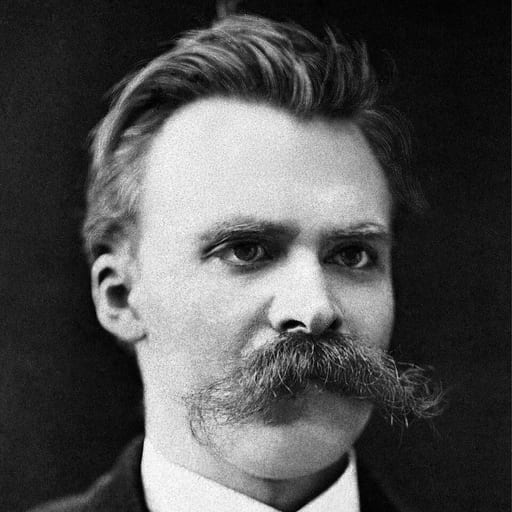
Friedrich Nietzsche
프리드리히 니체
German philosopher of will, values and self-overcoming
1,124 records in all
- Principles 389
- Episodes 232
- Quotes 503
3 free questions a day, no sign-up.
Photo: Friedrich Hermann Hartmann Public domain Original cropped
Quotes
75 basic records of 503
Quotes are word for word from the source.
Signs of Discovery
It is a common occurrence for a series of striking signs and wonderful emotions to precede an epoch-making discovery.
Our noteNietzsche notes that great breakthroughs are often preceded by intense emotional and intellectual signals.
Instinct vs consciousness
everything which was created in those times with conscious aesthetic insight, was infinitely inferior to the songs that sprang up naturally in the poet's mind and were written down with instinctive power
Our noteHe compares the power of natural, instinctive creation against conscious technical composition.
Source of Creation
With the one it is his defects which philosophise, with the other it is his riches and powers.
Our noteHe distinguishes between creating out of a need for healing versus creating from a position of strength.
Higher Standards
The taste of the higher nature devotes itself to exceptional matters, to things which usually do not affect people, and seem to have no sweetness; the higher nature has a singular standard of value.
Our noteThe author explains why exceptional individuals pursue goals that others find confusing.
Capacity for defense
we despise the person who has neither the ability nor the good-will for revenge--whether it be a man or a woman.
Our noteHe notes that the ability to strike back is a necessary component of being respected.
Utility of rhythm
It was intended that a human entreaty should be more profoundly impressed upon the Gods by virtue of rhythm, after it had been observed that men could remember a verse better than an unmetrical speech.
Our noteNietzsche explains that poetry originated from a practical need to make messages memorable and persuasive.
Foundational hard work
for the benefit of some few who are always "to come," and are not there, a very great amount of painful, and even dirty labour has to be done beforehand
Our noteHe describes the invisible, rigorous labor required to preserve valuable knowledge for future generations.
Knowledge as End
It is something new in history that knowledge claims to be more than a means.
Our noteObserving the shift where seeking knowledge becomes a passion in itself rather than a tool for virtue.
Clarity vs Obscurity
He who knows that he is profound strives for clearness; he who would like to appear profound to the multitude strives for obscurity.
Our noteNietzsche explains the difference between true depth and the mere appearance of it.
Personifying personal pain
I have given a name to my pain, and call it "a dog,"--it is just as faithful, just as importunate and shameless, just as entertaining, just as wise, as any other dog
Our noteHe describes a method of managing personal suffering by treating it as a domesticable pet.
Measuring personal strength
I want to have my lion and my eagle about me, that I may always have hints and premonitions concerning the amount of my strength or weakness.
Our noteNietzsche uses symbolic animals to represent the need for constant self-assessment of one's power.
Personal Values
Let us _confine_ ourselves, therefore, to the purification of our opinions and appreciations, and to the _construction of new tables of value of our own
Our noteHe suggests focusing on building one's own standards instead of judging others.
Unique Action
every action that has been done, has been done in an entirely unique and inimitable manner, and that it will be the same with regard to all future actions
Our noteNietzsche argues that every human action is unique and cannot be generalized by universal laws.
Inherited intellectual habits
The talent for classifications, for tables of categories, betrays something; it is not for nothing that a person is the child of his parents.
Our noteHe suggests that our professional methods are often inherited from our ancestors' occupations.
The Experimental Mindset
the individual is convinced that he can do almost anything, that he _can play almost any rôle,_ whereby everyone makes experiments with himself
Our noteHe describes the modern democratic conviction that one can constantly reinvent their career and identity.
You are seeing 168 basic records. Membership answers from all 1,124 of this master's records.
See membershipMore masters in this field
See the whole fieldPhilosophy and wisdom traditions
These records are our compilation of public statements and sources. We are not affiliated with or endorsed by Friedrich Nietzsche or any related company. If something should come down, tell us. Takedown request form