
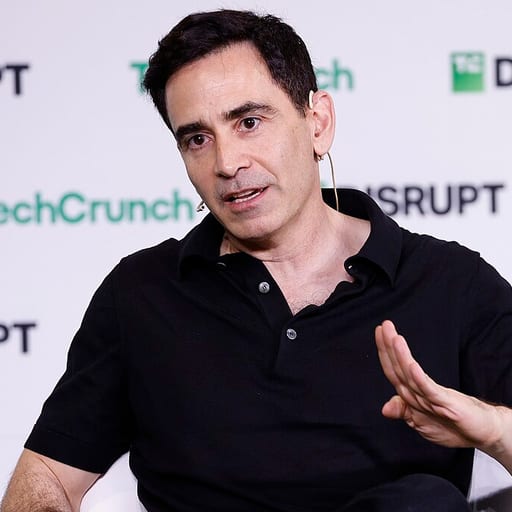
Chris Dixon
크리스 딕슨
General partner at Andreessen Horowitz; founder turned investor
1,416 records in all
- Principles 579
- Episodes 284
- Quotes 553
3 free questions a day, no sign-up.
Quotes
83 basic records of 553
Quotes are word for word from the source.
Platform and complements
The best (selfish) economic situation for a platform like Windows is lots of tiny complements that have little pricing power but that make the platform itself more valuable.
Our noteDixon explains why platforms prefer a fragmented ecosystem of small third-party developers.
The value of hobbies
Hobbies are what the smartest people spend their time on when they aren't constrained by near-term financial goals.
Our noteDixon explains why hobbies are a leading indicator of future technological breakthroughs.
Acquisition strategy
If Google really wants to catch up, they'll need to go back to the strategy they succeeded with in the past of acquiring relevant companies and letting them run as separate business units.
Our noteHe suggests that buying and maintaining independence is better than building from scratch.
Default state of failure
The default state of the world is to stay the way it is, which means the default state of a startup is failure.
Our noteDixon summarizes the inherent difficulty of disrupting the status quo.
The real competitor
Your #1 competitor starting out will always be the BACK button, nothing else.
Our noteChris quotes Garry Tan to emphasize that user indifference is the primary threat to a new startup.
Analyzing competitor failure
If you think your competitors executed poorly, you should develop a theory of what they did wrong and how you'll do better.
Our noteDixon advises founders to have a clear thesis when entering a market with existing players.
Products as processes
To distinguish toys that are disruptive from toys that will remain just toys, you need to look at products as processes.
Our noteHow to identify which seemingly trivial products have the potential to become disruptive.
The Bait and Switch
For 3rd parties, this transition from cooperation to competition feels like a bait-and-switch.
Our noteDescribing how centralized platforms eventually compete with the developers who helped build them.
Innovation Through Openness
Allowing websites to be federated and extensible will open up a whole new wave of innovation.
Our noteDixon predicts that combining APIs with extensible app frameworks will lead to significant technological progress.
Marketing timeline
If you are going for marketing traction, that almost always takes (a lot) longer than people expect.
Our noteDixon advises founders to account for delays when trying to gain user growth.
Surface Level Innovation
As I see it, these companies have merely built nice UI's to Wall Street
Our noteDixon critiques startups that only improve the interface of existing financial systems without changing the underlying structure.
Adapting the World
Weak technologies adapt to the world as it currently exists. Strong technologies adapt the world to themselves.
Our noteDixon distinguishes between technologies that compromise and those that redefine reality.
Hardware Commoditization
Eventually, handset designs will converge and, as happened in the PC market, consumers will stop paying premiums for performance improvements
Our noteDixon predicts the inevitable decline of hardware profit margins.
Funding open services
tokens provide a way not only to define a protocol, but to fund the operating expenses required to host it as a service.
Our noteExplaining how tokens solve the funding gap for open-source protocols.
Predicting commitment
The best way to predict how committed Google will be to a given project is to figure out whether it is "strategic" or not.
Our noteDixon explains how to evaluate if a tech giant will truly support a new product.
Product Era Phases
Each product era can be divided into two phases: 1) the gestation phase , when the new platform is first introduced but is expensive, incomplete, and/or difficult to use, 2) the growth phase , when a new product comes along that solves those problems
Our noteDixon describes the predictable lifecycle of major computing platforms.
AI Startup Focus
Startups building AI products will need to stay laser focused on specific applications to compete against the big tech companies who have made AI a top priority.
Our noteDixon advises small companies on how to survive against tech giants in the AI era.
Data Network Effects
AI systems get better as more data is collected, which means it's possible to create a virtuous flywheel of data network effects (more users → more data → better products → more users).
Our noteDixon explains the competitive advantage of data-driven software.
Risk in content
Blogging new hypotheses also means a decent portion of your blog posts need to be ignored or ridiculed. Otherwise you are playing it too safe.
Our noteDixon explains why receiving negative feedback or being ignored is a sign of bold thinking.
Defensible media assets
The defensible asset for media publishers is the machine - the combination of people, technology, practices, financial and other assets - that produces a constant flow content.
Our noteDixon describes how modern media companies build value through production systems rather than just archives.
Founder Anticipation Skills
A good founder is capable of anticipating which turns lead to treasure and which lead to certain death.
Our noteThe difference between a prepared founder and one who just rushes in.
Market price disconnection
Combining this "allocated" demand with a constrained supply (due to the small float of many of these IPOs) can lead to prices that are disconnected from fundamental values.
Our noteDixon warns about how sector-specific allocation can inflate asset prices beyond their worth.
Myth of overnight success
The problem with this model of Series A and B investing is that, in reality, many of the companies with big hits weren't overnight successes
Our noteHe critiques VCs who only chase winners that have already started to take off.
Innovation cycles
Once you do, you discover all sorts of things you couldn't imagine before, which in turn create new opportunities for invention and entrepreneurship.
Our noteDixon describes how new technologies lead to unforeseen secondary opportunities.
Customer acquisition costs
Even if you succeed in getting local businesses to pay you, it often costs you more to acquire them than you earn over the lifetime of the relationship.
Our noteDixon discusses the poor unit economics of selling to local businesses via call centers.
Security product strategy
InfiniTrust believes the best way for users to be both protected and have a satisfying browsing experience is to 1) whitelist trusted programs, 2) blacklist purely malicious programs, and 3) inform users about the trade offs
Our noteDixon outlines the three-pronged approach to balancing security and user experience.
Freemium distribution strategy
InfiniTrust plans to offer a limited-functionality free version that can be downloaded directly from infinitrust.com and will also be distributed through channels.
Our noteOutlining the initial go-to-market strategy for the security software product.
Demonstrating product value
The free version will remind the user of its value by displaying periodic reminders of the specific dangers it has blocked or warned about.
Our noteHow the free software converts users by making invisible security work visible.
Digital marketing advantage
startups are able to compete on a level playing field in keyword and banner auctions instead of having to, say, fight for shelf space in retail stores
Our noteDixon highlights how online advertising lowered the barrier to entry for new software companies.
Innovation in startups
As usual, though, the best ideas are coming from startups.
Our noteDixon discusses where the most effective advertising technology innovations originate.
You are seeing 213 basic records. Membership answers from all 1,416 of this master's records.
See membershipMore masters in this field
See the whole fieldInvesting and capital allocation





These records are our compilation of public statements and sources. We are not affiliated with or endorsed by Chris Dixon or any related company. If something should come down, tell us. Takedown request form