
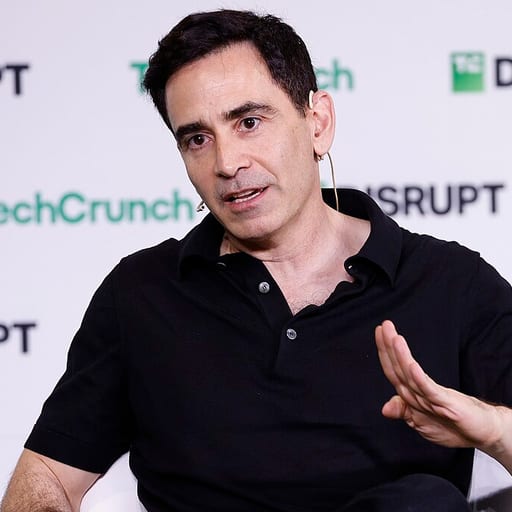
Chris Dixon
크리스 딕슨
General partner at Andreessen Horowitz; founder turned investor
1,416 records in all
- Principles 579
- Episodes 284
- Quotes 553
3 free questions a day, no sign-up.
Quotes
83 basic records of 553
Quotes are word for word from the source.
Prudence before funding
When you do planning, research, experimenting etc. without having raised money, investors think you are prudent
Our noteThe perception of a founder's research phase before they take outside capital.
Building strong ties
The relationships start off weak - a retweet, @ reply, or blog comment - but often strengthen through further discussions and eventually become new friendships and business relationships.
Our noteDixon explains how social media interactions evolve into meaningful professional and personal connections.
Due diligence on investors
the most important question to ask before taking seed money is: How many companies that the sponsor passed on went on to raise money from other sources?
Our noteDixon advises founders on how to evaluate seed programs run by large venture firms.
Logic of bundling
But this reasoning misses the economic logic behind bundling: under assumptions that apply to most information-based businesses, bundling benefits buyers and sellers.
Our noteDixon explains why bundling is not just a relic of physical distribution but an economic strategy.
Preference variance
The benefits of bundled pricing are proportionate the buyers' variance of preferences for the goods.
Our noteDixon explains that bundling works best when customers value different items in the bundle differently.
Smartphone adoption growth
By 2020, 80% of adults on earth will have a smartphone: And each of those phones is equivalent to what we used to call a supercomputer
Our noteChris was discussing the massive scale and power of the upcoming smartphone revolution.
Direct monetization economics
The economics of low take rates plus enthusiastic fandom does wonders. On Substack, 1,000 newsletter subscribers paying $10/month nets over $100K/year to the writer.
Our noteDixon explains how low platform fees and direct fan support significantly increase creator income.
Evolution of mobile apps
It seems natural that the first wave of mobile apps would be about improving core smartphone apps (e.g. photo apps) or porting apps from other devices (e.g. games).
Our noteHe explains why early mobile apps focused on digital-only features.
SEO virtuous cycle
This led to a virtuous cycle where SEO drew more users, leading to more contributors and more inbound links, leading to more SEO, and so on.
Our noteDixon explains how early web giants like Yelp and Wikipedia used SEO to scale their growth.
Code as trust
A user or developer can trust that a piece of code running on a blockchain computer will continue to behave as designed
Our noteHe describes the technical guarantees that blockchain provides to developers compared to corporate platforms.
Growing the pie
Instead of fighting over pieces of a shrinking pie , try to grow the pie by getting more people to read and write books.
Our noteHe suggests that industries should encourage user creativity rather than stifling it with litigation.
Evaluating strategic position
When evaluating an internet company's strategic position (the defensibility of its profit moat ), you need to consider: 1) how the company generates revenue and profits, 2) the loop in its entirety
Our noteDixon outlines the two key factors for assessing a company's competitive advantage in the digital economy.
Native tablet productivity
If the historical pattern repeats, productivity apps that are "native" to the tablet will be invented.
Our noteHe predicts that new user interfaces always lead to new classes of software.
Ad revenue and intent
The lesson is that the RPMs* of online ads are directly proportional to the degree** to which the user has purchasing intent
Our noteDixon explains why certain search terms generate more money than others.
Macro trend prediction
Anyone who claims to know what will happen over the next 3 years at the macro level is blowing hot air. That's why smart investors continue investing at a regular pace through ups and downs.
Our noteDixon explains why predicting the macro economy is impossible and how smart investors behave.
Direct founder outreach
Most journalists, when talking candidly, will tell you they'd vastly prefer getting an email from the founder of a startup than a PR firm.
Our noteDixon explains why founders should handle their own press relations instead of hiring PR firms early on.
Limitations of algorithms
Algorithms that deal with large data sets tend to be accurate at best 80%-90% of the time (an old "joke" about machine learning is that it's really good at partially solving any problem ).
Our noteDixon explains the inherent inaccuracy of machine learning models when dealing with large datasets.
Past vs Future Returns
But it's a mistake to assume that - because VC brands and institutional knowledge persist - past returns will predict future returns.
Our noteDixon explains why relying on old track records in venture capital is a flawed strategy.
Partners Drive Returns
VC returns are driven by partners, not firms. Studies have shown this, as will a quick perusal of the big exits at prominent VC firms.
Our noteHe argues that individual talent matters more than the firm's brand name.
Isolation for creativity
The presence of others can only inhibit [the creative] process, since creation is embarrassing.
Our noteExplaining why the early stages of ideation should happen in private.
Entrepreneurial activity shift
In the transition from installation to deployment, the bulk of the entrepreneurial activity moves "up the stack".
Our noteDiscussing how opportunities move from infrastructure to applications over time.
Equity dilution risks
I've seen many cases where large investors used financial engineering to artificially reduce the value of smaller investors' equity.
Our noteChris discusses how large investors can manipulate deal terms to disadvantage smaller shareholders.
Integrated vs Non-integrated
The non-integrated approach lowers costs, but adds friction between components that compromises performance.
Our noteDixon explains the trade-offs between building hardware and software together versus separately.
You are seeing 213 basic records. Membership answers from all 1,416 of this master's records.
See membershipMore masters in this field
See the whole fieldInvesting and capital allocation



These records are our compilation of public statements and sources. We are not affiliated with or endorsed by Chris Dixon or any related company. If something should come down, tell us. Takedown request form