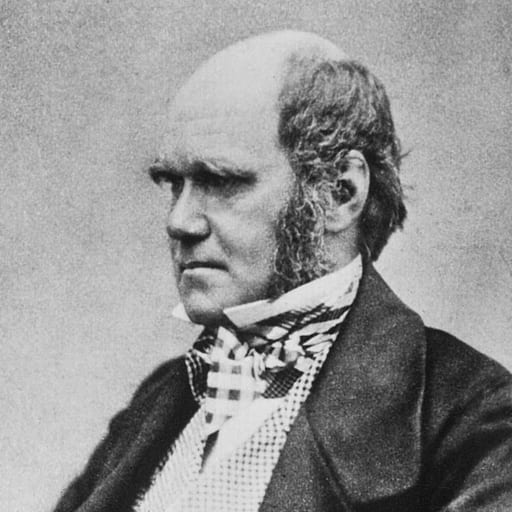
Charles Darwin
찰스 다윈
Naturalist; theory of evolution by natural selection
1,031 records in all
- Principles 361
- Episodes 311
- Quotes 359
3 free questions a day, no sign-up.
Photo: Henry Maull (1829–1914) and John Fox (1832–1907) (Maull & Fox); derivative work: Beao Public domain Original cropped
Quotes
54 basic records of 359
Quotes are word for word from the source.
Seeking external advice
I was instantly eager to accept the offer, but my father strongly objected, adding the words, fortunate for me, "If you can find any man of common-sense who advises you to go I will give my consent.
Our noteDarwin's father sets a condition for allowing him to join the Beagle voyage.
Thorough research
This book, though a small one, cost me twenty months of hard work, as I had to read every work on the islands of the Pacific and to consult many charts.
Our noteDarwin describes the intense labor required to produce his book on coral reefs.
The power of selection
I soon perceived that selection was the keystone of man's success in making useful races of animals and plants.
Our noteDarwin identifies the core mechanism behind domestic breeding.
Trusting human judgment
But then with me the horrid doubt always arises whether the convictions of man's mind, which has been developed from the mind of the lower animals, are of any value or at all trustworthy.
Our noteDarwin questions the absolute reliability of human reasoning given its evolutionary origins.
Financial responsibility
I have cost my father so much money, I am quite ashamed of myself.
Our noteDarwin expresses guilt over the expenses incurred during his education and preparation.
Fairness in competition
It seems hard on me that I should be thus compelled to lose my priority of many years' standing, but I cannot feel at all sure that this alters the justice of the case.
Our noteDarwin reflects on whether it is fair to publish his abstract now that he knows a competitor is ready.
Managing expectations
Please do not say to any one that I thought my book on species would be fairly popular, and have a fairly remunerative sale (which was the height of my ambition), for if it prove a dead failure, it would make me the more ridiculous.
Our noteDarwin expresses his modest hopes for his book's success while fearing public failure.
Focus on argument
How I could have written so badly is quite inconceivable, but I suppose it was owing to my whole attention being fixed on the general line of argument, and not on details.
Our noteDarwin reflects on why his initial manuscript required such heavy and expensive corrections.
reasoning by analogy
The appearance so much resembles that which may be seen in every torrent, where the stream uncoils into long streaks the froth collected in the eddies, that I must attribute the effect to a similar action
Our noteDarwin uses a familiar physical process to explain a complex natural phenomenon.
Nature versus technology
When we hear that the strongest battery in Paris was used, and that its power on a substance of such easy fusibility as glass was to form tubes so diminutive, we must feel greatly astonished at the force of a shock of lightning
Our noteDarwin compares man-made electrical experiments with the immense power of natural lightning.
Remarkable physical endurance
I have been assured that an unloaded horse can travel a hundred miles a day for many days successively.
Our noteDarwin notes the extreme efficiency and mobility of the local cavalry's horses.
Building a reputation
He first gained his celebrity by his laws for his own estancias, and by disciplining several hundred men, so as to resist with success the attacks of the Indians.
Our noteDarwin explains how General Rosas built his initial influence through local management and security.
Cultural alignment for influence
By these means, and by conforming to the dress and habits of the Gauchos, he has obtained an unbounded popularity in the country, and in consequence a despotic power.
Our noteDarwin observes how Rosas gained power by mirroring the lifestyle of his followers.
Clearing for growth
In grassy plains unoccupied by the larger ruminating quadrupeds, it seems necessary to remove the superfluous vegetation by fire, so as to render the new year's growth serviceable.
Our noteDarwin explains why the locals set fire to the plains to improve future pasture.
Dangers of false theories
the necessity of a theory being felt, they came to the conclusion that, like the bizcacha, the mastodon was formerly a burrowing animal!
Our noteLocal guides invent a theory to explain fossil placement without scientific evidence.
Analogical thinking
I imagine this habit of the jaguar is exactly similar to one which may any day be seen in the common cat, as with outstretched legs and exserted claws it scrapes the leg of a chair
Our noteDarwin connects exotic animal behavior to common domestic observations.
Unyielding persistence
every inch he gained he firmly kept, standing close before me erect and determined.
Our noteDarwin describes the determined behavior of a penguin defending its path to the sea.
Equality and progress
The perfect equality among the individuals composing the Fuegian tribes must for a long time retard their civilization.
Our noteDarwin observes how a lack of hierarchy can hinder the accumulation of resources and societal advancement.
Measuring personal worth
I often find myself going back to Darwin's saying about the duration of a man's friendships being one of the best measures of his worth.
Our noteThis was a recollected statement about the importance of long-term relationships.
Limits of knowledge
it is those who know little, and not those who know much, who so positively assert that this or that problem will never be solved by science.
Our noteHe critiques the tendency of the uninformed to dismiss scientific potential.
Definition of disuse
The term "disuse" does not relate merely to the lessened action of muscles, but includes a diminished flow of blood to a part or organ
Our noteHe clarifies that lack of use affects the entire resource allocation to a specific part.
Historical Evidence
It is an interesting fact that ancient races, in this and several other cases, more frequently present structures which resemble those of the lower animals than do the modern.
Our noteDarwin notes that older lineages show more physical traits shared with ancestral species.
Environment drives variation
Domesticated animals vary more than those in a state of nature; and this is apparently due to the diversified and changing nature of the conditions to which they have been subjected.
Our noteDarwin discusses how changing conditions and environments lead to greater individual differences.
Use and disuse
The inferiority of Europeans, in comparison with savages, in eyesight and in the other senses, is no doubt the accumulated and transmitted effect of lessened use during many generations
Our noteDarwin explains how the lack of use of certain senses leads to their gradual decline over generations.
Correlated variation
In man, as in the lower animals, many structures are so intimately related, that when one part varies so does another, without our being able, in most cases, to assign any reason.
Our noteExplaining how different parts of a system change in tandem.
Difficulty of precision
Even to hammer with precision is no easy matter, as every one who has tried to learn carpentry will admit.
Our noteDarwin notes that even basic manual skills require significant practice and coordination.
Tools for success
Man could not have attained his present dominant position in the world without the use of his hands, which are so admirably adapted to act in obedience to his will.
Our noteDarwin explains how the physical evolution of the hand was essential for human dominance.
Long term survival
The best built individuals would in the long run have succeeded best, and have survived in larger numbers.
Our noteDiscussing how advantageous physical traits lead to long-term success in a competitive environment.
Followers and leaders
They are essentially slavish, and accept the common determination, seeking no better lot than to be led by any one ox who has enough self-reliance to accept the position.
Our noteDarwin describes how most individuals in a group prefer to follow a self-reliant leader.
Survival through community
With those animals which were benefited by living in close association, the individuals which took the greatest pleasure in society would best escape various dangers
Our noteDarwin explains that social cohesion is a competitive advantage for survival.
You are seeing 155 basic records. Membership answers from all 1,031 of this master's records.
See membershipMore masters in this field
See the whole fieldScience and first-principles thinking
These records are our compilation of public statements and sources. We are not affiliated with or endorsed by Charles Darwin or any related company. If something should come down, tell us. Takedown request form