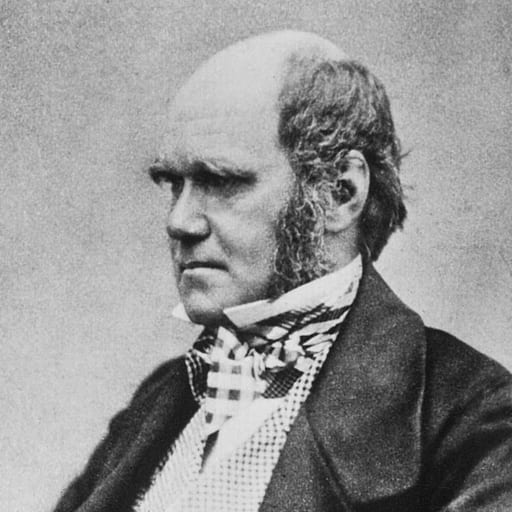
Charles Darwin
찰스 다윈
Naturalist; theory of evolution by natural selection
1,031 records in all
- Principles 361
- Episodes 311
- Quotes 359
3 free questions a day, no sign-up.
Photo: Henry Maull (1829–1914) and John Fox (1832–1907) (Maull & Fox); derivative work: Beao Public domain Original cropped
Quotes
54 basic records of 359
Quotes are word for word from the source.
Complex systems
We know that these qualities are easily affected by changed conditions of life, or by close inter-breeding, and that they are governed by highly complex laws
Our noteDiscussing how fertility and biological traits are influenced by environment and complex variables.
Bias in observation
Our imagination is another and still more serious source of error; for if from the nature of the circumstances we expect to see any expression, we readily imagine its presence.
Our noteDarwin warns about how our expectations can cloud our objective judgment when analyzing data.
Natural efficiency
Respiration is partly voluntary, but mainly reflex, and is performed in the most natural and best manner without the interference of the will.
Our noteDarwin explains how reflex actions often outperform conscious effort.
Direct action
In this latter case the sensory nerve-cells apparently excite the motor nerve-cells without any waste of power by first communicating with the cerebral hemispheres
Our noteHe describes the efficiency of bypassing conscious deliberation for speed.
Involuntary Expression
when movements, associated through habit with certain states of the mind, are partially repressed by the will, the strictly involuntary muscles, as well as those which are least under the separate control of the will, are liable still to act
Our noteDarwin discusses how true emotions leak out through muscles we cannot easily control.
Intentions and movements
So strongly are our intentions and movements associated together, that if we eagerly wish an object to move in any direction, we can hardly avoid moving our bodies in the same direction
Our noteDarwin explains how physical actions often mirror our internal desires automatically.
Leveraging Assets
They are, as I may add, so fully conscious of the power of their weapons, that when enraged they will charge backwards with their spines erected, yet still inclined backwards.
Our noteDarwin describes how porcupines use their spines offensively when they are aware of their advantage.
Competitive escalation
both the attackers and the attacked endeavour to make themselves as dreadful as possible to each other; and both possess for this purpose specialised means
Our noteDarwin describes the evolutionary arms race between predators and prey.
Expressing anticipation
Under the expectation of any great pleasure, dogs bound and jump about in an extravagant manner, and bark for joy.
Our noteDescribing how animals physically manifest the anticipation of a positive outcome.
Residual habits
Moreover, when complex actions or movements have long been performed in strict association together, and these are from any cause at first voluntarily and afterwards habitually checked, then if the proper exciting conditions occur, any part of the action or movement which is least under the control of the will, will often still be involuntarily performed.
Our noteDarwin discusses how parts of a habit persist even after the main action is suppressed.
Perplexing observations
During several years no expression seemed to me so utterly perplexing as this which we are here considering.
Our noteDarwin reflects on the difficulty of understanding the specific muscle movements associated with grief.
Unbiased testing
On my return home I made three of my children, without giving them any clue to my object, look as long and as attentively as they could, at the summit of a tall tree
Our noteDarwin describes his method of testing a hypothesis by observing his children's natural physical reactions.
Novelty in ideas
something unexpected - a novel or incongruous idea which breaks through an habitual train of thought - appears to be a strong element in the ludicrous.
Our noteHe describes how breaking habitual patterns of thought creates a sense of the ludicrous.
Reflection and difficulty
Deep reflection can, however, seldom be long carried on without some difficulty, so that it will generally be accompanied by a frown.
Our noteDarwin notes why we associate deep thinking with a furrowed brow.
Universal human expressions
Rage, anger, and indignation are exhibited in nearly the same manner throughout the world; and the following descriptions may be worth giving as evidence of this
Our noteDarwin notes that core emotional expressions are consistent across different cultures and ethnicities.
Signals of refusal
As shrugging the shoulders generally implies "I cannot do this or that," so by a slight change, it sometimes implies "I won't do it.
Our noteDarwin discusses how a simple gesture can signal a firm refusal to act.
Observing gradual change
the most interesting gradation can be traced, some of the rounded particles retaining their proper forms, and others insensibly melting into the granulo-crystalline paste.
Our noteDarwin describes the visible transition of matter under the influence of heat.
Identifying novel opportunities
I am not aware that any similar case has been described: it appears to me an interesting one
Our noteDarwin notes the novelty of his observation regarding volcanic focus and mineral composition.
Describing the unknown
It is composed of rocks, unlike any which I have met with, and which I cannot characterise by any name, and must therefore describe.
Our noteDarwin encounters unique rocks on St. Paul's Rocks that defy existing classifications.
Identifying cause and effect
This structure no doubt has been caused by the ejected fragments and ashes being always blown, during eruptions, in greater quantity towards one side than towards the other.
Our noteDarwin explains why the volcanic cones on Ascension Island are asymmetrical.
Detailed observation
I have described these fragments in detail, because it is rare to find granitic rocks ejected from volcanoes with their MINERALS UNCHANGED, as is the case with the first specimen
Our noteDarwin explains why he meticulously documents specific rock samples during his geological survey.
Expert uncertainty
I have shown the incrustation, both in this latter and in its ordinary state to several geologists, but not one could conjecture its origin, except that perhaps it was of volcanic nature!
Our noteDarwin notes that even experts can be stumped by phenomena that look like one thing but are another.
Identifying hidden patterns
The different growth, however, of the trees on the streams, often plainly marked their different ages.
Our noteDarwin uses biological indicators to distinguish between geological events that otherwise look identical.
Beware of quantity arguments
Had Dr. Macaulay seen the enormous masses of rolled particles of shells and corals on the beach of Ascension, and especially on coral-reefs; and had he reflected on the effects of long-continued, gentle winds, in drifting up the finer particles, he would hardly have advanced the argument of quantity, which is seldom trustworthy in geology.
Our noteDarwin critiques a fellow scientist for using the sheer volume of material as proof of its origin.
You are seeing 155 basic records. Membership answers from all 1,031 of this master's records.
See membershipMore masters in this field
See the whole fieldScience and first-principles thinking

These records are our compilation of public statements and sources. We are not affiliated with or endorsed by Charles Darwin or any related company. If something should come down, tell us. Takedown request form