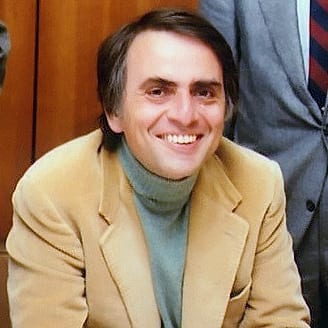
Carl Sagan
칼 세이건
Astronomer and science communicator; creator of Cosmos
236 records in all
- Principles 56
- Episodes 79
- Quotes 101
3 free questions a day, no sign-up.
Photo: NASA/JPL Public domain Original cropped
Quotes
15 basic records of 101
Quotes are word for word from the source.
Evaluating useful ideas
If you are only skeptical, then no new ideas make it through to you ... On the other hand, if you are open to the point of gullibility and have not an ounce of skeptical sense in you, then you cannot distinguish the useful ideas from the worthless ones.
Our noteHe explains the dangers of extreme skepticism versus extreme gullibility.
Questioning authority
If we are not able to ask skeptical questions, to interrogate those who tell us that something is true, to be skeptical of those in authority, then we're up for grabs for the next charlatan, political or religious, who comes ambling along.
Our noteSagan warns about the dangers of not applying skeptical thinking to those in power.
Questioning authority
That kind of skeptical, questioning, "don't accept what authority tells you" attitude of science - is also nearly identical to the attitude of mind necessary for a functioning democracy.
Our noteLinking the values of scientific inquiry to democratic principles.
Willingness to Pivot
In my view, the human condition would be greatly improved if such confrontations and willingness to reject hypotheses were a regular part of our social, political, economic, religious and cultural lives.
Our noteHe reflects on how testing ideas against reality improves the human condition.
Courage to Question
Science is based on experiment, on a willingness to challenge old dogma, on an openness to see the universe as it really is. Accordingly, science sometimes requires courage - at the very least the courage to question the conventional wisdom.
Our noteHe describes the mindset needed to challenge established beliefs and see reality clearly.
Critical thinking training
But the lack is not in intelligence, which is in plentiful supply; rather, the scarce commodity is systematic training in critical thinking.
Our noteSagan discusses why people often fall for pseudoscience despite being intelligent.
Science as method
The idea of science as a method rather than as a body of knowledge is not widely appreciated outside of science, or indeed in some corridors inside of science.
Our noteSagan clarifies that science is a process of inquiry, not just a list of facts.
Constructive criticism
The objective of such criticism is not to suppress but rather to encourage the advance of new ideas: those that survive a firm skeptical scrutiny have a fighting chance of being right, or at least useful.
Our noteHe explains why vigorous debate is essential for progress and finding useful truths.
Facing frightening ideas
In any case, we do not advance the human cause by refusing to consider ideas that make us frightened.
Our noteEncouraging the exploration of uncomfortable or scary concepts for progress.
Value of intelligence
Other things being equal, it is better to be smart than to be stupid.
Our noteA simple observation on the evolutionary advantage of intelligence.
Human potential
Humans are very good at dreaming, although you'd never know it from your television.
Our noteReflecting on human imagination versus its representation in popular media.
Rational decision making
I try not to think with my gut. If I'm serious about understanding the world, thinking with anything besides my brain, as tempting as that might be, is likely to get me into trouble.
Our noteSagan emphasizes the importance of using evidence over intuition.
Human problem solving
Nearly all our problems are made by humans and can be solved by humans. No social convention, no political system, no economic hypothesis, no religious dogma is more important.
Our noteSagan emphasizes human agency in solving global environmental and social issues.
Evidence based judgment
I maintain that this is not prejudice. It is postjudice. That is, not a judgement made before examining the evidence but a judgement made after examining the evidence.
Our noteHe clarifies the difference between dismissing ideas blindly and rejecting them after investigation.
Prioritizing survival resources
When there isn't enough food, the body has to make a decision on how to invest the limited foodstuff available to it. Survival comes first, growth comes second.
Our noteExplaining how the body prioritizes resources during nutritional scarcity.
You are seeing 35 basic records. Membership answers from all 236 of this master's records.
See membershipMore masters in this field
See the whole fieldScience and first-principles thinking

These records are our compilation of public statements and sources. We are not affiliated with or endorsed by Carl Sagan or any related company. If something should come down, tell us. Takedown request form