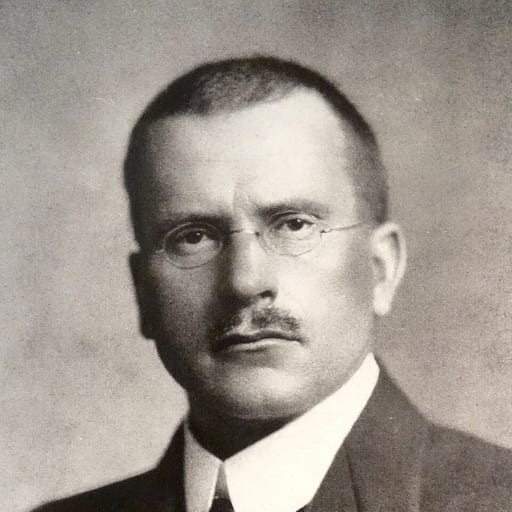
Carl Jung
카를 융
Swiss psychiatrist, founder of analytical psychology
1,078 records in all
- Principles 381
- Episodes 233
- Quotes 464
3 free questions a day, no sign-up.
Photo: Unknown author Public domain Original cropped
Quotes
70 basic records of 464
Quotes are word for word from the source.
Childhood as model
The little world of childhood with its familiar surroundings is a model of the greater world.
Our noteJung explains how early family environments shape an adult's perception of the world.
Cycle of trauma
The healthy man does not torture others - generally it is the tortured who turn into torturers.
Our noteJung discusses the psychological origins of cruelty and aggression.
Misunderstanding others
If one does not understand a person, one tends to regard him as a fool.
Our noteJung observes how lack of understanding leads to dismissive judgments of others.
Value of imagination
But without this playing with fantasy no creative work has ever yet come to birth. The debt we owe to the play of imagination is incalculable.
Our noteJung describes the essential role of fantasy and play in the creative process.
Intellect and feeling
We should not pretend to understand the world only by the intellect; we apprehend it just as much by feeling.
Our noteJung argues that intellectual judgment is only half of the truth.
Mental Oscillation
The pendulum of the mind oscillates between sense and nonsense, not between right and wrong.
Our noteJung explains how the mind moves between different states of meaning.
Life without rules
Man strives toward reason only so that he can make rules for himself. Life itself has no rules. That is its mystery and its unknown law.
Our noteJung contrasts human-made logic with the inherent mystery and chaos of life.
Limits of knowledge
What you call knowledge is an attempt to impose something comprehensible on life.
Our noteJung critiques the human tendency to over-rationalize the complexity of existence.
Constructive dissent
I am indeed very far from regarding a modest and moderate criticism as a "falling away" or a schism; on the contrary, through it I hope to help on the flowering and fructification
Our noteJung argues that internal criticism is necessary for the growth of a movement or business.
Independent Personality
It seems as if, at this age, a considerable step had been made towards emancipation and the formation of a new and independent personality.
Our noteJung describes the developmental milestone where a child begins to form an independent self.
Sublimation vs Repression
We call this process _sublimation_, when this operation occurs without injury to the adaptation of the individual; we call it _repression_ - when the attempt fails.
Our noteHe distinguishes between the healthy redirection of energy and its failed suppression.
Proof through results
An engineer who has built a bridge, and has worked out its bearing capacity, wants no other proof for the success of its bearing power.
Our noteJung explains why practitioners value empirical results over the abstract proofs demanded by outside critics.
Recognizing coherence
For anyone who understands psychoanalytic work it is a well-known fact that it is not so very difficult to see where there is coherence, and where there is none.
Our noteHe explains that experts can distinguish between genuine patterns and false data.
Diagnostic tools
The association-experiment is thus not directly a means to unlock the unconscious, but rather a technique for obtaining a good selection of defective reactions, which can then be used by psychoanalysis.
Our noteHe describes the practical utility of his experimental methods.
Focus on Present
The pathogenic conflict exists _only in the present moment_. It is just as if a nation wanted to regard its miserable political conditions at the actual moment as due to the past
Our noteJung argues that the real causes of problems are found in current circumstances, not just history.
Normal utilization of energy
The man returns, when he finds an insurmountable difficulty, and uses his libido, which could not attain its original aim, for the ascent of another mountain.
Our noteJung explains how a healthy person redirects their drive when facing a real obstacle.
Infantile reactions
It is very characteristic of children, and of naïve minds, not to find the fault in their own shortcomings, but in external circumstances
Our noteJung identifies the tendency to blame the outside world as a sign of psychological immaturity.
Memory distortion
Wherever the libido takes hold of a reminiscence, we may expect that this reminiscence will be elaborated and altered, as everything that is touched by the libido revives, takes on dramatic form, and becomes systematized.
Our noteJung discusses how our current emotional energy reshapes and dramatizes our past memories.
Adaptation to Reality
When people try always to adapt themselves to the conditions of life, the libido is employed rightly and adequately.
Our noteJung explains that mental energy is healthy when focused on adapting to life's actual demands.
Avoiding real tasks
The neurotic fled from his duties and his libido withdrew, at least partly, from the tasks imposed by real life.
Our noteJung describes how people retreat into fantasy when they refuse to face real-world difficulties.
Avoid rigid rules
Nowhere is the abstraction of universal rules more difficult than in psychoanalysis, for which reason it is better to abstain from too many rules.
Our noteJung warns against over-relying on standardized procedures in complex human systems.
No blind chances
In interpreting dreams we have to pay attention to such apparent accidents, since in psychology we find no blind chances, much as we are inclined to think these things accidental.
Our noteJung argues that spontaneous thoughts and associations are never truly accidental but have causal roots.
Proactive Education
Therefore it would be much better if children could learn about certain important secrets of life in a clean way and at suitable times, so that they would not need to be enlightened by their playmates
Our noteJung discusses the importance of providing clear information to prevent children from seeking distorted versions elsewhere.
Reality versus fantasy
In the analysis she learned about the two ways of life, the way of phantasy, of regression, and the way of reality, wherein lay her present child's duties.
Our noteJung explains the choice between retreating into imagination and facing current responsibilities.
The power of fantasy
the indulgence in day-dreams and phantasies was practically universal not only among children but among adults, that even whole lives were being lived out in a phantastic world created by the dreamer
Our noteJung discusses how people often live in internal worlds to satisfy desires impossible in reality.
Root of resistance
the pathogenic cause of the disturbances lies not in the ignorance of individuals, but in those inner resistances which are the underlying basis of this ignorance.
Our noteJung identifies that the real problem is often the internal resistance to knowing the truth.
The Risk of Introversion
certain people never relinquish the seeking for satisfaction in the shadowy world of phantasy and even though they make certain attempts at adaptation they are halted and discouraged by every difficulty and obstacle
Our noteJung discusses how some individuals retreat into their inner world when faced with life's challenges.
Overcoming Avoidance
Therefore Jung does not ask from what psychic experience or point of fixation in childhood the patient is suffering, but what is the present duty or task he is avoiding
Our noteJung's approach focuses on identifying the specific current responsibility a person is failing to meet.
Independence and growth
The mind dawns at the moment the child begins to be free of the mother - He seeks to win the world, and leave the mother
Our noteExplaining how psychological independence triggers the development of the individual mind.
The Creative Impulse
Explanations are of no avail; they merely destroy a transitory form of manifestation, but not the creating impulse.
Our noteJung argues that logical explanations cannot kill the fundamental human drive to create myths.
You are seeing 162 basic records. Membership answers from all 1,078 of this master's records.
See membershipMore masters in this field
See the whole fieldMindset and resilience






These records are our compilation of public statements and sources. We are not affiliated with or endorsed by Carl Jung or any related company. If something should come down, tell us. Takedown request form