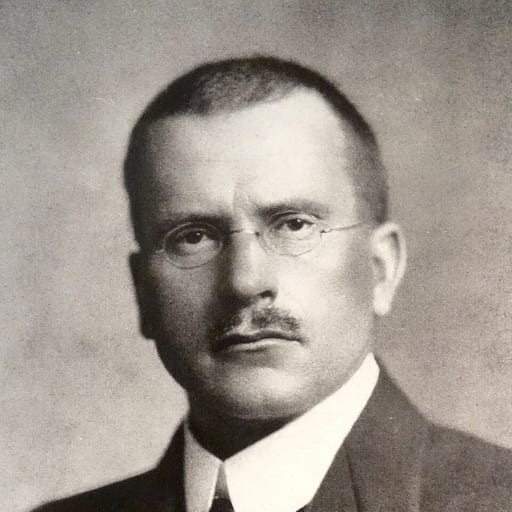
Carl Jung
카를 융
Swiss psychiatrist, founder of analytical psychology
1,078 records in all
- Principles 381
- Episodes 233
- Quotes 464
3 free questions a day, no sign-up.
Photo: Unknown author Public domain Original cropped
Quotes
70 basic records of 464
Quotes are word for word from the source.
Understanding Hidden Desires
The conscious phantasies tell us of mythical or other material of undeveloped or no longer recognized wish tendencies in the soul.
Our noteJung discusses how our daydreams and fantasies reveal underlying psychological needs.
Underestimating subtle cues
One is only too easily inclined to take such an impression lightly, and one admits so gladly the statements of the participators when they represent everything as simple
Our noteJung warns against taking people's surface-level explanations of their feelings at face value.
Limits of self-analysis
Miss Miller, because she had no knowledge of psychoanalysis, left off at the thoughts which necessarily bring the deep complex lying at the bottom of it to light in an indirect, that is to say, censored manner.
Our noteJung notes how beginners often stop short of discovering the true meaning of their thoughts.
Conscious moral action
Whoever, on the other hand, to his conscious sin just as consciously places religion in opposition, does something the greatness of which cannot be denied.
Our noteJung distinguishes between unconscious habits and conscious moral decisions.
Internal power
To bear a God within one's self signifies a great deal; it is a guarantee of happiness, of power, indeed even of omnipotence
Our noteJung describes the psychological benefit of identifying with a higher internal power.
Universal symbolic sources
The visionary images of both texts are developed from a source, not limited to one place, but found in the soul of many divers people, because the symbols which arise from it are too typical for it to belong to one individual only.
Our noteJung explains that certain symbols appear across different cultures and eras because they stem from a shared human psyche.
Defining the libido
Originally taken from the sexual sphere, this word has become the most frequent technical expression of psychoanalysis, for the simple reason that its significance is wide enough to cover all the unknown and countless manifestations of the Will
Our noteJung clarifies that 'libido' represents the total creative and psychological energy, not just sexual drive.
Displacement of Interest
Experience forces us to the assumption of a capacity for displacement of the libido, because functions or localizations of non-sexual force are undoubtedly capable of taking up a certain amount of libidinous sexual impetus
Our noteExplaining how psychological drive can be redirected from one area to another.
The Flow of Drive
From this fact results the Freudian comparison of the libido with a stream, which is divisible, which can be dammed up, which overflows into branches, and so on.
Our noteDescribing the fluid nature of human drive and motivation.
Regression in Failure
_A dropping away of the last acquisition of the function of reality (or adaptation) must of necessity be replaced by an earlier mode of adaptation.
Our noteJung describes how the mind reverts to older patterns when current reality-testing fails.
Seeking external objects
The result, therefore, is that the purely onanistic activity turns out to be insufficient, and another object must be sought for, which takes the place of the incest object.
Our noteJung describes the psychological necessity of moving from self-absorption to external creative work.
Succession and power
The setting sun appoints a successor whom he invests with the power of the sun.
Our noteJung explains how leaders or deities transfer their authority to a successor before departing.
Symbol of renewal
Briefly stated, the fish is a libido symbol, and, indeed, as it seems predominately _for the renewal of the libido
Our noteJung discusses how certain symbols represent the restoration of vital energy and drive.
Duality in belief
The idea of the mortal and the immortal seems to have passed also into the Christian worship.
Our noteJung observes the recurring pattern of pairing mortal figures with immortal ones in mythology.
Burden of secrets
the _possession of a subjectively important secret generally creates a great disturbance
Our noteHe notes that keeping secrets often leads to internal psychological unrest.
Psychological Symbolism
The double significance of the tree is readily explained by the fact that such symbols are not to be understood "anatomically" but psychologically as libido symbols
Our noteJung explains that symbols represent psychological energy rather than literal physical objects.
Self-defined happiness
To-day there are countless neurotics who are so simply because they do not know how to seek happiness in their own manner. They do not even realize where the lack lies.
Our noteJung discusses why many people feel unfulfilled and neurotic in modern society.
Path to autonomy
This would be the course of moral autonomy, of perfect freedom, when man could without compulsion wish that which he must do, and this from knowledge, without delusion
Our noteJung describes the state of acting from internal knowledge rather than external religious compulsion.
Conquering the monster
[526] Whoever vanquishes this monster has gained a new or eternal youth. For this purpose one must, in spite of all dangers, descend into the belly of the monster[527] (journey to hell) and spend some time there.
Our noteJung explains that facing the 'dreadful mother' or death symbol is necessary for rebirth.
Observation before theory
My habit in my daily practical work is to confine myself for some time to studying my human material.
Our noteJung describes his process of gathering data from patients before forming general psychological rules.
Future of discipline
The psychiatry of the future must advance by way of psychology
Our noteHe argues for a psychological rather than purely physical approach to the mind.
Rapid communication speed
The last words and sentences were produced so quickly that it was not possible to follow without first inverting the letters.
Our noteJung describes the intense speed of the medium's automatic communications during a séance.
Mental level limits
The content of the talk did not rise above the mental level of the "communications."
Our noteJung notes that the medium's trance speech reflected her own existing knowledge and background.
Attention to detail
They were always worked out with a quite bewildering certainty, and surprised one by an extremely clever evaluation of certain details which she had noticed or taken from somewhere.
Our noteJung notes how the subject used small observations to build convincing, complex systems.
Delicate perception
In reality the transition is a very gradual one, and there are people who live on a higher stage of knowledge because their perceptions and sensations are more delicate than those of others.
Our noteJung explains the subject's view that some people perceive forces that others cannot see.
Limits of Consciousness
The frequency of these occurrences in the patient point to a considerable limitation of the field of consciousness
Our noteJung explains that frequent mental errors indicate a narrowed field of conscious awareness.
Identity formation
The question, "Who is doing this?" "Who is speaking?", is the suggestion for the synthesis of the unconscious personality which as a rule does not like being kept waiting too long.
Our noteJung discusses how the mind creates a persona to explain automatic or subconscious actions.
Signs of power
These hallucinations are "precursors or signs of mighty spiritual power." The vision is "an increased excitation which is harmoniously adapted to the most complete health of mind and body.
Our noteJung quotes Hecker regarding the positive potential of complex hallucinations in healthy individuals.
New normal
The second state gradually became the chief one, and finally so far suppressed the first state that the patient called her normal states, lasting now but a short time, "crises.
Our noteExplaining how a secondary, more confident personality can eventually become the dominant one.
power of conviction
The less waking consciousness intervenes by reflection and reasoning, the more certain and convincing becomes the objectivation of the dream
Our noteHe discusses how total immersion without self-doubt leads to a more convincing performance or reality.
You are seeing 162 basic records. Membership answers from all 1,078 of this master's records.
See membershipMore masters in this field
See the whole fieldMindset and resilience






These records are our compilation of public statements and sources. We are not affiliated with or endorsed by Carl Jung or any related company. If something should come down, tell us. Takedown request form