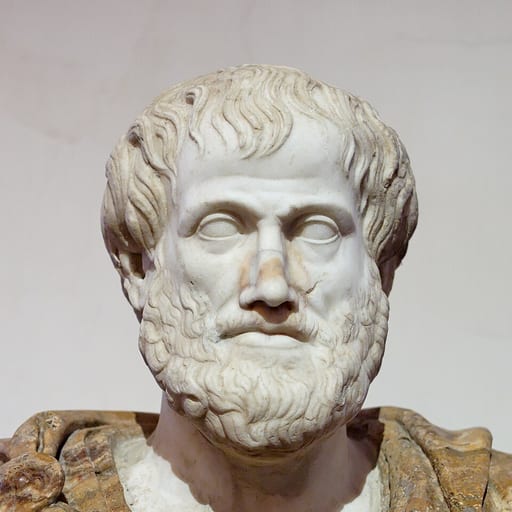
Aristotle
아리스토텔레스
Greek philosopher; ethics, rhetoric and logic
952 records in all
- Principles 311
- Episodes 302
- Quotes 339
3 free questions a day, no sign-up.
Photo: After Lysippos Public domain Original cropped
Quotes
51 basic records of 339
Quotes are word for word from the source.
Fact versus reason
Knowledge of the fact differs from knowledge of the reason for the fact.
Our noteAristotle distinguishes between knowing that something happened and understanding why.
Law of contradiction
It is impossible for the same attribute at once to belong and not to belong to the same thing and in the same relation
Our noteDefining the most certain principle of logic and reality.
Forms of beauty
The chief forms of beauty are order and symmetry and definiteness, which the mathematical sciences demonstrate in a special degree.
Our noteArguing that mathematics reveals the essential elements of beauty and goodness.
Purposeful action
Every art, and every system, and in like manner every action and purpose aims, it is thought, at some good
Our noteThe opening premise of his ethical theory regarding human goals.
Iterative planning
Let this serve as an outline of the good; for we must presumably first sketch it roughly, and then later fill in the details.
Our noteHe describes the process of starting with a rough outline before refining details.
Learning by doing
For the things we have to learn before we can do, we learn by doing.
Our noteAristotle discusses how human beings acquire skills and virtues through practice.
Causes of action
Thus every action must be due to one or other of seven causes: chance, nature, compulsion, habit, reasoning, anger, or appetite.
Our noteHe categorizes the fundamental drivers behind all human behavior.
Effective communication
It is simplicity that makes the uneducated more effective than the educated when addressing popular audiences.
Our noteAristotle explains why simple language resonates more with a general audience.
Focus on substance
Commonly people attach the 'making' to the metre and say 'elegiac-makers', 'hexameter-makers,' giving them a common class-name by their metre, as if it was not their imitation that makes them 'makers
Our noteAristotle argues that the essence of a craft is its function, not its outward form.
Organic plot resolution
the Denouement also should arise out of the plot itself, arid not depend on a stage-artifice
Our noteHe argues that solutions to problems should come from the story's internal logic.
Natural discovery
The best of all Discoveries, however, is that arising from the incidents themselves, when the great surprise comes about through a probable incident
Our noteHe explains that the most effective revelations are those that feel earned by the plot.
Defining class interests
Democracy, he explains, is the government not of the many but of the poor; oligarchy a government not of the few but of the rich.
Our noteAristotle redefines political systems based on the economic status of those in power.
Definition of wealth
wealth is very often supposed to consist in the quantity of money which any one possesses, as this is the medium by which all trade is conducted
Our noteAristotle notes the common perception that wealth is simply the accumulation of currency.
Utility of money
he who abounds in money often wants necessary food; and it is impossible to say that any person is in good circumstances when with all his possessions he may perish with hunger.
Our noteHe warns that currency is useless if it cannot be converted into the actual necessities of life.
Incentives and Industry
for every man's attention being employed on his own particular concerns, will prevent mutual complaints against each other; nay, by this means industry will be increased, as each person will labour to improve his own private property
Our noteAristotle explains why private ownership leads to better results than communal property.
Individual Happiness
for happiness cannot be thus added together, but must exist in every individual, as some properties belong to every integral
Our noteHe critiques the idea that a collective can be happy if the individuals are not.
Insatiable human desire
for the wickedness of mankind is insatiable. For though at first two oboli might be sufficient, yet when once it is become customary, they continually want something more, until they set no limits to their expectations
Our noteHe observes that satisfying basic needs does not stop people from wanting more as they habituate to wealth.
Managing subordinates
It seems to me indeed, if nothing else, yet something very troublesome to keep upon proper terms with them; for if you are remiss in your discipline they grow insolent, and think themselves upon an equality with their masters
Our noteAristotle discusses the difficulty of managing a workforce that is prone to resentment or insolence.
Risk of specialization
The destruction of it commenced with their victories: for they knew not how to be idle, or engage in any other employment than war.
Our noteDiscussing how a state built only for war fails when it finally achieves peace.
Merit over seniority
if amongst the candidates there are any of greater merit than the rest, these they prefer to those who may be older
Our notePraising the Carthaginian method of selecting leaders based on merit rather than age.
Leaders and makers
they indeed are like flute-makers, while those who govern are the musicians who play on them.
Our noteAristotle uses a musical metaphor to distinguish between those who execute and those who direct.
Consent and Authority
The one commands, in the manner the law directs, those who willingly obey; the other, arbitrarily, those who consent not.
Our noteAristotle distinguishes between legitimate kingship based on law and tyranny based on force.
Power of partnership
two men of worth are certainly better than one
Our noteHe argues that collaborative leadership is superior to a single person's judgment.
Prioritizing value
If, then, the mind is a more valuable part of man than the body, every one would wish to have those things more regarded in his city which tend to the advantage of these
Our noteAristotle emphasizes that intellectual and judicial functions are more vital than mere physical labor.
Moderate Fortune
It is therefore the greatest happiness which the citizens can enjoy to possess a moderate and convenient fortune
Our noteHe argues that extreme wealth or poverty prevents a stable and happy community.
Stability Through Balance
The middle state is therefore best, as being least liable to those seditions and insurrections which disturb the community
Our noteAristotle discusses how a strong middle class prevents political and social upheaval.
Resource management
in small states it is necessary that a few of the citizens should execute many employments; for their numbers are so small it will not be convenient to have many of them in office at the same time
Our noteHe discusses how small organizations must adapt by having individuals handle multiple roles due to limited staff.
Betrayal by friends
even a man's friends will do this if they despise him; for from the confidence he places in them, they think that they shall not be found out.
Our noteAristotle warns that losing the respect of close associates leads to betrayal.
Intent behind learning
there is a great deal of difference in the reason for which any one does or learns anything
Our noteHe emphasizes that the motivation behind acquiring a skill changes the nature of the skill itself.
Extreme inequality risks
The whole country was in the hands of a few persons, and if the tenants failed to pay their rent they were liable to be haled into slavery, and their children with them.
Our noteAristotle describes the severe social conditions in Athens before Solon's reforms.
You are seeing 143 basic records. Membership answers from all 952 of this master's records.
See membershipMore masters in this field
See the whole fieldPhilosophy and wisdom traditions
These records are our compilation of public statements and sources. We are not affiliated with or endorsed by Aristotle or any related company. If something should come down, tell us. Takedown request form