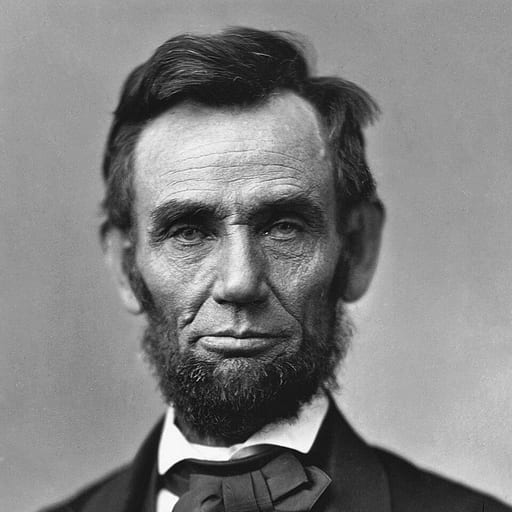
Abraham Lincoln
에이브러햄 링컨
16th US president; led the Union through the Civil War
990 records in all
- Principles 338
- Episodes 201
- Quotes 451
3 free questions a day, no sign-up.
Photo: Alexander Gardner Public domain Original cropped
Quotes
68 basic records of 451
Quotes are word for word from the source.
Demand for evidence
I cannot interpose without a better showing than you make. When did he desert? when did he write the letters?
Our noteLincoln refuses to intervene in a legal case without specific facts and evidence.
Prudent timing
With every disposition, not merely to do justice, but to oblige you, I feel constrained to say I think the publications better not be made now.
Our noteLincoln advises against publishing reports prematurely during a sensitive inquiry.
Scaling and limitations
The extensive blockade has been constantly increasing in efficiency as the Navy has expanded, yet on so long a line it has so far been impossible to entirely suppress illicit trade.
Our noteLincoln discusses the effectiveness and the inherent challenges of the naval blockade.
Evaluating character
He is not a difficult man to satisfy, sincerity and courage being his strong traits. Believing in our cause, and wanting to fight for it, is the whole matter with him.
Our noteLincoln was recommending General Milroy for active service based on his core values.
Respecting operations
This is in no sense an order, nor is it even a request that you will do anything which in the least shall be a drawback upon your military operations
Our noteLincoln communicated a citizen appeal to General Sherman without interfering with military goals.
Batching Error Corrections
Since the adjournment of the last session of Congress, other errors of a kind similar to those which this resolution was designed to correct, have been discovered in the law
Our noteLincoln explains his decision to veto a partial correction bill in favor of a more comprehensive one.
Evidence over character
Now, if you undertake to disprove that proposition, and to show that it is erroneous, would you prove it to be false by calling Euclid a liar?
Our noteLincoln explains that attacking a person's character does not disprove the logical evidence they have presented.
Logical Premise Analysis
There is a fault in it as I think, but the fault is not in the reasoning; but the falsehood in fact is a fault of the premises.
Our noteLincoln explains that even a logical conclusion is wrong if the starting facts are false.
Substance Over Sarcasm
I think it will take a better answer than a sneer to show that those who have said that the right of property in a slave is distinctly and expressly affirmed in the Constitution, are not prepared to show that no constitution or law can destroy that right.
Our noteLincoln argues that serious legal and moral challenges require rigorous arguments rather than mockery.
Containment as strategy
They insist that it should, as far as may be, be treated as a wrong; and one of the methods of treating it as a wrong is to make provision that it shall grow no larger.
Our noteLincoln explains the Republican strategy of preventing the expansion of slavery to eventually end it.
Clarity in communication
I am not master of language; I have not a fine education; I am not capable of entering into a disquisition upon dialectics, as I believe you call it; but I do not believe the language I employed bears any such construction
Our noteLincoln addresses his opponent's misinterpretation of his speech by acknowledging his own humble background while defending his intent.
Honest ambition
I do not claim, gentlemen, to be unselfish; I do not pretend that I would not like to go to the United States Senate,--I make no such hypocritical pretense
Our noteLincoln admits his personal ambition while debating the larger national issues with Judge Douglas.
Shared values
That is the electric cord in that Declaration that links the hearts of patriotic and liberty-loving men together
Our noteLincoln describes how the principle of equality unites people regardless of their ancestral background.
Commitment to truth
I was very careful not to put anything in that speech as a matter of fact, or make any inferences, which did not appear to me to be true and fully warrantable.
Our noteLincoln explains his meticulous process for preparing a major speech to ensure factual accuracy.
Right to earnings
But in the right to eat the bread, without the leave of anybody else, which his own hand earns, he is my equal, and the equal of Judge Douglas, and the equal of every living man.
Our noteLincoln argues for the fundamental right of every person to own the fruits of their labor.
Vision for stability
I believe we shall not have peace upon the question until the opponents of slavery arrest the further spread of it, and place it where the public mind shall rest in the belief that it is in the course of ultimate extinction
Our noteLincoln explains that conflict persists until a clear path to a solution is established.
Shaping public opinion
Consequently, he who moulds public sentiment goes deeper than he who enacts statutes or pronounces decisions. He makes statutes and decisions possible or impossible to be executed.
Our noteLincoln argues that the person who influences how people think holds the true power.
Exposing evasive tactics
I am quite aware that he was shirking and dodging around the form in which he put it, but I can make it manifest that he leveled his "fatal blow" against more persons
Our noteLincoln points out how his opponent tries to avoid accountability for his previous accusations.
Ownership of decisions
if any policy was to be maintained or changed, he, the President, was to direct that on his responsibility; and that in performing that duty the President had a right to the advice of his secretaries.
Our noteLincoln responding to Seward's attempt to seize control of the administration's policy.
Unintended consequences of lawlessness
When men take it in their heads to-day to hang gamblers or burn murderers, they should recollect that in the confusion usually attending such transactions they will be as likely to hang or burn some one who is neither
Our noteLincoln warns that vigilante justice often strikes the innocent due to inherent chaos.
Persistence in Justice
The probability that we may fall in the struggle ought not to deter us from the support of a cause we believe to be just; it shall not deter me.
Our noteLincoln was speaking about the Sub-Treasury and the importance of standing by one's principles.
Earning Public Esteem
Every man is said to have his peculiar ambition. Whether it be true or not, I can say, for one, that I have no other so great as that of being truly esteemed of my fellow-men, by rendering myself worthy of their esteem.
Our noteLincoln addressed the public during his candidacy for the State Legislature.
Internal Responsibility
If destruction be our lot, we must ourselves be its author and finisher. As a nation of freemen, we must live through all time, or die by suicide.
Our noteLincoln spoke at the Lyceum about the dangers of internal lawlessness and mob rule.
Integrity in speech
I believe it is an established maxim in morals that he who makes an assertion without knowing whether it is true or false, is guilty of falsehood; and the accidental truth of the assertion, does not justify or excuse him.
Our noteLincoln writes about the moral responsibility of verifying one's claims before speaking.
Professional Diligence
Leave nothing for to-morrow which can be done to-day. Never let your correspondence fall behind. Whatever piece of business you have in hand, before stopping, do all the labor pertaining to it which can then be done.
Our noteNotes for a law lecture regarding the importance of diligence in work.
Risk of ignoring principles
Is it quite safe to disregard it - to despise it? Is there no danger to liberty itself, in discarding the earliest practice, and first precept of our ancient faith?
Our noteDiscussing the danger of undermining the principles of progress in America.
Consistency in ethics
How can any one who abhors the oppression of negroes, be in favor of degrading classes of white people?
Our noteCritiquing the hypocrisy of those who support new forms of discrimination.
Right to labor
in her natural right to eat the bread she earns with her own hands without asking leave of any one else, she is my equal, and the equal of all others.
Our noteLincoln defines equality through the right to enjoy the fruits of one's own work.
The right to change
Senator Douglas holds, we know, that a man may rightfully be wiser today than he was yesterday - that he may rightfully change when he finds himself wrong.
Our noteLincoln acknowledges his opponent's belief that changing one's mind is a sign of growth.
Discarding quibbles
Let us discard all this quibbling about this man and the other man, this race and that race and the other race being inferior
Our noteLincoln calls for unity and the rejection of arguments about human inferiority.
You are seeing 149 basic records. Membership answers from all 990 of this master's records.
See membershipMore masters in this field
See the whole fieldLeaders in history and crisis
These records are our compilation of public statements and sources. We are not affiliated with or endorsed by Abraham Lincoln or any related company. If something should come down, tell us. Takedown request form